

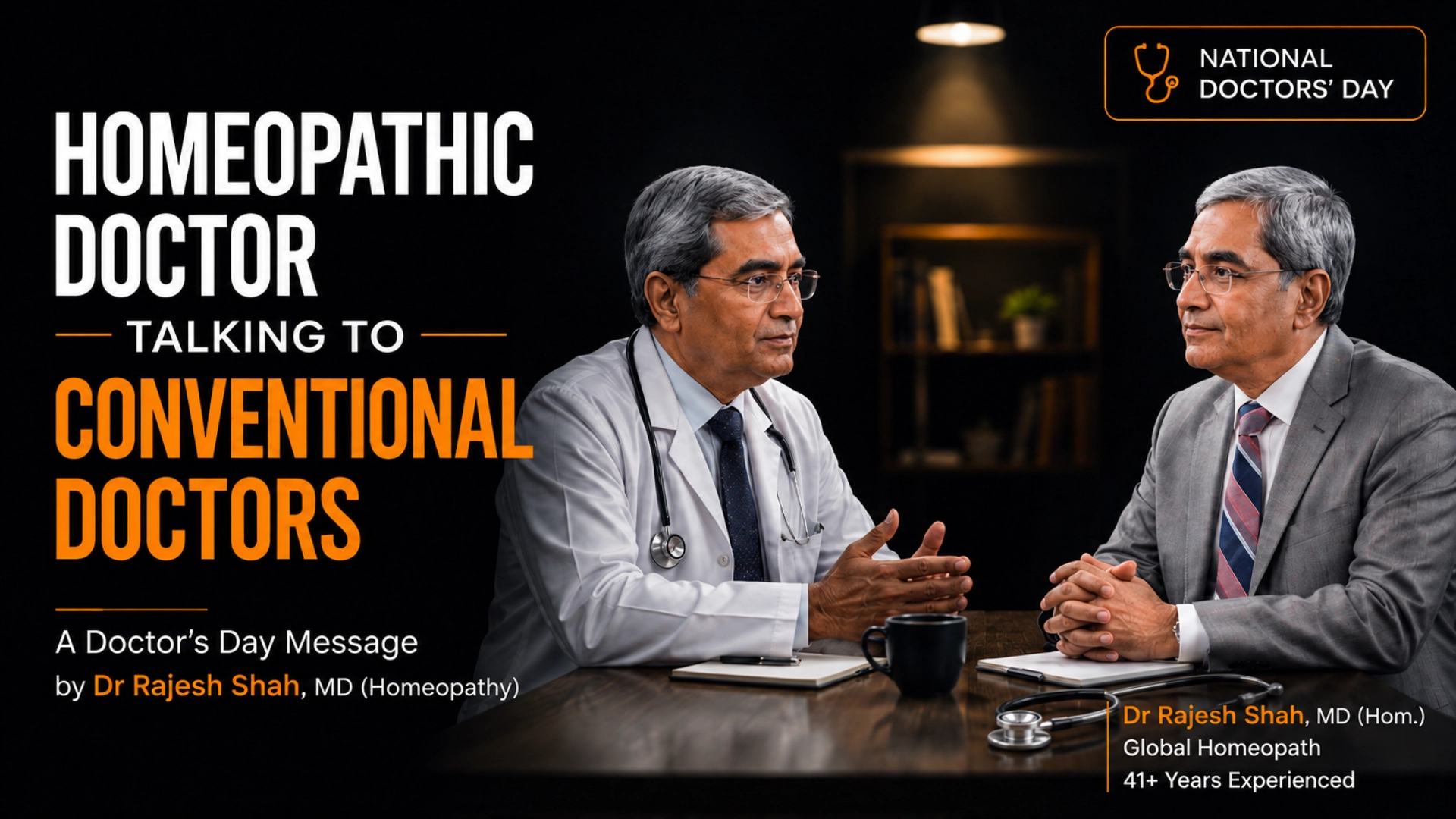
“My greetings to all conventional doctors on this Doctor’s Day.”
Is it not unusual that homeopathic doctors and conventional doctors (previously known as allopathic doctors) have not been on friendly talking terms with each other for so long? Let us use this Doctor’s Day as an opportunity to bridge that gap.
Let me introduce myself. My name is Dr. Rajesh Shah. I am a medically trained homeopathic doctor in practice since 1985. I have also served as a teacher at a medical college for many years. I have had the opportunity to teach not only homeopathic doctors and students but also many conventional doctors in countries such as the United States, the United Kingdom, Ireland, Holland, Sweden, Norway, Croatia, Greece, Japan, and others.
In addition, I have been engaged in medical research in homeopathy for the last thirty years. I have been studying the fundamental principles of homeopathy and evaluating the efficacy of homeopathic medicines using conventional pharmacological standards. In this process, I have collaborated with professionals from multiple disciplines, including immunologists, nanotechnologists, biomedical engineers, molecular scientists, policymakers, drug regulators, and government officials from bodies such as the FDA, CDSCO, the Ministry of Health, and the Ministry of Ayush.
1. Medicine is complex and our knowledge is limited
No medical expert has complete knowledge of any organ system or disease. A neurologist does not know everything about every neurological condition, and an immunologist does not have complete knowledge of immunity.
Medicine must therefore be practiced with an understanding of its inherent limitations. At the same time, medical opinions regarding diagnosis and treatment should remain open and non-rigid.
2. Doctors are shaped by what they are taught
A doctor’s knowledge is primarily derived from medical university education and textbooks. It is important to recognize that medical textbooks evolve approximately every 20 to 50 years.
In addition to formal education, clinical experience and individual perspectives also shape medical understanding. As a result, the practice of medicine often extends beyond what is formally taught in medical institutions.
Over time, many doctors gradually move beyond the initial biases formed during their early training.
3. Bias is not limited to any group
Bias is not restricted to individuals with limited education. Many senior professors, policymakers, scientists, and journal editors also hold strong biases.
History has shown that several scientific studies have been rejected due to editorial or institutional bias.
4. Conventional medicine and homeopathy represent different schools of thought
These two systems are based on fundamentally different principles of treatment.
Conventional medicine follows the principle of contraries. For example, in cases of inflammation, anti-inflammatory drugs are used to suppress or counteract the condition.
Homeopathy follows the principle of similars. In this approach, a substance capable of producing similar symptoms is used in a highly diluted form to stimulate a therapeutic response.
This concept is often better understood through examples such as vaccines and hormesis. Vaccines work by exposing the body to microbial components, which then trigger an immune response that provides protection against infection.
Both principles are observed in nature, and both have biological relevance.
The gap between the two systems largely exists because they are not taught together in medical education. This often results in differing interpretations and perspectives.
5. Limited research has contributed to confusion about homeopathy
With industrialization and scientific advancement, conventional medicine evolved rapidly through developments in microbiology, pharmacology, diagnostics, and surgical techniques.
Homeopathy did not undergo the same level of structured scientific modernization during the 19th and 20th centuries.
As a result, while conventional medicine advanced significantly, homeopathy saw comparatively limited large-scale research during the same period.
Despite this, homeopathy continued to be practiced based on its foundational principles.
The use of highly potentized medicines, often described as ultra-diluted, was frequently criticized and labeled as a placebo. This perception persisted until emerging developments in nanotechnology in the 21st century introduced new perspectives.
6. From ultra-dilute substances to nanomedicine
Homeopathic medicines are diluted beyond Avogadro’s number (10⁻²³), which led to the long-standing belief that no material substance remains.
However, research conducted by scientists at IIT Bombay and other international institutions has indicated the possible presence of nanoparticles of the original substance in such preparations.
This finding has generated renewed scientific interest in homeopathy.
What was previously dismissed for nearly two centuries is now being re-examined within the broader context of nanomedicine. However, acceptance is still gradual due to longstanding scientific biases.
7. Does this nanomedicine have biological effects
This is an important and valid question.
Research conducted by several scientists, including my own work over the past three decades, suggests that these nanoscale medicinal preparations may produce biological effects.
These effects have been observed at epigenetic and immunological levels in both pre-clinical and clinical studies.
8. Existing gaps require systematic scientific evaluation
With the emergence of new scientific perspectives, it is necessary to re-evaluate the extensive therapeutic knowledge accumulated over the past 200 years.
This includes systematic validation, redevelopment, and rigorous scientific assessment, similar to the process followed in other evolving medical systems.
At the same time, new research in drug development and biomedical exploration is equally important.
9. We are at the beginning of a scientific journey
In the last two decades, research in homeopathy has primarily focused on foundational studies.
While early findings are encouraging, meaningful, and scientifically relevant, much larger and more comprehensive research is required in the future.
A significant collaborative effort from the scientific community will be needed to fully understand its potential.
10. Homeopathy should be understood in terms of its strengths
No single system of medicine, including conventional medicine, is capable of addressing all diseases effectively.
A balanced and thoughtful integration of different medical systems may better serve patient care.
Homeopathy is particularly relevant in the management of chronic and recurring conditions.
It is important for every medical professional to be aware of its potential strengths.
Ignoring or not exploring its scope may, in certain cases, limit clinical understanding.
A closing thought
This isn’t a message to convince anyone.
It’s just a reminder that we’re all doctors first.
And whatever system we come from, the patient is always bigger than the system.
Maybe the future is not about choosing sides.
Maybe it’s just about understanding each other a little better and working together more often.
Because in the end, medicine is not about labels.
It’s about people.
And we’re all still learning.