

Recently, there has been debate and opposition around a state government’s decision to allow homeopathic doctors to practice allopathy after completing the government-recognized Certificate Course in Modern Pharmacology (CCMP), a year-long, intensive pharmacology program.
Background
In India, the conventional medicine graduate course (MBBS) and the homeopathic medicine graduate course (BHMS) are nearly identical in duration (4.5 + 1 = 5.5 years), examination style, textbooks, and subject matter. The one exception is pharmacology: MBBS students study modern pharmacology, while BHMS students study homeopathic pharmacology (materia medica).
The core difference, then, comes down to a single subject. In Maharashtra, the government launched the one-year CCMP course specifically to teach this missing subject — modern pharmacology.
How does this help?
Learning this missing subject empowers homeopathic doctors to serve thousands of patients in day-to-day general practice. These doctors play a vital role in primary healthcare, particularly in areas where medical services are scarce. In short, it’s about making fuller use of existing medical capability, not creating a shortcut.
Why the objection?
The Indian Medical Association (IMA) argues that this added training could increase competition for conventional doctors. But its underlying argument is somewhat unfair — that homeopathic education doesn’t cover the necessary medical subjects. That simply isn’t true. And if it were true, the appropriate response would be to ask the concerned authorities to strengthen homeopathic education, not to block this path to empowerment.
A few parallels worth considering
- Should electrical or civil engineers be barred from working in AI engineering just because they didn’t originally study it?
- Should chartered accountants be barred from advising on investments, since they only studied accounting?
- Should an orthopedic surgeon be barred from learning robotic surgery simply because it wasn’t part of their original training?
It sounds absurd when framed this way, doesn’t it? Empowerment through additional education shouldn’t be a point of objection. That said, courses like the CCMP can certainly be made more rigorous, with stricter passing criteria, to ensure there are no gaps in how this training is applied in practice.
Living with a Chronic Condition? Get Expert Guidance.
Talk to Dr. Rajesh Shah — 40+ years of experience in managing chronic skin conditions with a personalized, long-term approach.
Where does this bias come from?
In India, students choose between MBBS and BHMS after Class XII, based largely on their NEET score. Unlike most engineering programs, where students share common first-year subjects before specializing, medical education here diverges from day one. MBBS students never study the homeopathic pharmacopoeia, even though nearly every other subject overlaps between the two courses. Most people are unaware of this. As a result, some allopathic doctors form a negative opinion of homeopathy — for better or worse — often without ever having studied it. This opinion tends to be based on bias rather than knowledge, and it frequently persists until they personally experience the benefits of homeopathic treatment.
A matter of choice
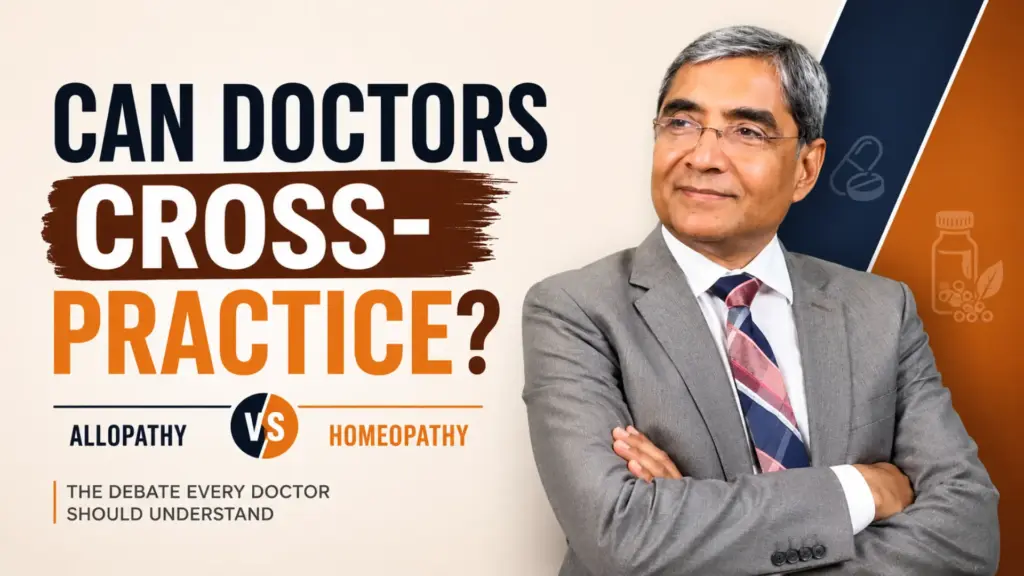
Some argue that once you’ve studied homeopathy or allopathy, you should stick to that path. This view is unnecessarily restrictive. People routinely expand their expertise through additional training. Do we tell engineers they can’t move into banking? Or commerce graduates that they can’t enter politics? Or scientists that they must confine their research to their original field of study? It’s ultimately a matter of choice. Allopathic doctors should be allowed to practice homeopathy after appropriate additional training, and homeopathic doctors should have the same opportunity in reverse. In fact, in most European countries (the UK, Germany, Austria, Holland, France, and others), as well as the US and Australia, many — though not all — practicing homeopaths originally trained as allopathic doctors and later chose to specialize in homeopathy. That was their choice to make.
A certificate course in homeopathy for modern medicine doctors
As is already the practice in many Western countries, India should introduce a formal certificate course to enable modern medicine (MBBS) doctors to learn and practice homeopathy. Given that homeopathic education covers four core subjects — Materia Medica, Organon of Medicine, Pharmacy, and Repertory — such a course would reasonably need to run for one to two years to provide adequate training.
Integration of medicine is the future
No single system of medicine is complete on its own — each has its strengths and limitations. Ideally, medical practice should draw on the best of all systems, integrated thoughtfully for the benefit of patients.
A clarification
For the record, I am a full-time, formally trained homeopath, and I do not practice modern medicine. I was formerly a faculty member at CMPH Medical College, then affiliated with the University of Mumbai. I have three to four decades of experience teaching homeopathy to both homeopathic and allopathic doctors across India, Europe, and the United States. I have no personal stake in expanding allopathic practice rights.
About the author:
Dr Rajesh Shah, MD (Homeopathy), is a senior homeopath, academician, researcher, and promoter of homeopathy. He is a former faculty member at CMPH Medical College, and he has taught homeopathy to homeopathic and conventional doctors in India, the US, the UK, Holland, Norway, Sweden, Greece, Japan, etc.