


Introduction
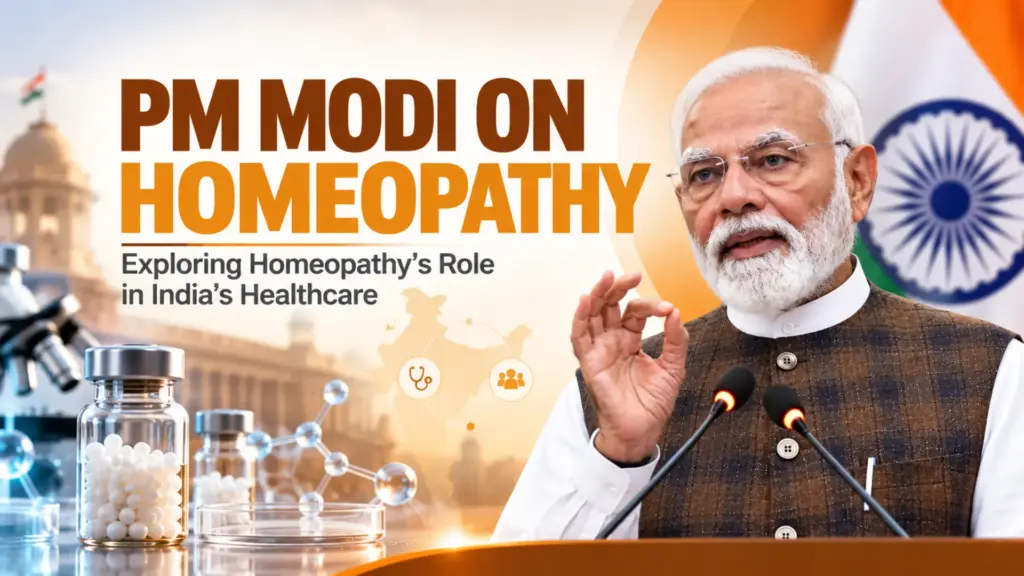
Homeopathy has been part of India’s healthcare journey for generations and continues to form part of the country’s pluralistic healthcare system. In April 2026, Prime Minister Narendra Modi shared an article by Union Minister of State for AYUSH Prataprao Jadhav discussing how homeopathy has evolved within India’s health and wellness landscape.
The article highlighted three themes: a patient-centred approach, a strong connection with communities and a sustainable outlook.
This renewed attention to homeopathy in India raises a broader question: what role can homeopathy responsibly play in the country’s healthcare system, and what will shape its future?
What Did PM Modi Highlight About Homeopathy?
It is important to understand the context behind PM Modi on homeopathy.
On April 10, 2026, Prime Minister Narendra Modi shared an article explaining how homoeopathy has become part of India’s pluralistic health and wellness system. The article discussed its holistic and patient-centred approach, community connection and sustainable outlook.
This should not be interpreted as an endorsement of any particular clinic, medicine or treatment outcome. Rather, it highlights the place of homeopathy within India’s broader healthcare landscape, where different systems of medicine are practised.
Living with a Chronic Condition? Get Expert Guidance.
Talk to Dr. Rajesh Shah — 40+ years of experience in managing chronic skin conditions with a personalized, long-term approach.
Why Does Homeopathy Have a Significant Presence in India?
Homeopathy in India has been practised for many decades and has developed a formal framework for education, regulation and research.
The National Commission for Homoeopathy is the statutory regulatory body for homoeopathy. It was constituted under the National Commission for Homoeopathy Act, 2020, which came into force in 2021.
Its responsibilities include areas such as homoeopathy education, medical assessment, professional ethics and registration. This institutional framework reflects the established place of homeopathy in India’s healthcare system.
Why Does Patient-Centred Care Matter?
The idea is simple: look at the person, not only the disease.
Two people with the same diagnosis may experience their condition differently. Their symptoms, lifestyle, previous treatments, emotional experiences and day-to-day challenges may not be the same.
A patient-centred consultation therefore involves listening carefully and understanding the person’s health concerns rather than looking at the diagnosis in isolation. This does not mean ignoring medical investigations or established diagnoses.
This approach is one reason the role of homeopathy in India is often discussed in the context of patient-centred and long-term care.
Where Could Homeopathy Fit in Chronic and Recurring Conditions?
Living with a health problem that keeps returning can be frustrating. Patients may look for approaches that help them manage their health over a longer period and improve their quality of life.
This is one reason some people explore homeopathy treatment in India for chronic and recurring concerns. Homeopathic practice traditionally gives importance to the person’s overall symptom pattern and personal characteristics during consultation.
However, expectations need to remain realistic. Improvement in an individual patient can result from several factors, including the natural course of a condition, lifestyle changes, conventional treatment and other interventions. Improvement alone does not establish that a particular treatment caused it. Careful follow-up, documentation and research therefore remain important.
What Is Happening in Homeopathy Research?
The future of any healthcare system depends not only on how widely it is used, but also on how carefully it is studied.
India has the Central Council for Research in Homoeopathy (CCRH), an autonomous organisation under the Ministry of AYUSH. Its research includes clinical research, drug proving, drug standardisation and pharmacological research.
Its research portfolio covers areas including urticaria, COPD, PCOS, hypothyroidism, irritable bowel syndrome, acne, osteoarthritis, diabetes and allergic rhinitis. CCRH also states that its clinical research uses objective assessment, statistical analysis and randomised controlled trials.
The important point is that research should help clarify where homeopathy may have a role and where evidence remains uncertain. More well-designed studies, transparent reporting and independent replication can contribute to that understanding.
Why Does Evidence Matter for the Growth of Homeopathy?
The growth of homeopathy in India should go hand in hand with stronger evidence and better documentation.
Research needs to distinguish between laboratory studies, observational research, case reports and controlled clinical trials because each provides different information. Positive findings should not be presented without considering limitations, and negative or inconclusive findings should also be reported.
For patients, the purpose of research should ultimately be simple: to provide clearer information so they can make informed healthcare decisions.
Can Homeopathy Become Part of India’s Broader Healthcare System?
The idea of bringing homeopathy into Indian healthcare should focus on responsible coordination, not competition between healthcare systems.
A patient may consult different healthcare professionals during the course of an illness. Good communication can help ensure that important investigations, prescribed medicines, specialist referrals and changes in health status are not overlooked.
Choosing homeopathy should never mean stopping prescribed medicines without medical advice, delaying emergency treatment, avoiding necessary investigations or ignoring worsening symptoms. A responsible practitioner should recognise when further investigation, specialist care or conventional treatment is needed.
Good healthcare is ultimately about making sure the patient receives appropriate care at the right time.
What Could Shape the Future of Homeopathy in India?
The future of homeopathy in India will depend on more than popularity.
Five areas are particularly important:
Stronger research: More well-designed clinical studies can help clarify where homeopathy may have a role and where evidence remains limited.
Better patient awareness: Patients need clear information about both the potential and limitations of any healthcare approach.
High professional standards: Education, ethical practice, proper documentation and continuing professional development remain important.
Better communication between healthcare systems: Patients may use different healthcare services, so coordination can support continuity and safety.
Measurable outcomes: Patient experiences matter, but objective assessments, validated measures and long-term follow-up can provide a clearer picture of health outcomes.
Life Force Homeopathy’s Perspective
At Life Force Homeopathy, patient care begins with understanding the person’s broader health story.
The duration of a condition, previous treatments, lifestyle, family history and individual symptoms can all provide useful context. Follow-ups also allow changes in symptoms and overall progress to be observed over time.
At the same time, responsible care requires realistic expectations and open communication. Patients should be encouraged to undergo appropriate investigations and seek specialist or conventional medical care whenever necessary.
For Life Force, the broader conversation around homeopathy treatment in India rests on three fundamentals: patient-centred care, responsible practice and continued research.
What Does India Need From Homeopathy Going Forward?
India’s healthcare system is diverse, and people may consider different approaches depending on their needs, preferences and circumstances.
The discussion around homeopathy in India should therefore move beyond a simple “homeopathy versus conventional medicine” debate.
The more useful questions are:
What does the patient need?
What evidence is available?
What are the limitations?
When is additional medical care necessary?
These questions create a more mature approach to healthcare and keep the focus where it belongs: on informed decisions and patient safety.
Conclusion
Homeopathy has a long history and an established institutional presence within the country’s pluralistic healthcare framework.
PM Modi’s April 2026 sharing of an article highlighting homeopathy brought renewed attention to its role in India’s health and wellness landscape, particularly its patient-centred, community-connected and sustainable aspects.
However, popularity and recognition alone cannot determine the future of a healthcare system. The future of homeopathy will depend on putting patients first, practising responsibly and continuing to strengthen the evidence through quality research.
For patients, the goal should remain informed healthcare rather than exaggerated promises or unnecessary comparisons.
Disclaimer
This blog is intended for educational and general informational purposes only. References to Prime Minister Narendra Modi concern his reported sharing of an article highlighting homeopathy’s role in India’s health and wellness system. They should not be interpreted as an endorsement of Life Force Homeopathy, any individual practitioner or any specific homeopathic treatment.
This information does not replace professional medical advice, diagnosis or treatment. Patients should make healthcare decisions based on their individual circumstances and seek appropriate medical care when required.