


Introduction
Finding a sudden lump under your skin can instantly trigger a wave of worry. Is it just a harmless insect bite, stubborn acne, or something that needs a doctor’s attention?
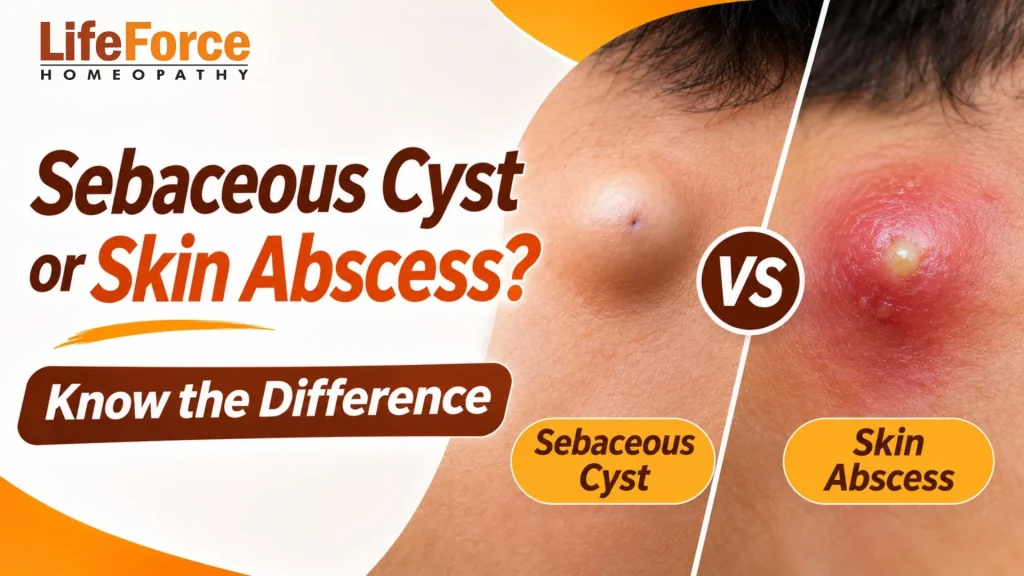
Two of the most common culprits behind skin lumps are sebaceous cysts and skin abscesses. While they might look remarkably similar at first glance, both create a noticeable bump under the surface and are entirely different conditions with distinct causes, behaviors, and treatment paths. Misidentifying them and trying to squeeze or treat them at home can lead to severe complications.
The article below breaks down the core differences between a sebaceous cyst and skin abscess, explores the difference between cyst and abscess, outlines modern medical care and skin abscess treatment options, and discusses the supportive role and limitations of homeopathy treatment for chronic skin conditions.
Few things are as unsettling as noticing a tender, swollen bump forming beneath your skin. At first, you might ignore it, hoping it will simply vanish. But what happens when that lump starts to throb, grows larger, or begins draining fluid?
Whether you are searching for sebaceous cyst treatment or trying to understand a painful flare-up, knowing what is happening beneath your skin is the first step toward safe recovery. Understanding conventional care and the complementary role of skin treatment in homeopathy can also help patients make informed decisions.
What Is a Sebaceous Cyst?
A sebaceous cyst is a slow-growing, benign (non-cancerous) sac located just beneath the surface of the skin. True sebaceous cysts arise from the sebaceous glands (which produce oil), though most lumps commonly called sebaceous cysts are technically epidermoid cysts.
Living with a Chronic Condition? Get Expert Guidance.
Talk to Dr. Rajesh Shah — 40+ years of experience in managing chronic skin conditions with a personalized, long-term approach.
Why Is It Also Called an Epidermoid Cyst?
Medically speaking, true sebaceous cysts originate from oil-producing glands, while epidermoid cysts develop from cells in the outer layer of your skin (the epidermis). Because their contents (a cheesy, yellowish protein substance called keratin) look similar, the terms are frequently used interchangeably by patients and doctors alike.
Common Signs and Symptoms
- A slow-growing, movable round lump under the skin.
- A tiny dark plug or opening (puneth) visible on the surface of the cyst.
- A thick, foul-smelling, cheesy material that may occasionally discharge if ruptured.
- Usually painless unless it becomes irritated, inflamed, or infected.
What Is a Skin Abscess?
Unlike a cyst, which is a structured sac, a skin abscess is an enclosed collection of pus that develops deep under the skin or within a hair follicle. It is your body’s acute immune response to a bacterial invasion usually Staphylococcus aureus trapped beneath the tissue.
What Causes a Skin Abscess?
- Bacteria entering through a tiny break or scratch in the skin.
- A blocked sweat gland or hair follicle that becomes deeply infected.
- Underlying immune suppression or chronic skin friction.
Common Signs and Symptoms
- A painful, tender, rapidly growing red lump.
- The center often becomes soft, white, or yellow as pus accumulates (forming a head).
- The surrounding skin feels hot, firm, and visibly inflamed.
- Fever, chills, or generalized body aches if the infection spreads.
Sebaceous Cyst vs. Skin Abscess: Key Differences
To better understand the difference between cyst and abscess, review the comparison below:
| Feature | Sebaceous Cyst | Skin Abscess |
|---|---|---|
| What it is | A closed, membranous sac filled with keratin and skin debris | An acute, localized pocket of pus caused by bacterial infection |
| Main cause | Trapped skin cells, damaged hair follicles, or blocked oil glands | Bacterial entry (often Staph) through skin breaks or infected follicles |
| Nature and contents | Firm or doughy; contains thick, cheesy, odorless or mild-smelling keratin | Soft or fluid-filled center; contains white blood cells, bacteria, and liquid pus |
| Onset | Very gradual (takes months or years to grow) | Rapid and sudden (develops over a few days) |
| Pain | Usually painless unless irritated or infected | Frequently throbbing, intense, and exquisitely tender to the touch |
| Redness and warmth | Minimal or absent unless inflamed | Significant redness, swelling, and localized heat |
| Treatment approach | Monitoring, anti-inflammatory care, or surgical excision of the sac | Warm compresses, medical incision and drainage (I&D), and antibiotics if needed |
Can a Sebaceous Cyst Become Inflamed or Infected?
Yes, and this is where confusion often arises. A stable cyst can suddenly flare up. It is important to distinguish between simple inflammation and an active bacterial infection.
Inflammation vs. Infection
| Point | Inflammation | Infection |
|---|---|---|
| What it means | The cyst wall has ruptured internally, leaking keratin into surrounding tissue and triggering a sterile immune reaction. | Bacteria have invaded the cyst structure, multiplying and creating active pus. |
| What you may notice | Sudden tenderness, firm swelling, and mild redness without pus discharge or systemic fever. | Throbbing pain, rapid enlargement, intense heat, pus leakage, and potential fever or chills. |
| What to do | Apply warm compresses gently; avoid squeezing; consult a doctor for anti-inflammatory guidance. | Seek medical evaluation promptly for potential drainage and antibiotic coverage. |
Why an Infected Cyst May Resemble an Abscess
When a sebaceous cyst becomes severely infected, it fills with pus, becomes hot and throbbing, and swells up. At this stage, it looks, feels, and acts almost identical to a primary skin abscess. A doctor must perform a clinical examination to determine whether an underlying cyst wall is present.
When Should You Seek Medical Attention?
Most minor skin bumps settle down, but you should seek prompt medical evaluation if you notice:
- Severe, worsening pain or throbbing that disrupts sleep.
- Spreading redness, red streaks radiating from the lump, or intense heat.
- Fever, chills, or body aches accompanying the skin lesion.
- Rapid swelling over a 24-to-48-hour period.
High-Risk Groups: Individuals with diabetes, compromised immunity, or poor circulation must never attempt home remedies and should see a doctor immediately at the first sign of an expanding skin infection.
How Do Doctors Diagnose a Cyst or Skin Abscess?
Doctors use straightforward diagnostic methods to evaluate skin lumps:
- Clinical Examination: Inspecting the lump’s texture, mobility, presence of a punctum, and surrounding inflammation.
- Patient History: Asking how fast the lump appeared and if it has drained before.
- Imaging: Rarely, an ultrasound may be used if the lump is deep or recurrent.
- Culture and Sensitivity: If an abscess or infected cyst is drained, a swab of the pus may be sent to the lab to identify the specific bacteria and choose the right antibiotic.
Treatment Options for Sebaceous Cysts and Skin Abscesses
When Can a Cyst Be Monitored?
If a sebaceous cyst is small, completely painless, and not growing, doctors often recommend a “watch and wait” approach.
When Is Cyst Removal Considered?
If a cyst repeatedly becomes inflamed, grows large, becomes infected, or causes cosmetic concerns, surgical excision is considered. Complete removal of the cyst wall is necessary to prevent it from returning.
When Does a Skin Abscess Need Drainage?
An established skin abscess rarely heals with medication alone because antibiotics cannot easily penetrate the pus cavity. A doctor must perform a minor procedure called Incision and Drainage (I&D) under local anesthesia to safely release the trapped fluid.
When Are Antibiotics Needed?
Antibiotics are prescribed when there is surrounding cellulitis (spreading skin infection), systemic fever, or if the patient has underlying health conditions like diabetes. They are not always necessary for simple, isolated cysts or fully drained superficial abscesses.
Sebaceous Cyst Homeopathy Treatment: Role, Evidence, and Limitations
Many individuals seeking alternative or complementary approaches explore homeopathic treatment for abscess and recurring skin problems. However, homeopathy has not been demonstrated through reliable clinical evidence to treat bacterial skin infections, eliminate cysts, or prevent recurring boils.
What Does a Homeopathic Consultation Involve?
A homeopathic practitioner typically evaluates more than the visible lump. The consultation involves exploring the patient’s skin type, tendency toward recurrent boils or cysts, family medical history, stress levels, dietary habits, and overall health.
People exploring homeopathy for recurring boils or homeopathy for chronic & recurrent skin conditions should also undergo appropriate medical evaluation to identify possible infections and underlying causes.
What Does the Evidence Support?
- Constitutional Support: Classical homeopathy selects remedies based on individual symptoms and overall health characteristics. However, proposed self-regulatory effects have not been established through robust clinical evidence.
- Reducing Tendency: Patients experiencing repeated skin eruptions sometimes explore individualized homeopathy treatment as complementary care. There is currently insufficient reliable evidence that homeopathic remedies reduce the frequency, intensity, or recurrence of boils or abscesses.
When Is Medical or Surgical Treatment Necessary?
- Homeopathy cannot remove a mature cyst wall or substitute for surgical drainage.
- Acute, painful abscesses require prompt medical assessment. Drainage or antibiotics may be necessary to control infection and prevent complications, including sepsis.
- Patients considering skin treatment in homeopathy should not delay or replace medically indicated treatment
Why Does a Cyst or Skin Abscess Keep Coming Back?
Recurrence After Cyst Drainage
If a cyst is simply lanced and drained of its fluid contents without removing the underlying epithelial sac wall, the sac will inevitably refill with keratin over time. Permanent resolution requires complete removal of the sac wall.
Repeated Abscesses and Underlying Causes
Experiencing a boil returning in the same spot can indicate a persistent local cause, including an underlying cyst, hidradenitis suppurativa, or another skin condition.
Recurrent skin abscesses can also be associated with uncontrolled blood sugar levels (diabetes), immune-system problems, or bacterial carriage, including Staphylococcus aureus. A medical assessment can help identify contributing factors and guide preventive care.
People researching homeopathy for recurring boils should understand that identifying and treating the underlying cause is essential to reducing further infections.
Caring for the Area: What Do and What to Avoid
- DO apply clean, warm compresses for 10–15 minutes a few times a day to encourage natural soothing or bring an abscess to a head.
- DO keep the area clean with mild soap and water.
- DO wear loose clothing to prevent friction over the lump.
- DON’T squeeze, pop, or needle a cyst or abscess at home. This can rupture the sac internally, push bacteria deeper into the tissue, and cause severe cellulitis or permanent scarring.
- DON’T apply harsh chemical home remedies or unverified ointments to broken skin.
Conclusion
Whether you are dealing with a quiet sebaceous cyst or a painful skin abscess, understanding what is happening beneath your skin empowers you to make safe health decisions. Avoid the temptation to squeeze or self-treat at home. Instead, seek a professional diagnosis, explore appropriate medical or surgical options when needed, and consider personalized constitutional care such as homeopathy treatment to support long-term skin health and reduce recurrence.