

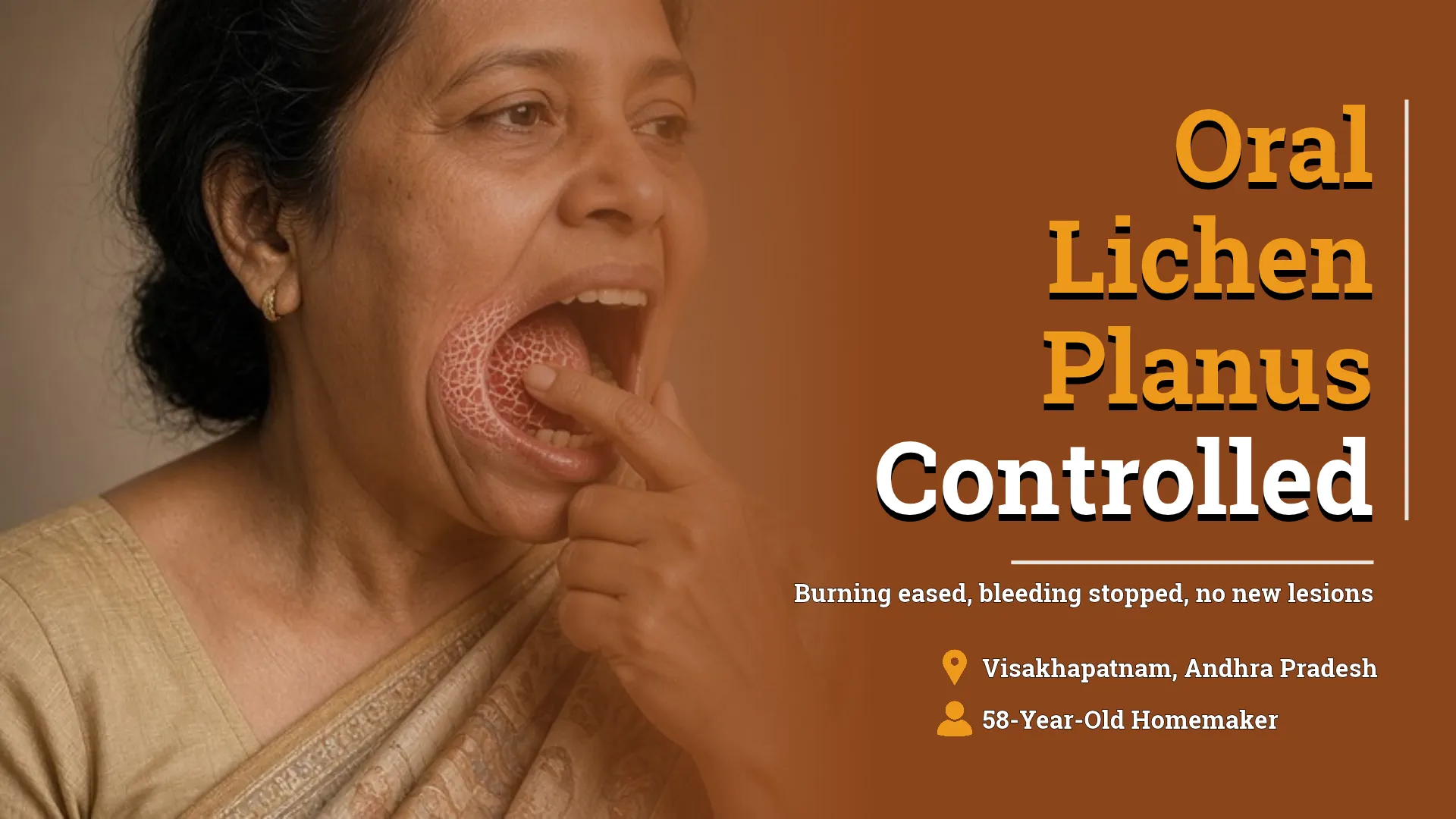
A 58-year-old woman from Andhra Pradesh had oral lichen planus that first settled with homeopathy at Life Force in 2009, then returned after 16 years with white patches, burning and bleeding in the mouth. She went back to homeopathic care with follow-ups about every two months. Her burning eased early, the bleeding stopped and the patches stayed stable with no new ones by September 2026. Mild sensitivity to spicy and hot food remains.
Table of Contents
- 01. Introduction
- 02. Patient Case Details
- 03. How Did the Patient Respond to Oral Lichen Planus Treatment in Homeopathy?
- 04. Key Takeaways
- 05. What Is Oral Lichen Planus?
- 06. Presenting Complaints: Painful Oral Lichen Planus After Prolonged Remission
- 07. Individualized Clinical Assessment at Life Force Homeopathy
- 08. Homeopathy Treatment Approach for Oral Lichen Planus (OLP)
- 09. Dietary Guidance and Oral Lichen Planus Home Remedies
- 10. Follow-Ups and Clinical Progress Timeline
- 11. Treatment Outcome: Clinical Status Before and After Follow-up
- 12. Key Clinical Learnings From This Oral Lichen Planus Case
- 13. Consult Life Force Homeopathy for Individualized Assessment
- 14. Conclusion
Introduction
Oral lichen planus can cause persistent mouth burning, painful white patches and difficulty eating. Even after a prolonged period of remission, symptoms may return and require renewed medical attention.
This case study documents the journey of a 58-year-old woman from Andhra Pradesh who previously received homeopathic treatment for oral lichen planus (OLP) at Life Force Homeopathy in 2009. After a prolonged symptom-free period, her condition recurred, affecting her tongue, lips and ability to eat comfortably.
Following individualized homeopathic care, dietary guidance, and regular clinical follow-ups, the patient reported reduced burning, cessation of bleeding, and improved eating comfort. Some white patches persisted but remained stable at her latest documented follow-up.
Patient Case Details
| Clinical Parameter | Patient Details |
| Patient | Mrs. MM |
| Patient ID (PIN) | 12539 |
| Age | 58 years |
| Gender | Female |
| Location | Andhra Pradesh, India |
| Medical Condition | Oral Lichen Planus (OLP) |
| First Episode | 2009 |
| Initial Treatment | August to December 2009 |
| Treatment Centre | Life Force Homeopathy |
| Recurrence | After prolonged remission |
| Duration of Recurrent Symptoms | Approximately six months before consultation |
| Documented Follow-up Period | January 2025 to September 2026 |
| Current Status | Ongoing clinical observation |
How Did the Patient Respond to Oral Lichen Planus Treatment in Homeopathy?
During approximately 20 months of documented follow-ups, the patient experienced a reduction in mouth burning, bleeding and discomfort while eating. White patches on the lips reduced, while some tongue lesions persisted without reported spread or new lesions at the September 2026 review. Mild sensitivity to spicy and hot food remained.
These observations represent an individual clinical outcome and do not establish the effectiveness of homeopathy for oral lichen planus in other patients.
Key Takeaways
- Oral lichen planus recurred after a prolonged period of remission.
- The patient initially experienced white patches, mouth burning, bleeding and difficulty eating.
- Mouth burning and eating discomfort reduced during follow-up.
- Bleeding stopped, and no new lesions were reported at the latest review.
- Some white patches and food-related sensitivity persisted.
- The patient remains under clinical observation.
What Is Oral Lichen Planus?
Oral lichen planus is a chronic inflammatory condition that affects the mucous membranes inside the mouth. It commonly involves the tongue, inner cheeks, gums and lips.
Unlike lichen planus on the skin, which may cause itchy, flat-topped bumps, oral lichen planus primarily affects the lining of the mouth.
Common oral lichen planus symptoms include:
- White, lacy or net-like patches inside the mouth
- Burning sensations on the tongue or inner cheeks
- Redness, inflammation and tenderness
- Painful erosions or ulcers
- Discomfort while eating spicy, acidic or hot food
- Occasional bleeding from affected areas
The condition may follow a relapsing and remitting pattern, with periods of improvement followed by recurring symptoms.
Persistent oral lesions require regular dental or medical evaluation because oral lichen planus carries a small risk of malignant transformation.
Presenting Complaints: Painful Oral Lichen Planus After Prolonged Remission
The patient first received treatment at Life Force Homeopathy between August and December 2009. According to her clinical history, she subsequently experienced a prolonged period of symptom relief.
When the condition recurred, she sought further treatment for painful oral lichen planus with the following complaints:
- White, lacy patches affecting the lips and tongue
- Persistent burning inside the mouth
- Difficulty eating due to soreness and discomfort
- Occasional bleeding from affected areas
- Increased sensitivity to certain foods
She reported no other significant systemic complaints.
The patient had received homeopathic medicines for approximately five months before the detailed follow-up records began. According to the case history, she was not taking concurrent conventional medicines for oral lichen planus during this period..
Individualized Clinical Assessment at Life Force Homeopathy
Before reviewing the patient's homeopathy treatment, the treating doctor evaluated her current symptoms, previous medical history, dietary triggers and general health.
| Assessment Area | Clinical Observations |
| Oral lesions | White patches affecting the lips and tongue |
| Burning sensation | Persistent discomfort affecting eating |
| Bleeding | Occasional bleeding from affected patches |
| Dietary triggers | Tomatoes, spicy food and very hot food |
| Previous medical history | Oral lichen planus since 2009 |
| Recurrence pattern | Symptoms returned after prolonged remission |
| General health | Appetite, eating comfort and overall well-being monitored |
The assessment helped the doctor document symptom severity, identify aggravating factors and monitor changes during subsequent consultations.
Homeopathy Treatment Approach for Oral Lichen Planus (OLP)
The patient's previous treatment history formed part of the clinical assessment. However, the doctor evaluated the recurrent episode independently because the severity, symptoms and behaviour of chronic conditions may change over time.
The individualized homeopathy treatment for oral lichen planus (OLP) included:
- Selection of homeopathic medicines based on the patient's symptom profile and medical history.
- Regular clinical follow-ups approximately every two months.
- Monitoring of white patches, burning sensations, bleeding and lesion progression.
- Dietary guidance to reduce irritation from specific food triggers.
- Assessment of eating comfort and overall well-being.
The patient did not report using concurrent conventional medicines for oral lichen planus during the documented follow-up period.
Evidence supporting the effectiveness of homeopathy treatment for lichen planus remains limited. Patients should not discontinue prescribed conventional medicines without consulting their treating healthcare professional.
Dietary Guidance and Oral Lichen Planus Home Remedies
During treatment, the doctor identified tomatoes, spicy food and very hot food as factors that aggravated the patient's mouth burning.
The patient received dietary guidance to avoid these specific triggers during symptomatic periods.
Patients searching for oral lichen planus home remedies may consider the following supportive self-care measures:
- Avoid foods that aggravate mouth burning.
- Allow hot food and beverages to cool before consumption.
- Maintain gentle oral hygiene using a soft-bristled toothbrush.
- Drink adequate water throughout the day.
- Avoid tobacco and alcohol.
- Attend regular dental and medical examinations.
These measures may help reduce oral irritation but do not replace professional medical treatment.
Follow-Ups and Clinical Progress Timeline
| Follow-up Date | Clinical Observations |
| 5 January 2025 | Burning reduced noticeably. Eating became more comfortable. Lip and tongue patches reduced, with no bleeding episodes. |
| 7 March 2025 | Tongue patches continued to fade. The patient reported no burning or bleeding. |
| 2 May 2025 | No burning or eating difficulty. Lip lesions improved, while tongue patches remained largely unchanged. |
| 25 June 2025 | Lesion thickness and white coating reduced without reported spread. Tomatoes triggered mild burning. |
| 23 August 2025 | Overall improvement continued. Lesions showed no spread, although sensitivity to spicy food persisted. |
| 23 October 2025 | White streaks and plaques remained on the top and sides of the tongue. Mild burning occurred after spicy food. |
| 24 December 2025 | The patient reported further improvement in burning. Tongue pigmentation remained visible. |
| 24 February 2026 | Overall comfort improved, although white patches and sensitivity to spicy and hot food persisted. |
| 30 April 2026 | No new lesions were reported. Existing patches remained stable. |
| 4 July 2026 | Overall condition remained better, with no new lesions. Food-related sensitivity continued. |
| 11 September 2026 | Existing lesions remained stable, with no new lesions reported. Mild burning with spicy or hot food persisted. |
Treatment Outcome: Clinical Status Before and After Follow-up
During approximately 20 months of documented follow-ups, the patient experienced improvement in several symptoms associated with oral lichen planus.
| Clinical Parameter | Initial Symptoms | Latest Documented Status |
| Mouth burning | Persistent burning | Largely controlled, with occasional food-related burning |
| Oral bleeding | Occasional bleeding | No further bleeding reported |
| Eating discomfort | Significant difficulty eating | Improved eating comfort |
| White patches on lips | Present | Reduced during follow-up |
| White patches on tongue | Present | Some patches persisted but remained stable |
| New lesions | Not documented at baseline | No new lesions reported at latest review |
| Food sensitivity | Present | Mild sensitivity to spicy and hot food persisted |
The patient reported improved oral comfort and a reduction in symptoms. However, complete resolution of oral lesions had not occurred at the latest documented review on 11 September 2026.
She remains under clinical observation.
Key Clinical Learnings From This Oral Lichen Planus Case
- Oral lichen planus may recur even after many years of remission.
- Symptom improvement does not necessarily indicate complete resolution of oral lesions.
- Identifying individual dietary triggers may help reduce oral discomfort.
- Clinical progress can vary across different affected areas of the mouth.
- Regular follow-ups are important for monitoring persistent lesions and identifying new changes.
- Individual case outcomes cannot predict how another patient will respond to the same treatment approach.
Living with Oral Lichen Planus ?
Receive a personalized treatment plan from our experienced homeopathic doctors. Trusted by over 100,000+ patients across 180+ countries for safe, natural and long term management of chronic diseases.
Consult Life Force Homeopathy for Individualized Assessment
Patients exploring oral lichen planus treatment in homeopathy can consult the medical team at Life Force Homeopathy for an individualized assessment of their symptoms, medical history and available care options.
Life Force Homeopathy has provided individualized homeopathic care for chronic and recurring conditions since 1985, with in-clinic and online consultation options.
Conclusion
This case study documents the clinical journey of a 58-year-old woman with recurrent oral lichen planus following a prolonged period of remission.
During individualized homeopathy treatment for oral lichen planus, dietary modifications and regular follow-ups at Life Force Homeopathy, the patient reported reduced mouth burning, cessation of bleeding, and improved eating comfort. Some tongue lesions and sensitivity to spicy and hot food persisted.
The case highlights the importance of long-term clinical observation, realistic treatment expectations and regular medical evaluation in managing chronic oral conditions.
Medical Disclaimer: This case study describes the clinical observations of an individual patient. It does not establish treatment efficacy or guarantee similar outcomes. Persistent oral lesions require regular professional evaluation. Patients should not discontinue prescribed medicines without consulting their treating healthcare professional.