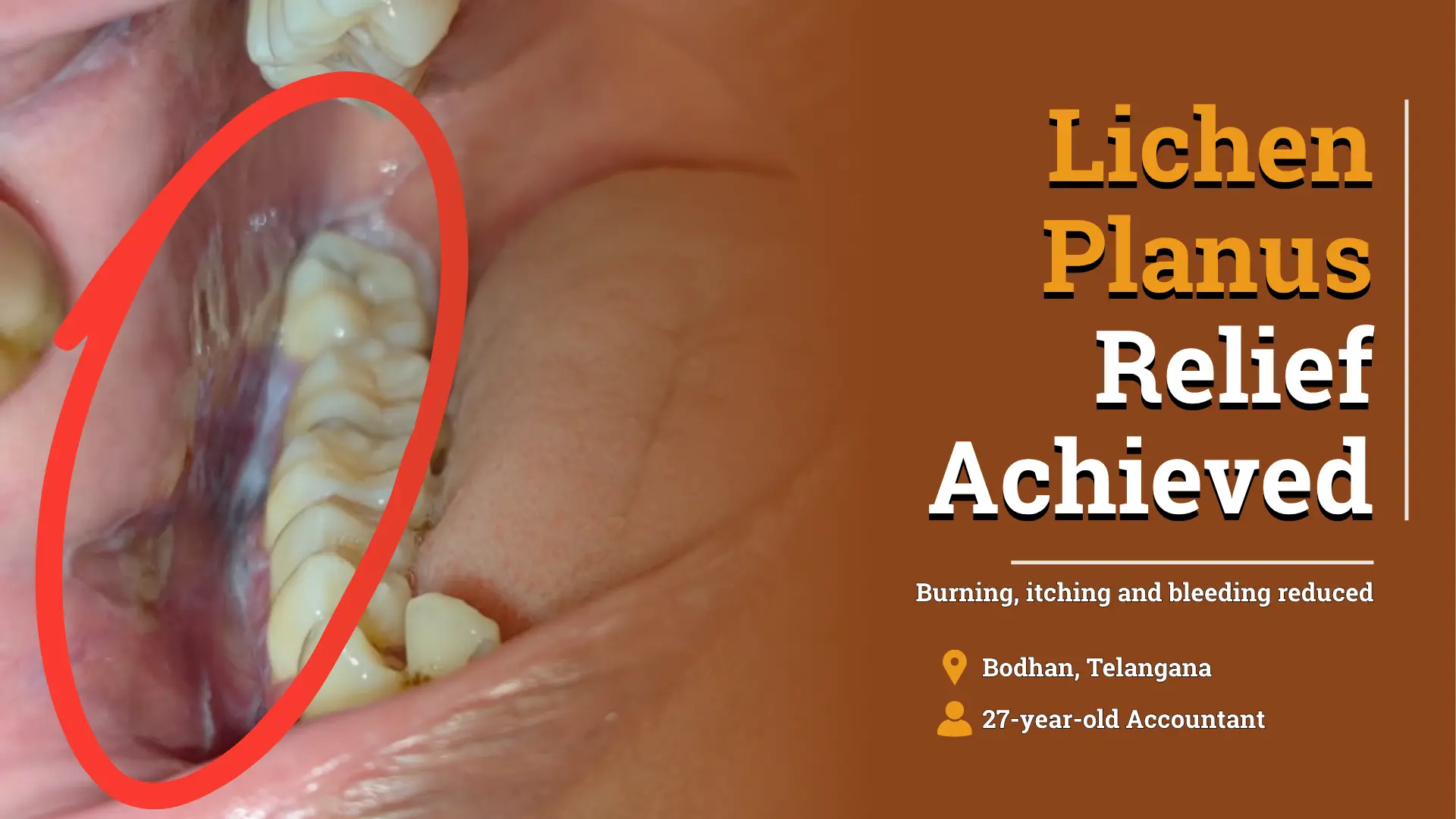


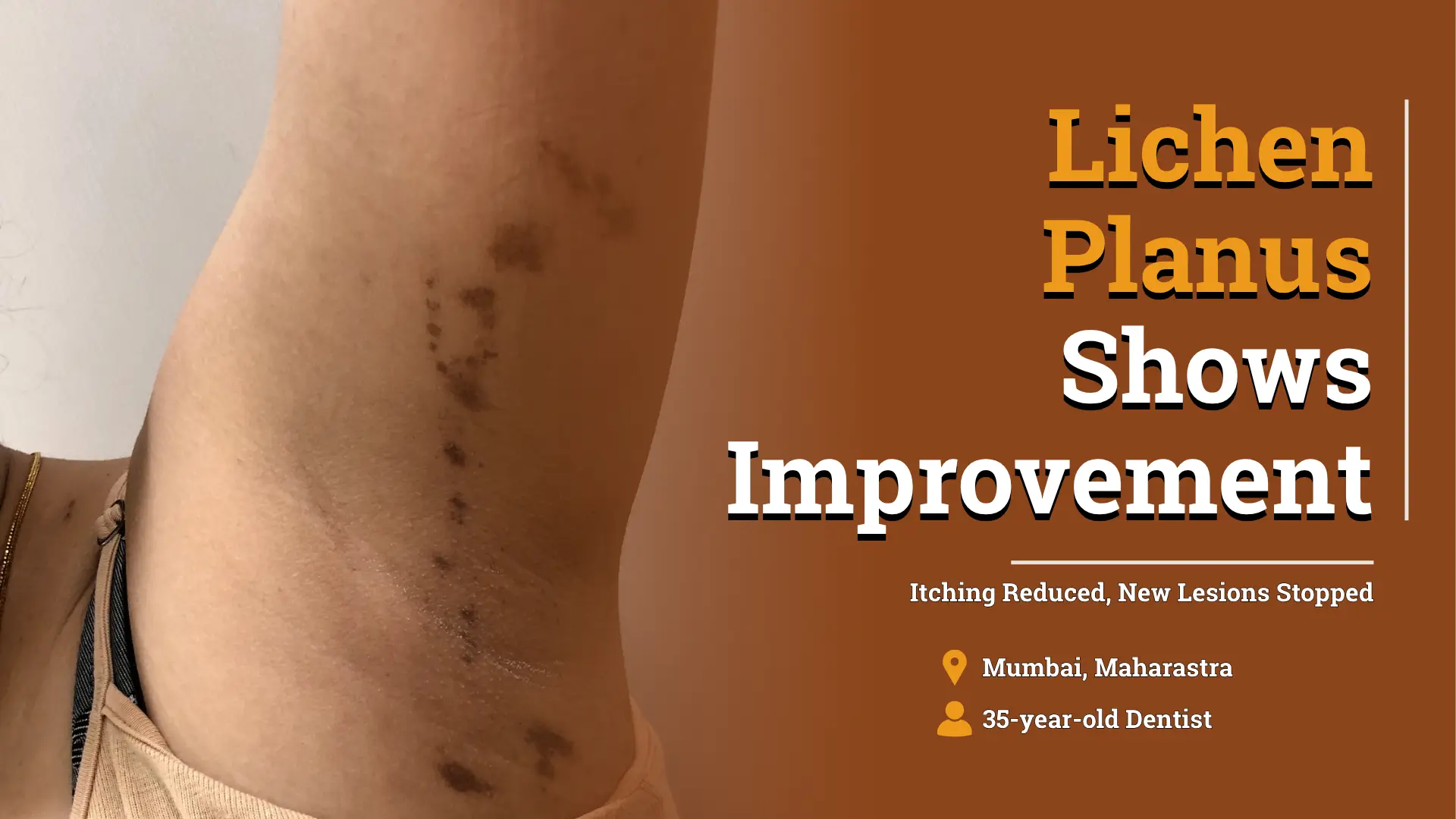
Patient ID 54596, a 35-year-old female dentist, visited Life Force Homeopathy on 18 May 2024 for Cutaneous Lichen Planus of 3 to 4 months’ duration. She had itchy purplish lesions over the right axilla, right breast, and both thighs, followed by dark pigmentation. The disease continued despite topical corticosteroids, and she also had allergic rhinitis. After individualized homeopathic treatment and regular follow-ups, itching reduced, fresh lesions stopped appearing, old lesions healed, and pigmentation started fading. By March 2025, she reported around 75% improvement, with continued recovery later.
Table of Contents
- 01. Patient Snapshot
- 02. About Cutaneous Lichen Planus
- 03. Complaints at the First Visit
- 04. Ready to Know Your Recovery Chances?
- 05. Personal and Medical Background
- 06. Professional and Emotional Context
- 07. How the Case Was Studied
- 08. Homeopathic Treatment Plan
- 09. Follow-Up Timeline
- 10. Treatment Outcome
- 11. Doctor’s Observation
- 12. Life Force Homeopathy for Lichen Planus
- 13. Conclusion
When a skin condition spreads quickly, the fear is not only about itching or discomfort. It is also about whether the marks will keep increasing and whether the skin will return to normal again.
This was the concern of a 35-year-old dentist, Patient ID 54596, who consulted Life Force Homeopathy on 18 May 2024 for lichen planus involving the skin. Her lesions had started only 3 to 4 months earlier, but they were spreading fast.
She had already used topical corticosteroids, yet the disease activity continued. The eruptions were itchy, purplish, and later left dark marks on the skin. The affected areas included the right axilla, right breast, and both thighs.
Along with this, she was also suffering from allergic rhinitis that was not settling well despite antihistamine use.
After starting individualized homeopathic treatment, her case moved gradually from an active spreading phase to a more stable healing phase. Itching reduced, new lesions stopped appearing, old lesions improved, and pigmentation slowly began to fade. By March 2025, she had achieved around 75% improvement.
Patient Snapshot
| Parameter | Details |
| Patient ID | 54596 |
| Age | 35 Years |
| Gender | Female |
| Profession | Dentist |
| First Visit | 18 May 2024 |
| Diagnosis | Cutaneous Lichen Planus |
| Duration Before Treatment | 3 to 4 Months |
| Earlier Medication | Topical corticosteroids |
| Associated Complaint | Allergic Rhinitis |
| Main Concerns | Itching, spreading lesions, dark pigmentation |
About Cutaneous Lichen Planus
Cutaneous Lichen Planus is a long-lasting inflammatory skin disorder. It often appears as itchy, violet or purplish, flat skin eruptions. After the active lesions heal, they may leave dark post-inflammatory pigmentation.
The condition may affect the thighs, arms, trunk, underarms, breast region, or skin folds. In some patients, the lesions remain limited, while in others they may spread or relapse.
Apart from itching, the dark marks after healing can become a major cosmetic concern.
To see how another patient’s skin lesions changed over time, read this lichen planus case involving the hands and legs.
Complaints at the First Visit
The patient came with the following concerns:
- Fast-spreading skin lesions diagnosed as Cutaneous Lichen Planus
- Severe itching
- Purplish eruptions turning into dark pigmentation
- Lesions over the right axilla, right breast, and both thighs
- Discomfort affecting daily ease
- Unsatisfactory response to topical steroid treatment
- Allergic rhinitis progressing despite antihistamines
The main challenge was to control the active spread and reduce itching while supporting gradual healing of the existing lesions.
Ready to Know Your Recovery Chances?
Discover your recovery chances from chronic diseases in percentage with Life Force Homeopathy's FREE Assessment Test. Get a personalized evaluation from our experienced doctors.
Start Your FREE Assessment Test →Personal and Medical Background
She was moderately built and followed a vegetarian diet. Her appetite was good, and she had a strong liking for spicy food. Her water intake was low.
Living with a Chronic Condition? Get Expert Guidance.
Talk to Dr. Rajesh Shah — 40+ years of experience in managing chronic conditions with a personalized, long-term approach.
Her menstrual cycles were sometimes delayed by 10 to 15 days. She was sensitive to both heat and cold.
Her family medical history included diabetes and heart disease.
These details helped the doctors understand her body tendency and select a medicine suited to her complete case.
Professional and Emotional Context
The patient was a qualified dentist. After pregnancy, she had paused her dental practice and was managing home responsibilities.
You can also read a separate postpartum lichen planus case study about another patient’s experience after pregnancy.
She had earlier worked at Parakh Hospital. Her husband was involved in the property business, and she described her home environment as stable and supportive.
Even though she was generally confident, expressive, gentle, and emotionally balanced, she felt stressed about not being able to continue her profession. This inner conflict was considered during the case evaluation.
How the Case Was Studied
At Life Force, the case was reviewed in detail under Dr. Rajesh Shah’s guidance.
Instead of looking only at the visible lesions, the doctors studied the full picture, including:
- Speed of spread
- Severity of itching
- Pigmentation after lesions
- Response to steroids
- Allergic rhinitis
- Heat and cold sensitivity
- Delayed menstrual cycles
- Low water intake
- Preference for spicy food
- Career-related stress
- Family history of diabetes and heart disease
This complete assessment helped build a personalized treatment plan.
Homeopathic Treatment Plan
The patient was prescribed individualized homeopathic medicines based on her total symptom pattern.
The treatment aimed to:
- Reduce itching
- Control the appearance of new lesions
- Help older lesions heal
- Support fading of pigmentation
- Monitor allergic rhinitis
- Adjust medicines as symptoms changed
- Maintain stability after the active phase reduced
Patients should not stop steroids or other medicines suddenly on their own. Any change in ongoing medication should be done with proper medical guidance.
Follow-Up Timeline
| Period | Clinical Progress |
| July to September 2024 | Itching started reducing after treatment began. After topical steroids were discontinued, a few lesions appeared on the back, and temporary spread was seen over the back and abdomen. The case was monitored closely. |
| October 2024 | The skin condition became more stable. No fresh lesions were seen. Itching was much better, though mild night-time dryness was present. |
| January 2025 | A small lesion appeared inside the navel area with mild itching and discharge. Lesions on the thighs and chest improved, while the axillary lesion remained stable. |
| March 2025 | The patient reported around 75% improvement. The umbilical lesion improved well. No fresh lesions appeared, and only a few active spots remained on the lower back. |
| May to July 2025 | Improvement continued. Itching stayed minimal, no new lesions came up, old lesions healed further, and pigmentation started reducing gradually. |
Treatment Outcome
Over about 14 months of treatment, the patient showed steady progress.
The outcome included:
- Major relief in itching
- No fresh lesions during the later phase
- Older lesions healing gradually
- Around 75% improvement by March 2025
- Continued improvement after March
- Pigmentation beginning to fade
- Disease activity becoming stable
- Better comfort and confidence in daily life
Results differ from patient to patient depending on disease activity, duration, steroid history, allergic tendency, stress, skin response, and follow-up consistency.
Living with a Lichen Planus?
Receive a personalized treatment plan from our experienced homeopathic doctors. Trusted by over 100,000+ patients across 180+ countries for safe, natural and long term management of chronic diseases.
Doctor’s Observation
In Lichen Planus, a case may not improve in a straight line. Some patients may first show reduced itching, while pigmentation takes longer to fade.
This patient had an active and fast-spreading form of Cutaneous Lichen Planus. Her allergic rhinitis, menstrual pattern, thermal sensitivity, low water intake, food preference, and career-related stress were all part of the treatment assessment.
A key turning point was when new lesions stopped appearing. After that, the focus shifted toward healing old lesions and reducing pigmentation.
Life Force Homeopathy for Lichen Planus
At Life Force Homeopathy, Lichen Planus cases are evaluated by studying the location of lesions, speed of spread, itching, pigmentation, past treatment response, associated complaints, and individual constitution.
Patients with itchy purple lesions, dark marks, or recurring skin flare-ups can get their case reviewed to understand the possible treatment direction.
The Assessment Test may help patients take an initial step when they are unsure whether their skin condition is suitable for further evaluation.
Conclusion
This case presents the improvement of a 35-year-old dentist with rapidly spreading Cutaneous Lichen Planus.
With personalized homeopathic treatment, itching reduced, new lesions stopped appearing, older patches healed, and pigmentation began fading. By March 2025, the patient had around 75% improvement, with further recovery in the following months.
If you have itchy purple skin lesions, spreading Lichen Planus, or dark marks after healing, a detailed case review can help you understand the next step.
You can submit your photos, symptoms, previous treatment details, and associated complaints through the Book Appointment page.