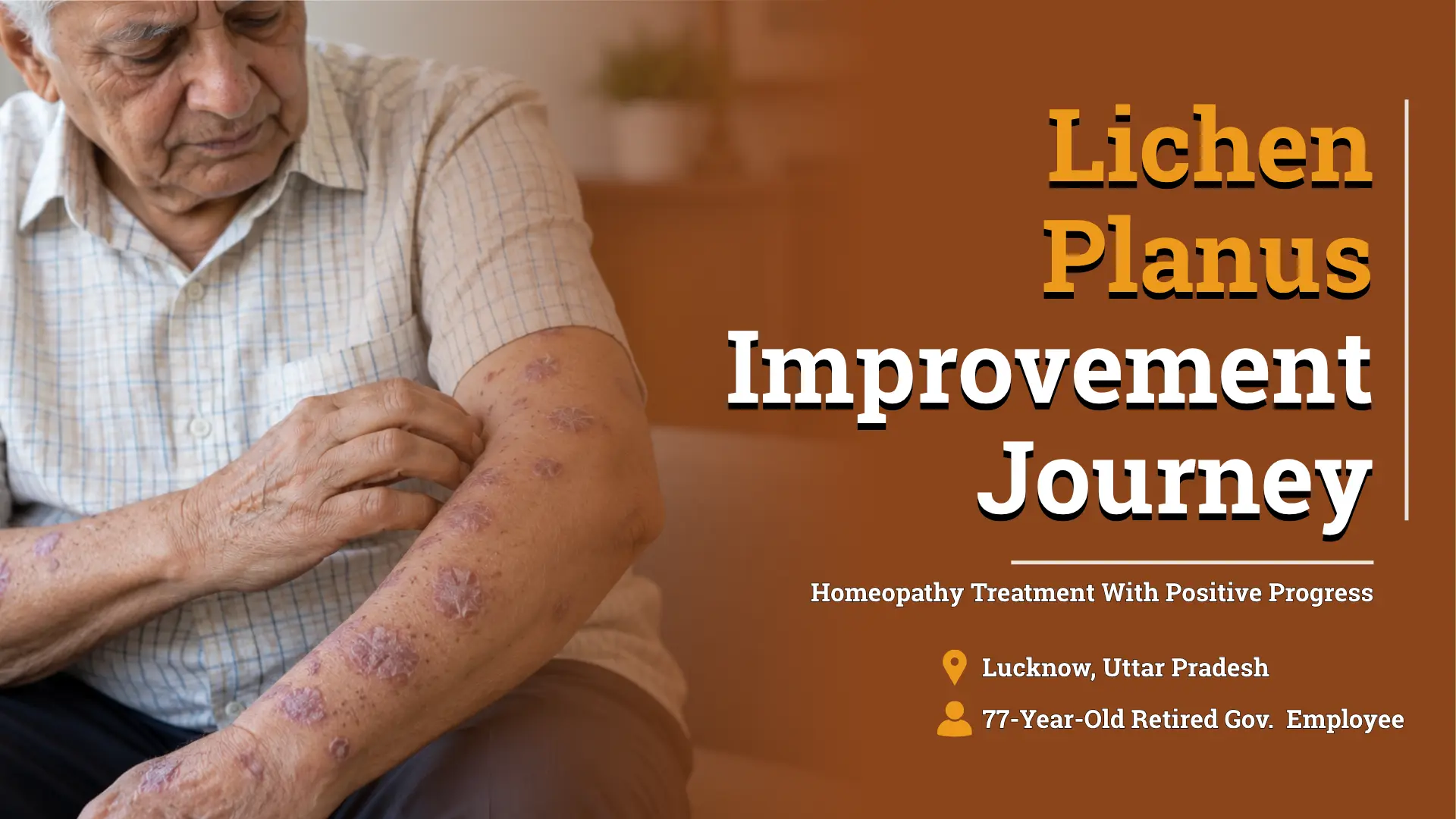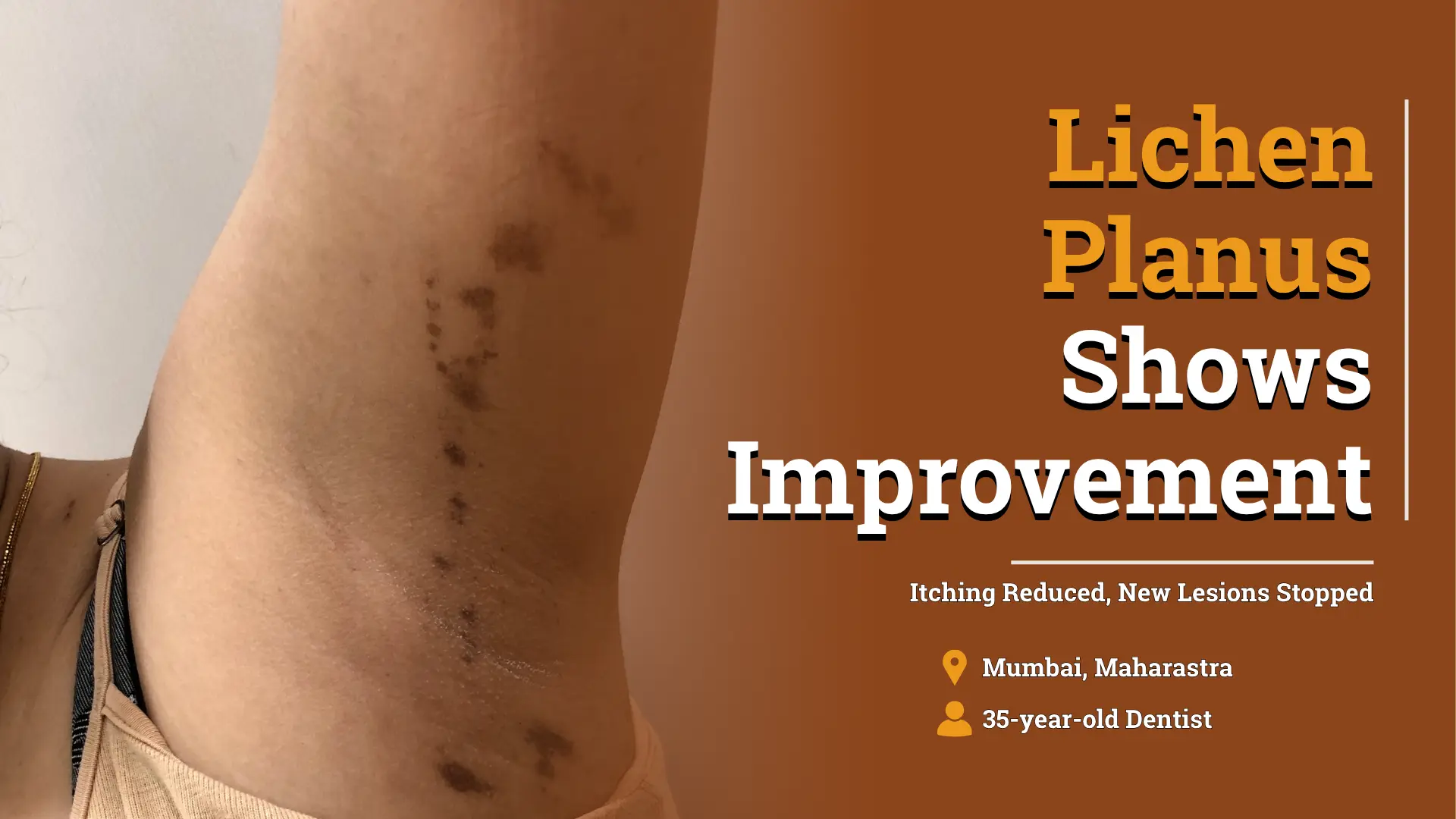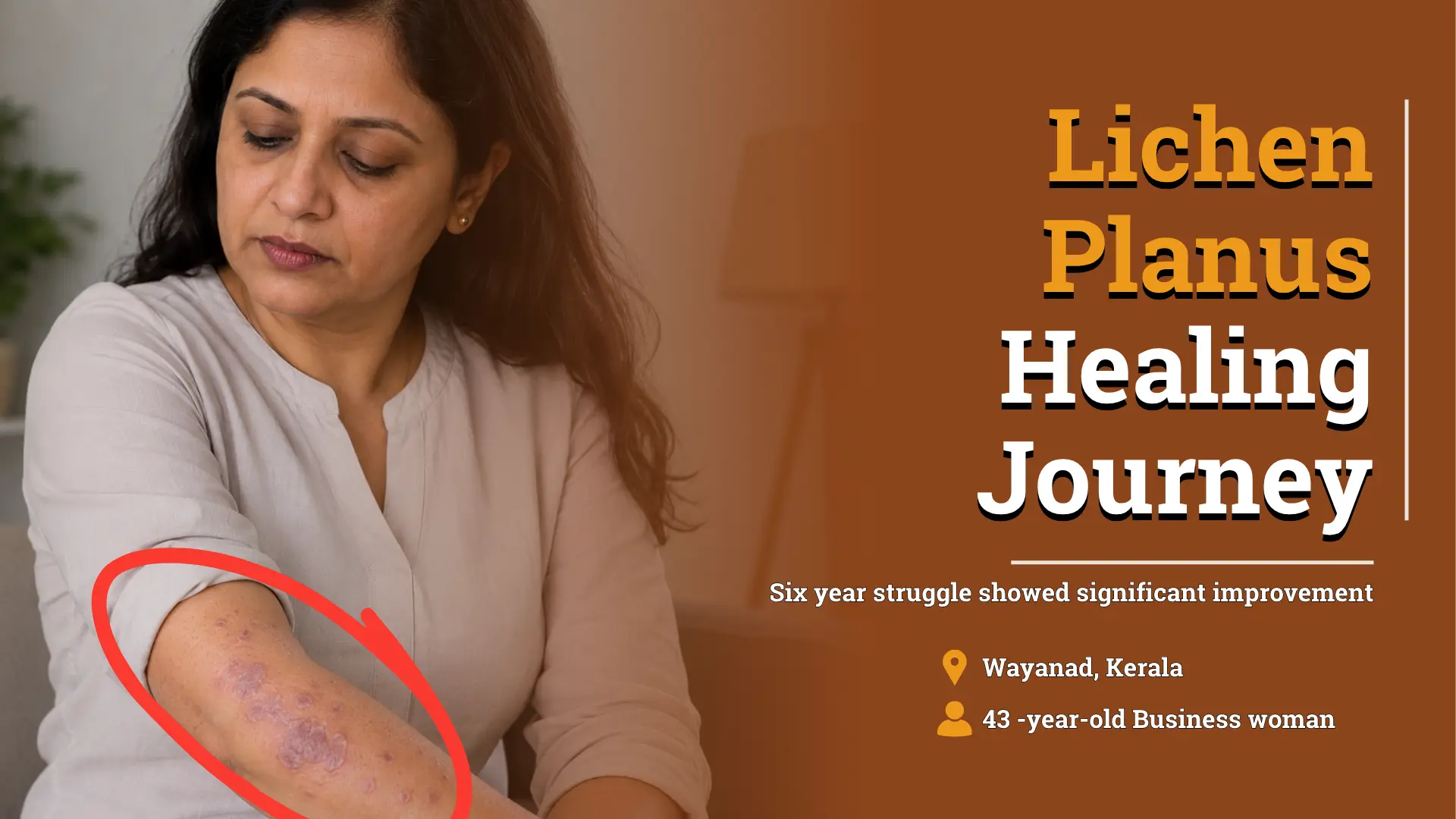


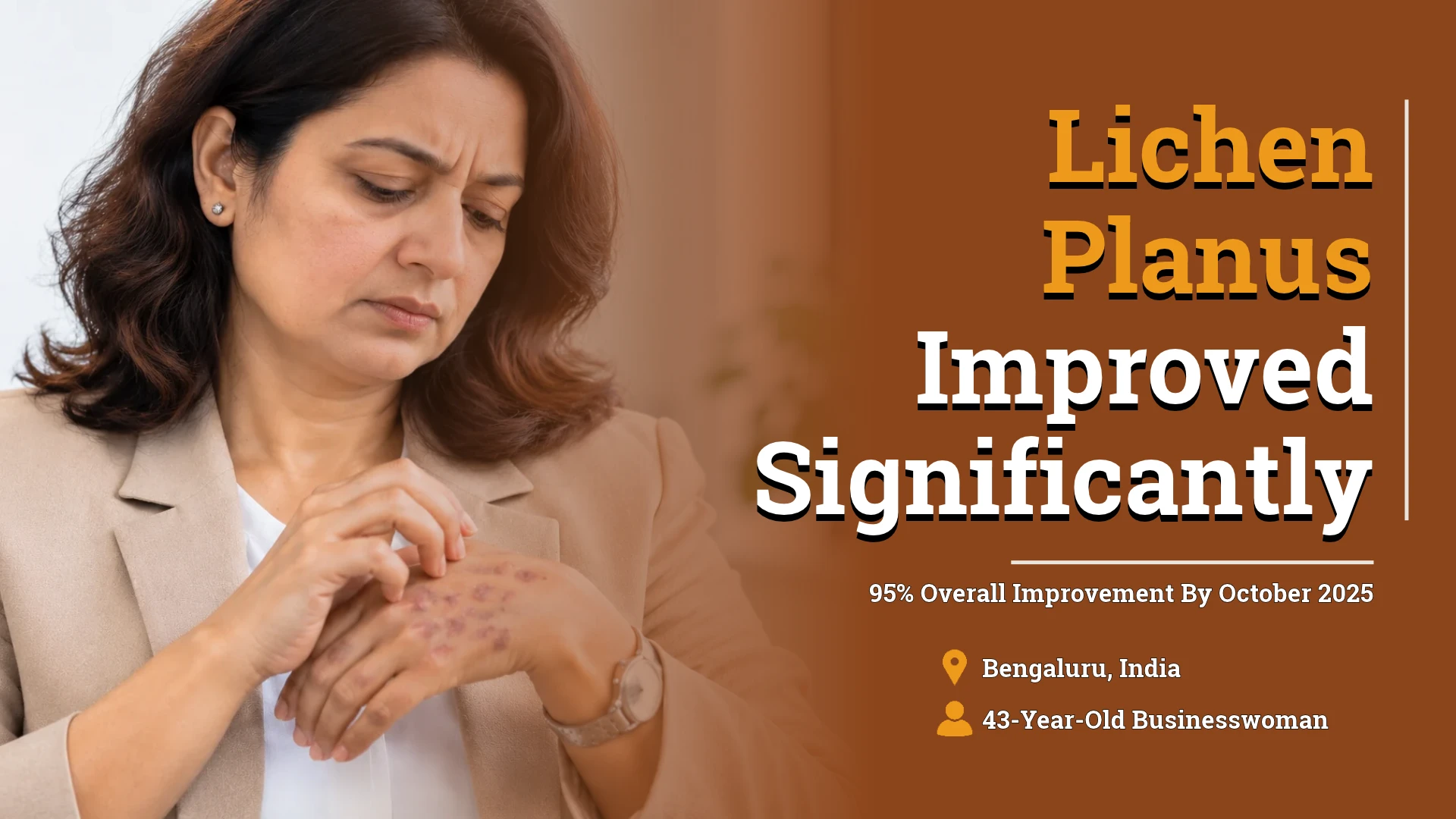
A 43-year-old woman from Bangalore with a six-year history of lichen planus affecting both hands and legs reported persistent itching, burning, and dryness aggravated by sun and dust. Following individualized homeopathic care, lesion spread gradually stabilized and most lesions healed during more than three years of follow-up. By October 2025, approximately 95% overall improvement was documented, with around 90% reduction in itching and dryness and residual post-inflammatory hyperpigmentation.
Table of Contents
- 01. Hero Introduction
- 02. Patient Case Details
- 03. About Lichen Planus
- 04. Lichen Planus Symptoms
- 05. Possible Aggravating Factors
- 06. Presenting Complaints
- 07. Why She Sought Homeopathic Care
- 08. Case Analysis and Treatment Approach
- 09. Follow-Up and Progress
- 10. Changes During Treatment
- 11. Skin Lesions
- 12. Itching and Dryness
- 13. Residual Pigmentation
- 14. Outcome
- 15. Key Learnings From This Case
- 16. Understanding Other Forms of Lichen Planus
- 17. Treatment Perspective
- 18. Homeopathy for Lichen Planus
- 19. Lichen Planus Treatment in Homeopathy
- 20. Doctor's Insight
- 21. Conclusion
Hero Introduction
Mrs. M.V., a 43-year-old businesswoman from Bangalore, had been living with lichen planus for six years before consulting Life Force Homeopathy on 9 June 2022. She had purplish-brown lesions over both hands and legs, with persistent itching and burning that worsened with sun exposure and dust. She also had concurrent melasma on her cheeks.
She had previously used steroids, which were discontinued one week before her first consultation. She subsequently began lichen planus treatment at Life Force Homeopathy, with regular follow-ups to monitor changes in her skin lesions, itching, dryness, and overall condition.
Over more than three years of documented follow-up, approximately 95% overall improvement was recorded, with around 90% reduction in itching and dryness by October 2025.
Patient Case Details
| Parameter | Details |
|---|---|
| Patient | Mrs. M.V. |
| Patient ID | 47415 |
| Age | 43 years |
| Gender | Female |
| Profession | Businesswoman |
| Location | Bangalore |
| First Consultation | 9 June 2022 |
| Condition | Lichen Planus affecting hands and legs with concurrent melasma |
| Duration | 6 years |
| Prior Treatment | Steroids, discontinued one week before first consultation |
| Family History | Family members also under treatment at Life Force Homeopathy |
About Lichen Planus
Lichen planus is a chronic inflammatory condition that can affect the skin and mucous membranes. It may appear as flat, purple or purplish-brown lesions and can be associated with itching and burning.
In this case, the documented lesions affected both hands and legs, while melasma was present on the cheeks.
Lichen Planus Symptoms
The patient's lichen planus symptoms included:
- Purplish-brown skin lesions
- Persistent itching
- Burning sensation
- Dryness
- Worsening with sun exposure
- Aggravation after dust exposure
- Concurrent melasma on the cheeks
Possible Aggravating Factors
The case records sun exposure and dust as aggravating factors. The source also mentions emotional and physical stress, certain medications, and skin injury or friction among factors associated with worsening complaints.
These factors were considered as part of the patient's overall clinical assessment.
Presenting Complaints
At her first consultation, Mrs. M.V. presented with:
- Purplish-brown lesions on both hands and legs
- Persistent itching and burning
- Dryness
- Aggravation after sun exposure
- Aggravation after dust exposure
- Melasma on the cheeks
- Six-year history of the condition
- Previous steroid use, discontinued one week before consultation
The documented lichen planus on skin was primarily seen over the hands and legs.
Why She Sought Homeopathic Care
After living with the condition for several years and using steroids, Mrs. M.V. wanted another approach to managing her recurring skin complaints.
Her family members were already receiving treatment at Life Force Homeopathy, which influenced her decision to seek consultation there.
She subsequently began homeopathic treatment for lichen planus with regular follow-up.
Case Analysis and Treatment Approach
Detailed Case Assessment
Dr. Rajesh Shah conducted a detailed evaluation covering the patient's physical complaints, emotional state, lifestyle, triggers, and family history.
The treatment plan was based on her individual symptom pattern rather than the diagnosis alone.
Individualized Treatment
The patient received individualized homeopathic care along with dietary and self-care guidance. Sun and dust exposure were considered among the factors relevant to her symptoms.
Regular consultations were used to assess changes and revise the treatment when required.
For patients exploring lichen planus homeopathic treatment, this case demonstrates how the treatment plan was reviewed according to the patient's changing clinical picture.
Centralized Homeopathic Medicines
Life Force Homeopathy prepares its own homeopathic medicines at a centralized facility. These medicines are then dispatched to other Life Force Homeopathy clinics for patient use.
Follow-Up and Progress
April 2022 | First Follow-Up
The source records approximately 10% overall improvement. The eruptions showed positive changes, itching had reduced, and the distribution of lesions had started to improve.
December 2022 | Second Follow-Up
Improvement was recorded at approximately 40% compared with the previous visit. A few new lesions appeared outside the face and scalp. Dryness and itching continued, and the treatment was revised according to the updated case picture.
May 2023 | Third Follow-Up
The spread of the lesions had nearly stabilized. This represented a change from the earlier stage when new lesions were still appearing.
25 October 2024 | Follow-Up
The patient's complaints had reduced by approximately 50% and remained largely stable. A few small active lesions were still present on the right leg, while further spread was reported to have been contained.
5 October 2025 | Latest Follow-Up
After more than three years of treatment, approximately 95% of the complaints had improved. Most lesions had healed, while dryness and itching had reduced by approximately 90%. Post-inflammatory hyperpigmentation remained at previously affected areas.
Changes During Treatment
Skin Lesions
The case progressed from active lesions on the hands and legs to a stage where most lesions had healed. The spread had nearly stabilized by May 2023, and only a few small active lesions remained on the right leg in October 2024.
Itching and Dryness
Itching and dryness were prominent complaints at the beginning. Both reduced during follow-up, with approximately 90% improvement documented by October 2025.
Residual Pigmentation
Post-inflammatory hyperpigmentation remained after most of the lesions had healed. This was documented separately from the active skin complaints.
Outcome
By October 2025, the case documented:
- Approximately 95% overall improvement
- Healing of most lesions
- Approximately 90% reduction in itching and dryness
- Stabilization of lesion spread
- Residual post-inflammatory hyperpigmentation
- More than three years of documented follow-up
Key Learnings From This Case
- The patient had a six-year history of lichen planus before consultation.
- The documented skin involvement was primarily over the hands and legs.
- Sun and dust were reported aggravating factors.
- New lesions initially continued to appear before the spread stabilized.
- Treatment was reviewed and revised during follow-ups.
- Most lesions had healed by October 2025.
- Itching and dryness had reduced substantially.
- Approximately 95% overall improvement was documented at the latest follow-up.
Understanding Other Forms of Lichen Planus
Lichen planus can present in different areas and patterns. However, not every form was documented in this patient's case.
Lichen Planus Mouth: The supplied case does not document lesions inside the mouth, so oral involvement cannot be attributed to this patient.
Genital Lichen Planus: Genital involvement was not reported in the case.
Lichen Planus Face: The case mentions lesions outside the face during one follow-up but does not establish active facial lichen planus. The melasma on the cheeks was documented separately.
Linear Lichen Planus: A linear pattern was not documented in this patient.
Lichen Planus Scalp: The December 2022 follow-up mentions lesions outside the face and scalp but does not provide sufficient detail to establish scalp involvement.
Lichen Planus Legs: Both legs were specifically documented as affected areas in this case.
Lichen Planus Types: The supplied case does not classify the patient's condition into a specific clinical subtype.
Treatment Perspective
Homeopathy for Lichen Planus
The patient's care involved individualized homeopathic treatment, dietary guidance, self-care advice, and regular follow-up. The treatment was revised according to changes observed during the follow-up period.
For patients researching homeopathy for lichen planus, this case provides an example of one patient's treatment journey rather than a fixed approach for every patient.
Lichen Planus Treatment in Homeopathy
The case involved assessment of the patient's physical symptoms, lifestyle, triggers, emotional state, and family history before and during treatment.
The term lichen planus treatment in homeopathy therefore refers to the individualized approach documented in this case, including ongoing assessment and treatment revision.
Doctor's Insight
The case involved assessment beyond the visible skin lesions. Dr. Rajesh Shah's evaluation considered the patient's physical symptoms, emotional state, lifestyle, triggers, and family history.
Her treatment was reviewed as the clinical picture changed, with revisions made during follow-up when required.
The progression documented in this case shows that active lesions, itching, dryness, and residual pigmentation did not necessarily change at the same rate.
Conclusion
Mrs. M.V. had a six-year history of lichen planus affecting both hands and legs, with persistent itching, burning, and dryness. During more than three years of documented follow-up, lesion spread stabilized and most lesions healed, while itching and dryness reduced substantially. By October 2025, approximately 95% overall improvement was recorded, with residual post-inflammatory hyperpigmentation remaining.