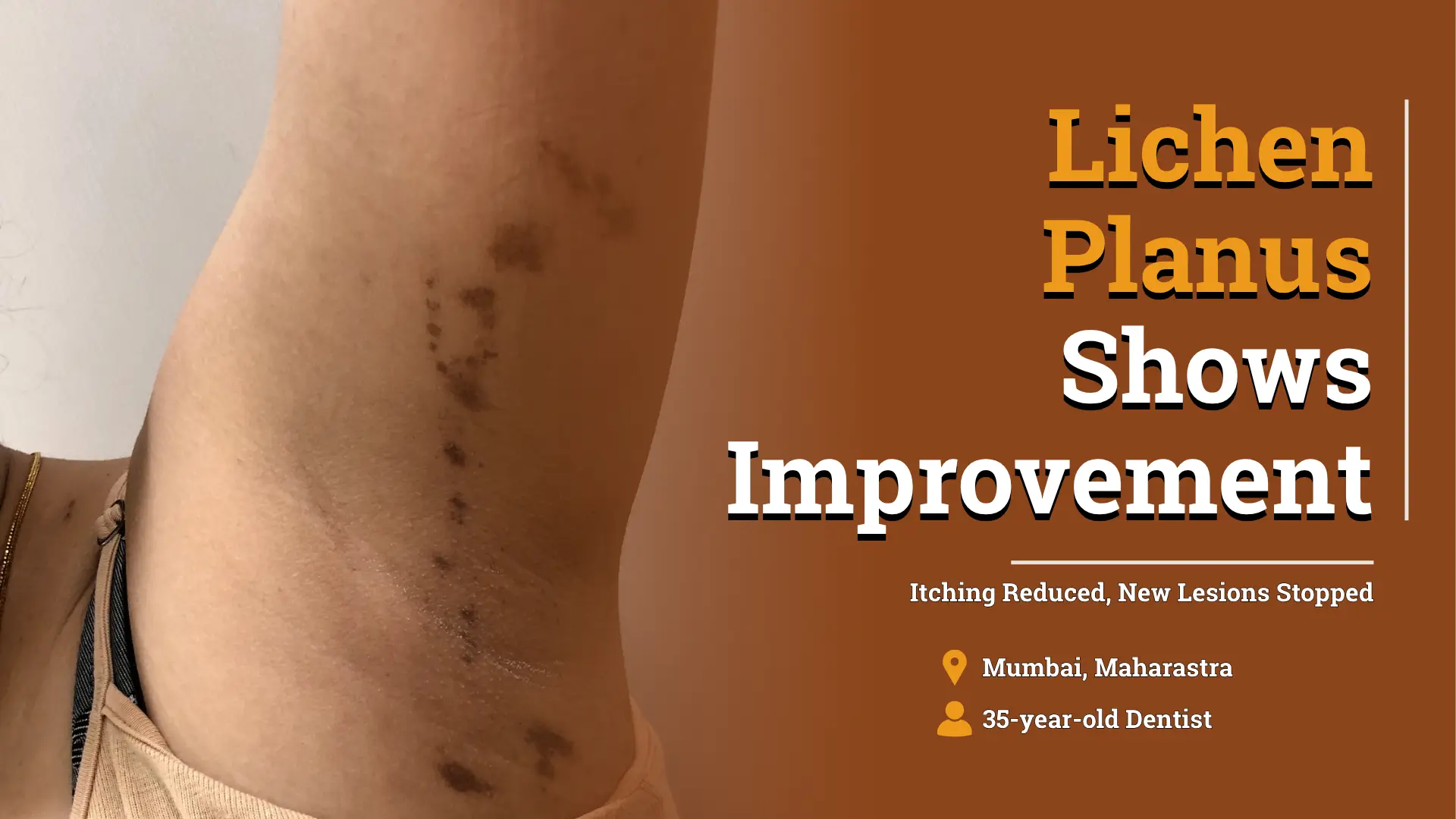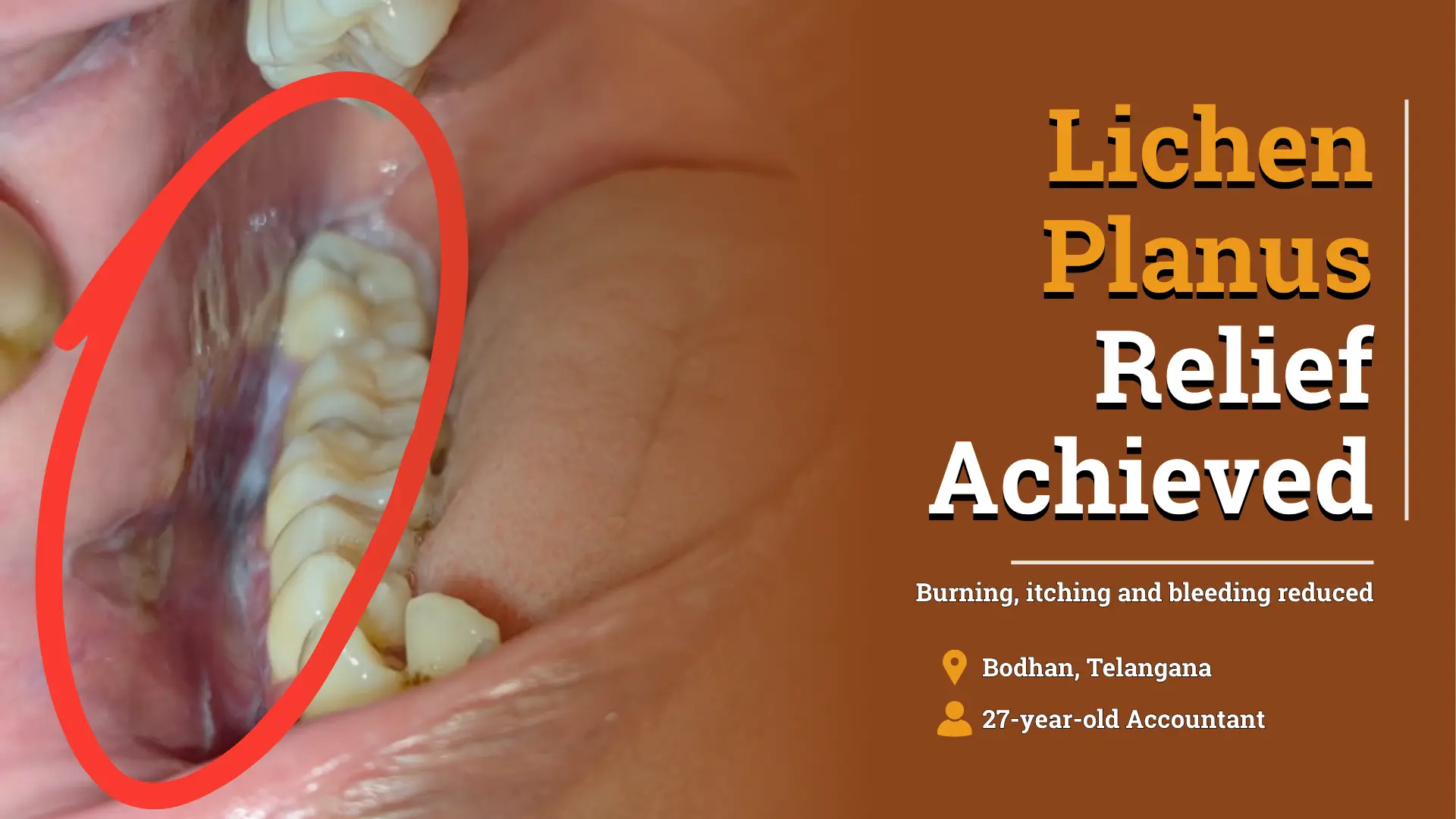


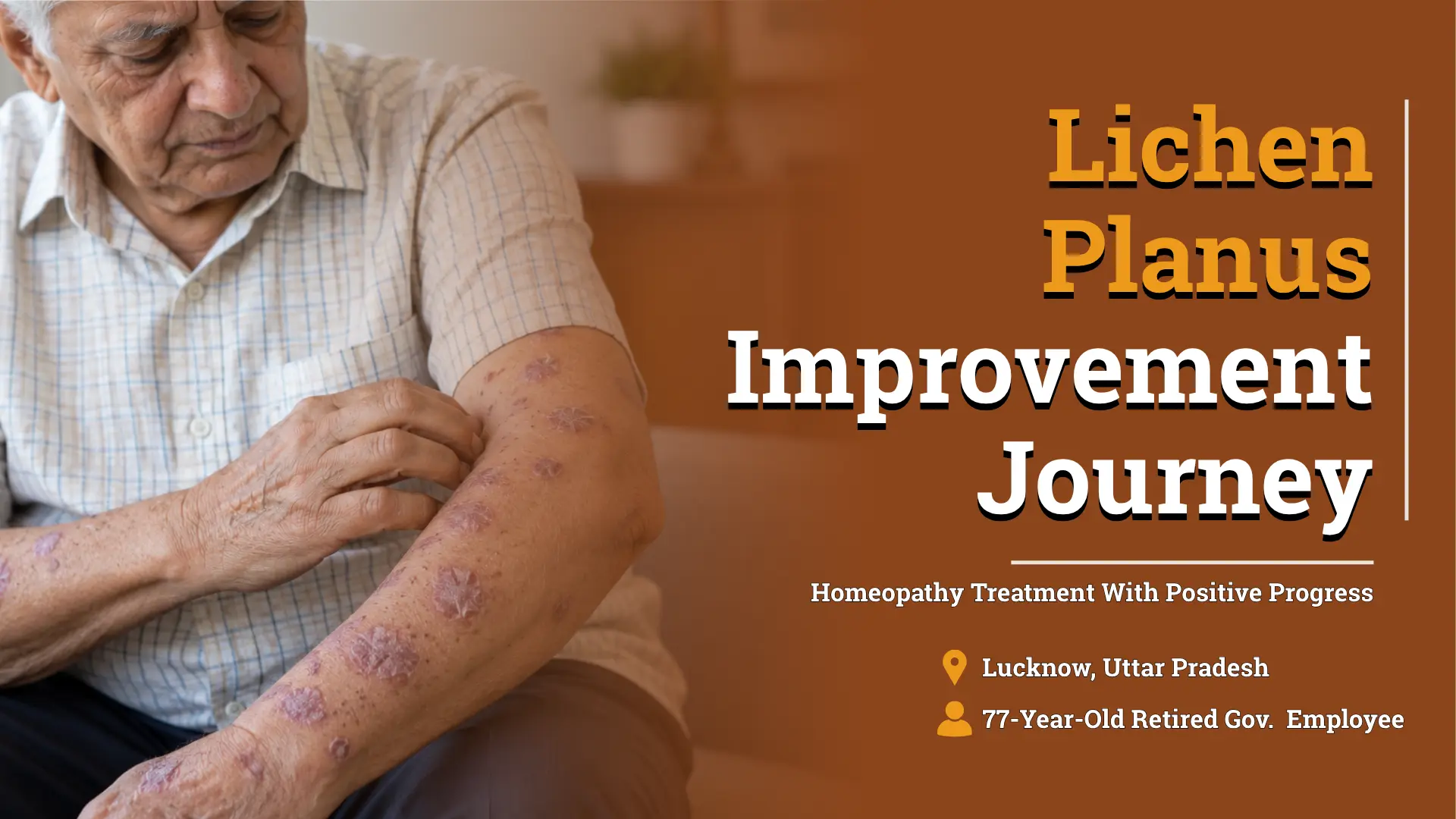
This case study describes a 77-year-old man with lichen planus who experienced purplish raised eruptions, intense itching, and pigmentation for around five months. After beginning individualized homeopathic treatment, his symptoms were monitored through regular follow-ups. By March 2026, approximately 80% overall improvement was documented, with no new eruptions and minimal residual pigmentation.
Table of Contents
- 01. Hero Introduction
- 02. Patient Case Details
- 03. Ready to Know Your Recovery Chances?
- 04. What Brought Him to Consultation?
- 05. What Is Lichen Planus and How Can It Affect the Body?
- 06. The Person Behind the Skin Complaints
- 07. How the Treatment Direction Evolved
- 08. Dr. Rajesh Shah’s Clinical Perspective
- 09. What Happened During Follow-Up?
- 10. From Recurring Lesions to Greater Stability
- 11. Key Takeaways From This Case
- 12. Conclusion
- 13. Ready to Know Your Recovery Chances?
Hero Introduction
For a 77-year-old retired man from Lucknow, persistent itching had become an uncomfortable part of everyday life. What began as purplish, raised lesions on his hands and legs continued to recur despite a three-week course of topical steroids, which provided only temporary relief.
Lichen planus is often described in everyday language as खुजली वाले बैंगनी दाने, meaning itchy purple patches or bumps. The condition can affect the lichen planus on skin, and in some people may also involve the mouth, scalp, nails, or genital area.
The patient had been looking for lichen planus treatment for around five months before he visited Life Force Homeopathy's Jayanagar branch on 2 January 2025. His itching was particularly intense in the morning, and the lesions left dark marks as they settled. Over the following months, the condition fluctuated before gradually improving. By March 2026, approximately 80% overall improvement was documented.
Patient Case Details
| Parameter | Details |
| Patient ID | 56556 |
| Age | 77 years |
| Gender | Male |
| Occupation | Retired Government Employee |
| Location | Lucknow, Uttar Pradesh |
| Condition | Lichen Planus |
| Duration Before Consultation | 5 months |
| First Consultation | 2 January 2025 |
| Branch | Jayanagar, Bengaluru |
| Previous Treatment | Topical steroids for 3 weeks |
| Treating Physician | Dr. Rajesh Shah |
Ready to Know Your Recovery Chances?
Discover your recovery chances from chronic diseases in percentage with Life Force Homeopathy's FREE Assessment Test. Get a personalized evaluation from our experienced doctors.
Start Your FREE Assessment Test →What Brought Him to Consultation?
At his first visit, the patient had purplish, raised eruptions on both hands and legs. The lichen planus symptoms were dominated by intense itching, particularly in the morning after waking.
As some lesions healed, they left behind noticeable dark marks. He had already tried topical steroids for three weeks, but the relief was temporary and the complaints returned.
The pattern prompted him to seek a more detailed assessment of his recurring skin symptoms.
What Is Lichen Planus and How Can It Affect the Body?
Lichen planus is an inflammatory condition that can affect the skin and mucous membranes. On the skin, it may appear as itchy, purplish or reddish, flat-topped or raised lesions that can leave pigmentation after they settle.
There are several lichen planus types, depending on how and where the condition appears. These may include cutaneous lichen planus, oral lichen planus, linear lichen planus, and forms affecting areas such as the scalp or genital region. Lichen planus mouth involvement, for example, can cause white, lacy patches or soreness inside the mouth, while lichen planus scalp may require particular attention because of its potential effect on hair follicles.
The lichen planus causes are not always clear. Certain medicines, stress, infections, and immune-related factors may be associated with its development or aggravation in some individuals.
Because several skin conditions can look similar, including psoriasis, a proper diagnosis is important. The appearance and distribution of lesions can help doctors distinguish lichen planus vs psoriasis and other inflammatory skin disorders.
The Person Behind the Skin Complaints
The consultation explored the patient's general health and personal characteristics alongside his skin symptoms.
He followed a non-vegetarian diet, had an average appetite, and particularly enjoyed spicy food and sweets. He drank around two litres of water daily, had satisfactory bowel movements, and reported no urinary complaints. He slept well, preferred lying on his side or back, and was sensitive to cold weather.
His personal history provided another dimension to the case. He described his childhood and marital life as happy and supportive. After retirement, however, he increasingly felt that life had become monotonous and that he had lost interest in activities he previously enjoyed.
He considered himself strict about his principles, methodical, irritable, and short-tempered. At the same time, he described himself as helpful and reported significant fear and anxiety related to disease.
These characteristics were considered along with his physical symptoms while reviewing the case.
How the Treatment Direction Evolved
After taking a detailed case history, Dr. Rajesh Shah considered the nature of the eruptions, itching pattern, general health, personal characteristics, and overall presentation before selecting the prescription.
A diet chart was also provided as part of the management plan. During follow-ups, the medicines were reviewed according to changes in the skin lesions, itching, dryness, and appearance of fresh eruptions.
The purpose of monitoring was broader than simply checking whether the itching had reduced. The team also observed whether new lesions were appearing, whether existing eruptions were becoming flatter, and how the pigmentation left behind by earlier lesions was changing.
This formed the basis of the patient's lichen planus homeopathic treatment journey.
Dr. Rajesh Shah’s Clinical Perspective
Lichen planus can be frustrating when lesions continue to appear or return after temporary relief. Dr. Rajesh Shah explains his clinical perspective on the condition and the importance of understanding the patient's overall symptom pattern rather than looking only at the visible skin lesions.
“Lichen planus is often more than a skin-deep condition. It tends to reflect an underlying immune imbalance and, in many patients, an emotional or constitutional undercurrent as well. In this gentleman's case, his rigid, principle-driven temperament and his post-retirement sense of boredom and lost purpose were as much a part of the case as the eruptions themselves. Treating the person as a whole, rather than merely suppressing the skin lesions, is what allowed us to see this level of sustained improvement.”
Dr. Rajesh Shah, MD (Hom.) Founder and Chief Physician, Life Force Homeopathy
What Happened During Follow-Up?
| Date | Clinical Observation |
| 2 January 2025 – First Visit | Purplish, raised eruptions were present on both hands and legs with intense itching, particularly in the morning after waking. Healed lesions had left dark marks. He had previously used topical steroids for three weeks with only temporary relief. |
| 1 March 2025 – 1st Follow-Up | Hand eruptions remained stable, with some flattening observed. Fresh active lesions continued to appear on the legs, more prominently on the right leg. Existing eruptions were becoming darker, while itching, particularly on the legs, remained the main concern. |
| 21 May 2025 – 2nd Follow-Up | New eruptions continued to appear above the knees, on the lower legs, and around the elbows. Itching persisted throughout the day and was accompanied by marked skin dryness. The medicines were revised accordingly. |
| 24 July 2025 | A slight reduction in itching was observed. Fresh lesions were still appearing above the knees and on the right calf, but they were less intense. No fresh eruptions were reported on the hands. |
| Subsequent Follow-Ups | The patient showed steady improvement over successive consultations. Fresh eruptions became progressively less frequent, while itching continued to reduce. |
| 8 March 2026 – Latest Follow-Up | Approximately 80% overall improvement was documented. No new eruptions were reported, minimal residual pigmentation remained at previously affected sites, and the patient reported an overall improvement in well-being. |
From Recurring Lesions to Greater Stability
The improvement did not happen immediately. During the initial months, new eruptions continued to appear on the legs, above the knees, and around the elbows, while itching and dryness remained troublesome.
The pattern gradually changed during later follow-ups. Fresh lesions became less frequent, the itching reduced, and previously affected areas became more stable. By March 2026, no new eruptions were reported, with only minimal residual pigmentation remaining.
Approximately 80% overall improvement was documented at the latest follow-up. This represents the experience of this individual patient and should not be considered a predictable outcome for every person undergoing homeopathy for lichen planus.
Living with Lichen Planus?
Receive a personalized treatment plan from our experienced homeopathic doctors. Trusted by over 100,000+ patients across 180+ countries for safe, natural and long term management of chronic diseases.
Key Takeaways From This Case
A few important observations emerged from this patient's journey:
- The condition showed periods of activity before becoming more stable.
- New eruptions and itching were monitored at each follow-up.
- Temporary relief from topical steroids did not prevent the complaints from returning.
- The patient's general health and personal characteristics formed part of the overall case assessment.
- Regular follow-up helped track changes in lesions, itching, dryness, and pigmentation.
- The documented improvement developed gradually over more than a year.
Conclusion
This case describes a 77-year-old retired government employee who had been experiencing lichen planus for approximately five months before his first consultation.
His initial complaints included purplish raised eruptions on the hands and legs, intense morning itching, and dark pigmentation after the lesions settled. During the early months, new eruptions continued to appear, particularly on the legs and elbows. With continued follow-up, however, the frequency of fresh lesions and intensity of itching gradually reduced.
By 8 March 2026, approximately 80% overall improvement was documented, with no new eruptions and minimal residual pigmentation.
Ready to Know Your Recovery Chances?
Discover your recovery chances from chronic diseases in percentage with Life Force Homeopathy's FREE Assessment Test. Get a personalized evaluation from our experienced doctors.
Start Your FREE Assessment Test →