

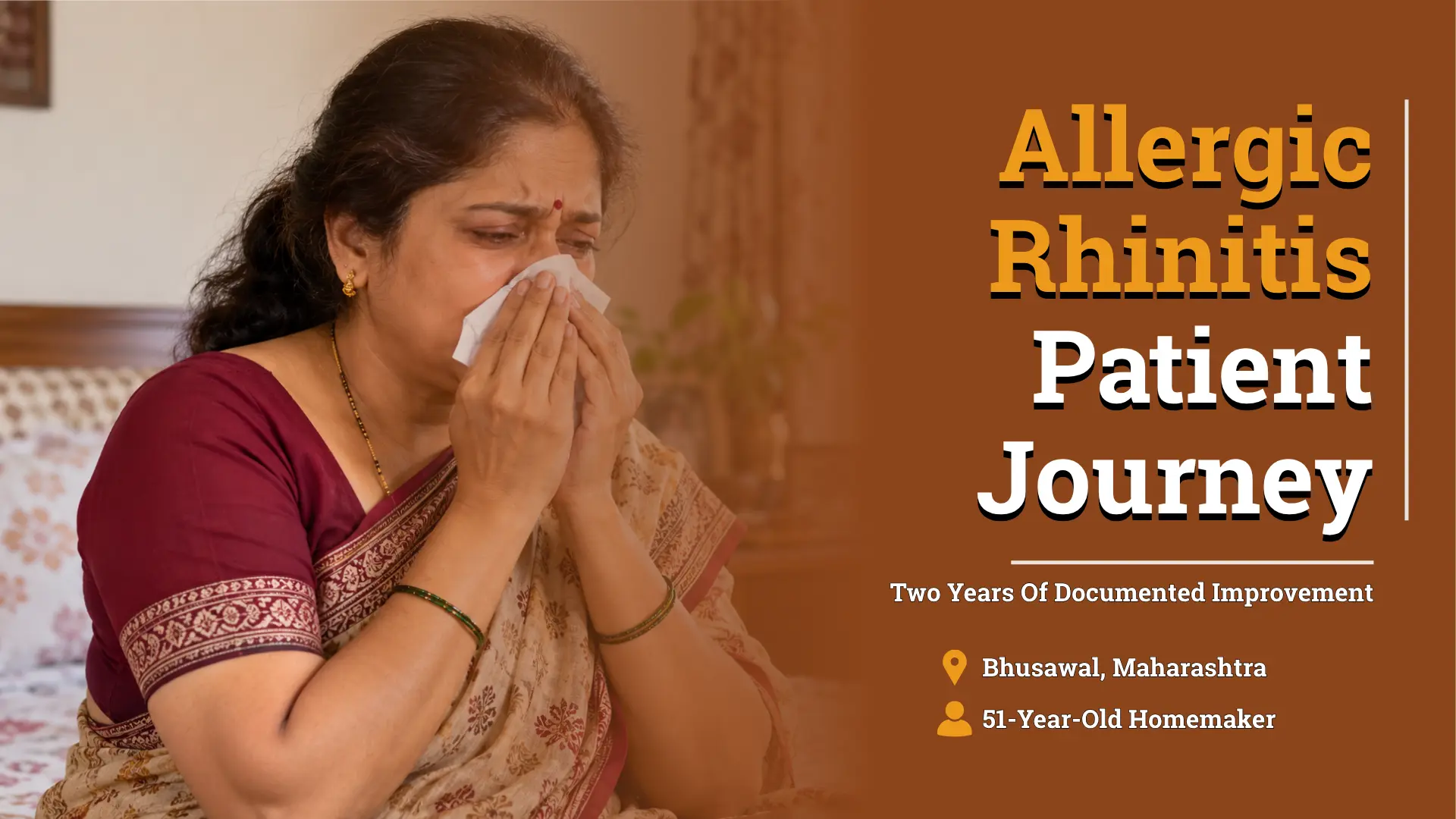
A 51-year-old homemaker from Bhusawal with a two-year history of chronic allergic rhinitis experienced frequent sneezing, watery nasal discharge, nasal blockage, and eye watering. After beginning treatment in March 2023, the frequency and severity of her episodes gradually reduced over two years. By February 2025, she reported being symptom-free for two months without conventional medicines, with approximately 90–95% overall clinical improvement documented.
Table of Contents
- 01. Introduction
- 02. Patient Details
- 03. What Symptoms of Allergic Rhinitis (Hay Fever) Did She Experience?
- 04. Understanding Allergic Rhinitis and Its Common Triggers
- 05. What Are the Risk Factors for Allergic Rhinitis (Hay Fever)?
- 06. Looking Beyond Her Nasal Symptoms
- 07. Ready to Know Your Recovery Chances?
- 08. How Was Her Homeopathy Treatment Planned?
- 09. Her Follow-Up Journey: March 2023 to February 2025
- 10. How Did Her Allergic Rhinitis Symptoms Change Over Time?
- 11. Seasonal Allergies and Environmental Triggers
- 12. Outcome: Approximately 90–95% Overall Clinical Improvement
- 13. Key Learnings From This Case
- 14. Dr. Rajesh Shah's Clinical Perspective
- 15. Conclusion
Introduction
For Mrs. S.N.P., a 51-year-old homemaker from Bhusawal, Maharashtra, mornings had become difficult due to recurring allergic rhinitis. For nearly two years, she experienced frequent sneezing, watery nasal discharge, and nasal stuffiness (congestion), particularly between 5 AM and 7 AM. Her symptoms had become more troublesome during the five months before consultation.
Seeking another approach to allergic rhinitis (hay fever) treatment, she visited Life Force Homeopathy's Chembur clinic in March 2023. Under Dr. Rajesh Shah's care, she received individualized homeopathy treatment with regular follow-ups. By February 2025, her clinical records documented approximately 90–95% overall improvement, with no allergic episodes reported during the preceding two months.
Patient Details
| Parameter | Details |
| Patient | Mrs. S.N.P. |
| Patient ID | 50981 |
| Age | 51 years |
| Gender | Female |
| Occupation | Homemaker |
| Location | Bhusawal, Maharashtra |
| Consultation | Life Force Homeopathy, Chembur |
| First Consultation | March 2023 |
| Condition | Chronic Allergic Rhinitis |
| Duration | Approximately 2 years |
| Treating Physician | Dr. Rajesh Shah |
What Symptoms of Allergic Rhinitis (Hay Fever) Did She Experience?
At her first consultation, Mrs. S.N.P. reported recurring symptoms of allergic rhinitis (hay fever) that significantly affected her mornings.
Her complaints included:
- Repeated sneezing, especially between 5 AM and 7 AM
- Profuse watery nasal discharge
- Nasal stuffiness (congestion) and difficulty breathing through the nose
- Burning and watering of the eyes
- Throat dryness caused by mouth breathing
- Body aches and feverish sensations
- Persistent tiredness and reduced energy
Each episode generally lasted 15–20 minutes and could occur twice daily.
Dust exposure, weather changes, travelling, and swimming were among the factors she identified as aggravating her symptoms.
Although conventional medication provided temporary relief, the recurring complaints continued to interfere with her routine.
Understanding Allergic Rhinitis and Its Common Triggers
Allergic rhinitis, commonly called hay fever, occurs when the immune system reacts to environmental allergens such as pollen, house dust mites, mould, and animal dander.
The condition can cause repeated sneezing, a runny or blocked nose, itching, and watery eyes. Symptoms can be seasonal or persistent throughout the year.
In this patient's case, early morning sneezing and nasal discharge were particularly troublesome.
What Are the Risk Factors for Allergic Rhinitis (Hay Fever)?
Common risk factors for allergic rhinitis (hay fever) include a family history of allergies, asthma, eczema, and exposure to environmental allergens.
Mrs. S.N.P.'s mother had a history of bronchial asthma. The patient also reported that grain dust and weather changes aggravated her nasal complaints.
These details were considered during her clinical assessment.
Looking Beyond Her Nasal Symptoms
During the consultation, Dr. Rajesh Shah reviewed her physical complaints, general health, dietary preferences, family history, and personal characteristics.
The homeopathic case record described her as a thermally hot patient who followed an eggetarian diet.
Her appetite was average, with a preference for salty, spicy, tangy, and sweet foods. She disliked bitter gourd, had moderate thirst, experienced increased perspiration, and generally slept well.
She lived with her husband and son in a supportive family environment and described her childhood as happy and secure.
Her family history included hypertension in her father, along with diabetes mellitus and bronchial asthma in her mother.
This information formed part of her individualized homeopathic case assessment.
Ready to Know Your Recovery Chances?
Discover your recovery chances from chronic diseases in percentage with Life Force Homeopathy's FREE Assessment Test. Get a personalized evaluation from our experienced doctors.
Start Your FREE Assessment Test →How Was Her Homeopathy Treatment Planned?
After reviewing the patient's symptoms, aggravating factors, general health, and individual characteristics, Dr. Rajesh Shah selected a constitutional homeopathic prescription.
Tuberculinum was prescribed based on her overall symptom picture.
Her individualized homeopathy treatment plan included regular follow-ups to monitor:
- Frequency and severity of sneezing episodes
- Watery nasal discharge and nasal blockage
- Eye watering and irritation
- Environmental triggers and recurring symptoms
- Changes in general well-being
- Use of conventional medicines
The consultation followed an individualized homeopathic approach in addition to reviewing her general clinical history.
Homeopathy has not been reliably established as an effective treatment for allergic rhinitis in high-quality clinical studies. Patients should continue medically indicated allergy care and seek appropriate evaluation for persistent or severe symptoms.
Her Follow-Up Journey: March 2023 to February 2025
March 2023 | Beginning of Treatment
At presentation, Mrs. S.N.P. was experiencing frequent sneezing, watery nasal discharge, nasal blockage, watering of the eyes, throat irritation, feverish sensations, and regular antihistamine use.
Her serum IgE was 139 IU/ml. Treatment was initiated following the detailed case evaluation.
May 2023 | Early Improvement
She remained better for the initial six weeks.
A temporary aggravation occurred after exposure to grain dust, although the symptoms were less intense than before.
July 2023 | Noticeable Progress
The frequency and severity of episodes reduced significantly.
She experienced only one to two mild episodes over the previous six weeks, compared with the frequent episodes reported before treatment.
September 2023 | Temporary Illness Phase
She developed an episode of bronchitis with cough and expectoration that continued for approximately three weeks.
Despite this respiratory illness, her allergic rhinitis remained controlled.
November 2023 | Mild Fluctuation
Five to six moderate episodes occurred during this period.
Although symptoms temporarily returned, their overall severity remained lower than before treatment.
January 2024 | Regaining Stability
A severe episode following a weather change required hospitalization.
She recovered well afterward, and her dependence on conventional medicines had reduced.
March 2024 | Significant Relief
No allergy episodes were reported for nearly two months.
Sneezing, watery nasal discharge, nasal blockage, and eye watering were absent during this period.
May 2024 | Stable Phase
She remained symptom-free and reported improved comfort while carrying out her daily activities.
July 2024 | Minimal Symptoms
Only one mild episode of sneezing and coryza was reported.
The episode lasted for approximately one day.
October 2024 | Sustained Improvement
No major allergic episodes occurred.
Only occasional early morning nasal discharge persisted.
December 2024 | Near-Complete Symptom Control
She remained stable, with only occasional mild throat irritation during weather changes.
February 2025 | Final Follow-Up
At the final follow-up, Mrs. S.N.P. reported being symptom-free for the previous two months.
She was no longer using conventional medicines and was comfortably carrying out her day-to-day activities. Treatment was completed with sustained improvement documented during the follow-up period.
How Did Her Allergic Rhinitis Symptoms Change Over Time?
The patient's symptom improvement developed gradually, with occasional fluctuations throughout the follow-up period.
| Follow-Up | Reported Progress |
| March 2023 | Frequent morning sneezing, watery discharge, and nasal congestion |
| May 2023 | Early improvement, with temporary dust-triggered symptoms |
| July 2023 | One to two mild episodes over six weeks |
| November 2023 | Five to six moderate episodes |
| January 2024 | Severe episode requiring hospitalization |
| March 2024 | Nearly two months without allergic episodes |
| July 2024 | One mild episode lasting approximately one day |
| October 2024 | No major episodes, occasional morning discharge |
| February 2025 | Two symptom-free months reported at final follow-up |
The timeline demonstrates how symptom frequency, severity, and day-to-day functioning changed during regular clinical monitoring.
Seasonal Allergies and Environmental Triggers
Some patients experience allergic rhinitis symptoms during particular seasons, while others develop complaints after exposure to environmental allergens throughout the year.
In Mrs. S.N.P.'s case, weather changes, dust exposure, travelling, and swimming were identified as aggravating factors.
Her symptoms were not restricted to one specific season, although early morning episodes were especially troublesome.
Identifying individual triggers is an important part of long-term allergic rhinitis management.
Outcome: Approximately 90–95% Overall Clinical Improvement
ver nearly two years of documented follow-up, Mrs. S.N.P. reported considerable improvement in her allergic rhinitis symptoms.
The clinical records described:
- A significant reduction in recurring allergic episodes
- Reduced severity of morning sneezing
- Improvement in watery nasal discharge
- Less nasal blockage and congestion
- Reduced eye watering and irritation
- Longer symptom-free intervals
- Reduced use of conventional medicines as reported by the patient
- Improved comfort during everyday activities
At her final follow-up in February 2025, she reported no allergic episodes during the preceding two months.
The treating physician documented approximately 90–95% overall clinical improvement.
This percentage reflects an individual clinical assessment and does not establish that homeopathy caused the reported improvement or predict outcomes for other patients.
Living with a Allergic rhinitis?
Receive a personalized treatment plan from our experienced homeopathic doctors. Trusted by over 100,000+ patients across 180+ countries for safe, natural and long term management of chronic diseases.
Key Learnings From This Case
Mrs. S.N.P.'s case highlights several important observations about chronic allergic rhinitis.
- Environmental triggers can influence recurring nasal symptoms.
- Symptom severity can fluctuate even during periods of overall improvement.
- Tracking the frequency and duration of episodes helps document clinical progress.
- Respiratory illnesses and severe episodes require appropriate medical evaluation.
- Regular follow-ups help monitor symptoms and medication requirements.
- Longer symptom-free periods can improve daily comfort and functioning.
Dr. Rajesh Shah's Clinical Perspective
Chronic allergic rhinitis symptoms can change with environmental exposures, weather conditions, and individual health factors.
A detailed clinical history helps identify symptom patterns, possible triggers, existing medication use, and changes over time.
At Life Force Homeopathy, consultations involve reviewing these individual factors while recognizing the importance of established medical assessment and allergy management.
Conclusion
Mrs. S.N.P., a 51-year-old homemaker from Maharashtra, had experienced recurring allergic rhinitis for nearly two years before consulting Life Force Homeopathy in March 2023.
Her initial complaints included repeated morning sneezing, watery nasal discharge, nasal congestion, eye irritation, throat dryness, and tiredness.
Over the documented follow-up period, her symptoms gradually became less frequent and less severe, although temporary fluctuations and a severe episode requiring hospitalization occurred.
By February 2025, she reported being symptom-free for two months, with approximately 90–95% overall clinical improvement recorded in her case notes.
Her patient journey highlights the importance of detailed clinical assessment, regular follow-up, identifying environmental triggers, and monitoring symptom changes over time.