

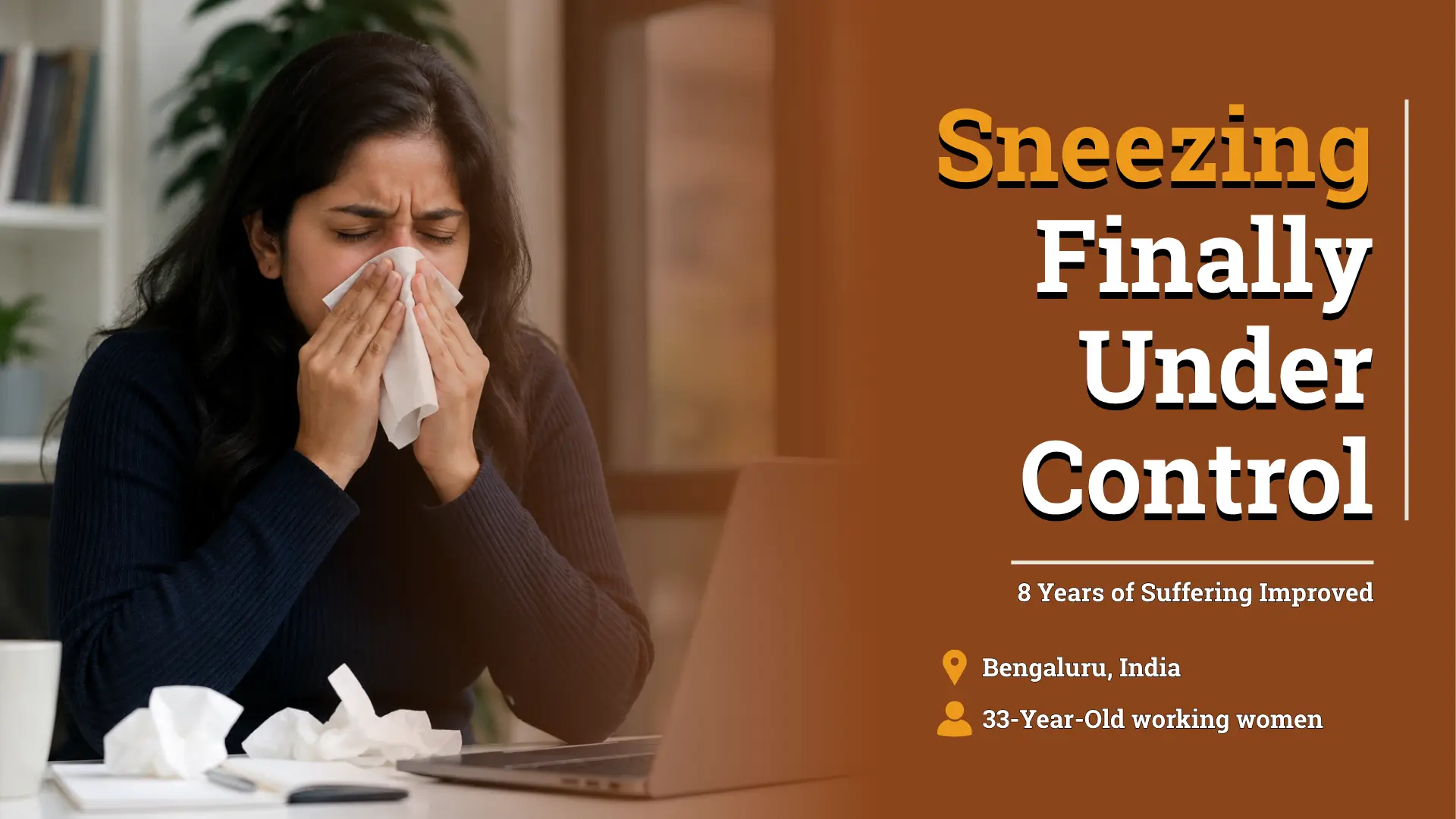
After struggling with allergic rhinitis for 8 years and relying on antihistamines for 2 years, I experienced gradual improvement with individualized homeopathic treatment. Over time, my episodes reduced, I no longer needed antihistamines, and I remained stable during pregnancy under my doctor's supervision. I sincerely thank Dr. Rajesh Shah and the Life Force Homeopathy team for their care and support throughout my treatment journey.
33-year-old Software Engineer, Bangalore
Table of Contents
Summary
A 33-year-old female software engineer from Bangalore, suffering from allergic rhinitis for 8 years and dependent on antihistamines twice a week for the past 2 years, sought treatment at Life Force Homeopathy, Jayanagar Branch, on 1st June 2025. Presenting symptoms included sneezing, watery coryza, lachrymation, itching of eyes and nose, nasal blockage, headache, body ache, and episodic fever.
Under the individualized homeopathic treatment plan curated by Dr. Rajesh Shah, MD (Homeopathy), the patient experienced significant and sustained improvement over approximately one year. Her antihistamine dependency gradually reduced and later stopped, with no recurrence of allergic rhinitis episodes reported in the final follow-up period, including during pregnancy under doctor supervision.
Patient Case Details
| Patient Case Details | Information |
| Patient ID | P.P. (ID: 57756) |
| Age | 33 Years |
| Gender | Female |
| Profession | Software Engineer |
| Location | Bangalore, India |
| First Consultation | 1st June 2025 |
| Condition | Allergic Rhinitis |
| Duration of Condition | 8 Years |
About the Condition
Allergic rhinitis is an inflammatory condition of the nasal passages triggered by airborne allergens such as dust, pollen, cold air, weather changes, or environmental pollutants. The immune system reacts sensitively to these triggers, resulting in symptoms such as sneezing, runny nose, nasal congestion, watery eyes, and itching.
Chronic allergic rhinitis can significantly affect quality of life, disturb sleep, and reduce work productivity. Conventional management commonly involves antihistamines, decongestants, and nasal sprays, which may provide symptomatic relief. However, in some patients, symptoms may keep recurring, leading to frequent medicine dependency.
The treatment of allergic rhinitis in homeopathy focuses on understanding the patient’s individual sensitivity, triggers, physical tendencies, and emotional profile. Rather than looking only at nasal symptoms, homeopathy evaluates the person as a whole to select an individualized medicine.
Presenting Complaints
The patient presented with the following symptoms at the time of first consultation:
- Frequent sneezing — occurring in episodes
- Profuse watery nasal discharge, also known as coryza
- Lachrymation, or watering of eyes
- Intense itching of the eyes and nose
- Nasal blockage
- Heaviness of the head
- Generalized body pain
- Episodic low-grade fever, approximately once every 2 months
- Frequency of episodes: 1–2 times per week
- Duration of each episode: Approximately 2 hours
- Drug dependency: Antihistamines taken twice a week for the past 2 years
The patient reported significant discomfort due to repeated allergic episodes and was concerned about long-term dependency on antihistamines. This motivated her to seek an individualized allergic rhinitis homeopathy treatment approach.
Individual Case Assessment
A detailed case history was taken by Dr. Rajesh Shah, evaluating both the physical generals and the mental-emotional constitution of the patient, in keeping with the principles of individualized homeopathy.
Living with a Chronic Condition? Get Expert Guidance.
Talk to Dr. Rajesh Shah — 40+ years of experience in managing chronic conditions with a personalized, long-term approach.
Physical Generals
Appetite: Average
Food preference: Craving for sweets
Thirst: Reduced — approximately 500 ml to 1 litre of water per day
Perspiration: Average
Thermal: Cold intolerant — worsening of symptoms in cold weather
Bowel: Satisfactory
Urine: Asymptomatic
Menstrual cycle: Regular, 28-day cycle
Sleep: Sound; preferred lying on the left side
Mental / Emotional Generals
- Moody temperament
- Introverted — small, close-knit circle of friends
- Brooding nature; tends to dwell on thoughts
- Emotionally sensitive
- Fear of heights
- Workaholic tendencies
- Curious and adventurous — enjoys travelling, exploring new places, people, and cuisines
- Highly competitive
These individualized characteristics formed the foundation of constitutional medicine selection, in line with the homeopathic approach of treating the patient as a whole, not merely the disease name.
Case Analysis & Treatment Approach
Dr. Rajesh Shah conducted a comprehensive evaluation of the totality of symptoms, including the presenting complaints, physical generals, and mental-emotional profile of the patient, to arrive at a suitable individualized homeopathic prescription.
The holistic analysis considered the patient’s characteristic thermal sensitivity, cold intolerance, reduced thirst, left-sided sleeping preference, emotional sensitivity, brooding tendency, competitive nature, and physical symptom pattern of allergic episodes.
Based on this individualized assessment, Dr. Shah prescribed a tailored course of homeopathic medicines. Regular follow-ups were scheduled to monitor progress, assess medicine response, and make adjustments as required.This structured approach is important in allergic rhinitis homeopathic treatment, especially in chronic cases with repeated episodes and long-term antihistamine dependency.
Follow-Ups & Progress Timeline
The patient was followed up at regular intervals over approximately one year. The treatment timeline is presented below:
| Follow-Up Date | Milestone | Key Observations |
| 17th August 2025 | 1st Follow-Up | The patient was better. Antihistamines were taken thrice in the past 2 months. Overall improvement: 10%. |
| 16th November 2025 | 2nd Follow-Up | Further improvement noted. Antihistamines were taken only twice in the past 2 months. Overall improvement: 30–40%. |
| 15th January 2026 | 3rd Follow-Up | Significant progress. No antihistamines in the past 2 months. Overall improvement: 80%. The patient was also confirmed to be 12 weeks pregnant. |
| 11th March 2026 | 4th Follow-Up | No episodes of allergic rhinitis. No antihistamines taken in the past 4 months. The patient was now 5 months pregnant. |
| 27th May 2026 | Final Follow-Up | The patient remained stable with no episodes reported. No antihistamines were required. |
Outcome
Over the course of approximately 12 months of homeopathic treatment, the patient experienced progressive and sustained improvement:
- Gradual reduction in the frequency and severity of allergic rhinitis episodes
- Stepwise decrease in antihistamine dependency — from twice weekly to no requirement in the later phase of treatment
- No episodes reported in the final follow-up period
- Stable improvement maintained during pregnancy under doctor supervision
- Improved quality of life, productivity, and overall comfort
The patient expressed heartfelt gratitude to Dr. Rajesh Shah and the entire Life Force Homeopathy team for helping her manage 8 years of allergic rhinitis more effectively.
Key Learnings
- Homeopathy offers an individualized approach to allergic rhinitis by considering the patient’s physical, emotional, and general health profile.
- Reduction in medicine dependency may be possible in suitable cases with a structured and consistent homeopathic treatment plan.
- Regular follow-ups are important for monitoring progress and adjusting the prescription when needed.
- Mental-emotional factors may play an important role in homeopathic case analysis and medicine selection.
- Chronic conditions of long duration may require longer treatment timelines; patience and treatment compliance are important.
- Pregnant patients should take homeopathic or any other treatment only under qualified medical supervision.
- Patients should not stop antihistamines or any prescribed medicine suddenly without consulting their doctor.
Conclusion
This case study highlights the role of individualized homeopathic treatment in the management of chronic allergic rhinitis. The patient’s journey from 8 years of suffering and 2 years of antihistamine dependency to sustained relief and reduced medicine dependency demonstrates the potential scope of homeopathy in suitable cases.
Under the expert guidance of Dr. Rajesh Shah, MD (Homeopathy), at Life Force Homeopathy, Jayanagar Branch, Bangalore, the patient experienced significant symptomatic relief, improved comfort, and stable progress over approximately one year of treatment.
This case also shows how the treatment of allergic rhinitis in homeopathy can be personalized according to the patient’s complete symptom picture, rather than focusing only on sneezing or nasal blockage.