


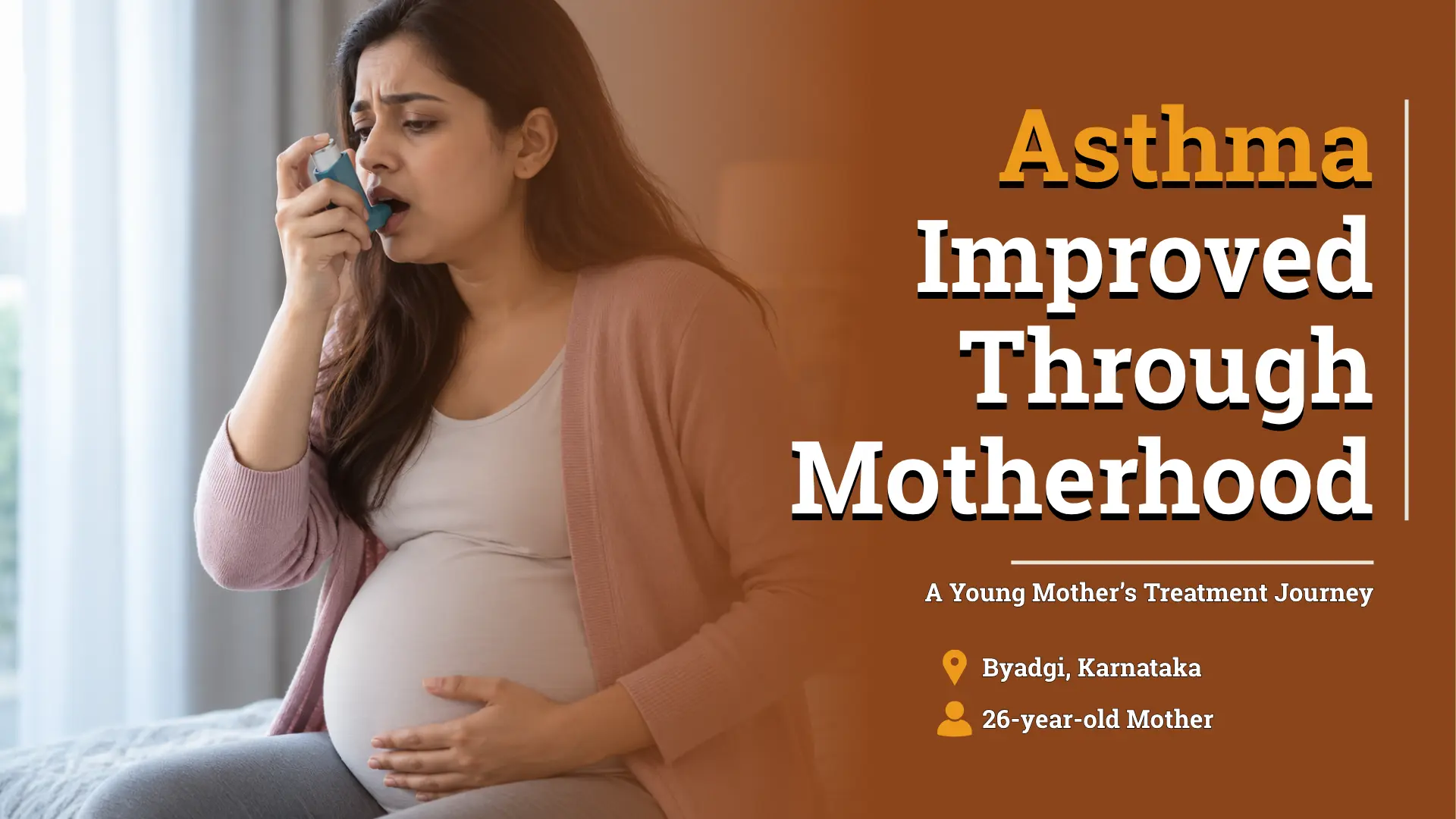
A 26-year-old female patient, Patient ID 54796, consulted Life Force Homeopathy Bangalore Branch in June 2024 for bronchial asthma of six years’ duration. Her symptoms included daily nasal blockage, breathlessness on exertion, wheezing during acute episodes, mostly dry cough, and occasional sneezing. Cold and damp climate was an important trigger. With individualized homeopathic treatment under Dr. Rajesh Shah and regular follow-ups, she showed gradual improvement. By March and May 2025, she was around 70% better, with no episodes of breathlessness, dry cough, wheezing, or nasal blockage. Around childbirth, she had a mild acute episode managed with short conventional treatment. By November 2025, she was stable during lactation and on no other medications. By January 2026, she reported around 80–90% improvement with no asthma episodes.
Table of Contents
- 01. Patient Details Before Her Motherhood Journey Began
- 02. Six Years of Breathing Trouble Before She Asked for Long-Term Help
- 03. When Climbing Stairs Became a Test of Breathing
- 04. What Bronchial Asthma Meant in Her Daily Routine
- 05. Why Pregnancy Made This Case More Sensitive
- 06. How Her Symptoms Were Studied Beyond Wheezing
- 07. Treatment That Continued With Medical Caution
- 08. Follow-Up Timeline From Early Relief to Longer Stable Phases
- 09. What Changed for Her by January 2026
- 10. Why the Choice of Doctor Matters in a Case Like This
- 11. What This Case Says About Real Asthma Control
- 12. Ready to Know Your Recovery Chances?
- 13. How the Bangalore Team Monitored Her Progress
- 14. A Safety Note for Every Asthma Patient
- 15. When Breathing Trouble Needs a Proper Case Review
For six years, this 26-year-old woman had lived with a fear that many asthma patients understand too well, the fear that breathing may suddenly become difficult again.
Climbing stairs was not always easy. Cold and damp weather could disturb her breathing. Some days began with nasal blockage. Some nights carried the quiet worry of wheezing or cough returning.
She consulted Life Force Homeopathy’s Bangalore branch in June 2024 for bronchial asthma, a condition that had become part of her daily life long before motherhood began.
In Hindi, asthma is commonly called dama or saans ki takleef. In Kannada, many families describe it as ಉಸಿರಾಟದ ತೊಂದರೆ, meaning breathing difficulty.
For this patient, it was not just a respiratory diagnosis. It affected movement, routine confidence, sleep comfort, and later, the sensitive journey of pregnancy and lactation.
Patient Details Before Her Motherhood Journey Began
| Parameter | Details |
| Patient ID | 54796 |
| Age | 26 Years |
| Gender | Female |
| Clinic | Life Force Homeopathy, Bangalore Branch |
| First Consultation | June 2024 |
| Main Condition | Bronchial Asthma |
| Duration Before Treatment | 6 Years |
| Main Symptoms | Breathlessness, wheezing, dry cough, nasal blockage |
| Main Trigger | Cold and damp climate |
| Treatment Duration | Around 19 months of recorded follow-up |
| Final Recorded Outcome | Around 80–90% improvement by January 2026 |
Six Years of Breathing Trouble Before She Asked for Long-Term Help
Her asthma was not a short seasonal cough that came and went once in a while.
By the time she came for treatment, she had already been dealing with symptoms for six years.
At the first consultation, she reported:
- Daily nasal blockage
- Breathlessness while climbing stairs
- Wheezing during acute episodes
- Mostly dry cough
- Occasional sneezing
- Symptoms worse in cold, damp weather
- Conventional medicines during acute flare-ups
She was not taking continuous treatment earlier. Her acute episodes were managed whenever they appeared.
That pattern can be emotionally tiring. A patient may feel better for some days, then suddenly cough, wheezing, or breathlessness returns and interrupts normal life again.
When Climbing Stairs Became a Test of Breathing
For her, exertion was one of the clearest signs that the airways were not settled.
Climbing stairs would bring breathlessness. During acute episodes, wheezing could appear. The cough was mostly dry, and nasal blockage remained a daily concern.
Cold and damp exposure made the pattern worse.
These details helped the doctors understand that her symptoms were not random. They followed a pattern, and that pattern needed to be studied carefully.
What Bronchial Asthma Meant in Her Daily Routine
Bronchial asthma is a chronic inflammatory condition of the airways. The breathing passages become sensitive and may narrow when exposed to triggers such as cold air, damp weather, dust, exertion, infections, or allergies.
Common allergic asthma symptoms may include wheezing, dry cough, breathlessness, chest tightness, nasal blockage, and sneezing.
In this patient, the important triggers were exertion and cold damp climate. This made her daily activities more difficult, especially stairs, weather changes, and acute respiratory episodes.
Asthma needs proper medical monitoring. Sudden breathlessness, bluish lips, inability to speak full sentences, chest tightness, or poor response to prescribed inhalers needs urgent medical care.
Why Pregnancy Made This Case More Sensitive
This case became more delicate because her treatment continued through pregnancy and later during lactation.
Asthma during pregnancy has to be handled with care. The aim should never be to suddenly stop essential medicines or ignore breathing symptoms. Good asthma control is important for the mother as well as the baby.
In this case, her symptoms were monitored through regular follow-ups. Conventional treatment was used when required during an acute phase around childbirth.
Her progress was not judged only by cough or wheezing. The doctors also looked at how stable she remained during pregnancy, delivery, and the lactating period.
How Her Symptoms Were Studied Beyond Wheezing
The case was not treated with a fixed “asthma medicine” approach.
The doctors studied the way her symptoms behaved in real life:
- When breathlessness appeared
- Whether wheezing came at night
- How often cough returned
- Whether nasal blockage came with breathing trouble
- How cold damp weather affected her
- Whether exertion triggered symptoms
- How often she needed conventional medicines
- How symptoms behaved during pregnancy and lactation
This helped in planning individualized bronchial asthma treatment based on her symptom pattern and overall health.
Treatment That Continued With Medical Caution
Dr. Rajesh Shah prescribed individualized homeopathic medicines after studying her case in detail.
The treatment focused on reducing the recurrence of cough, wheezing, breathlessness, and nasal blockage. Another important aim was to reduce the frequency of acute flare-ups and lower dependency on bronchodilators where medically suitable.
Conventional medicines were not stopped suddenly. They were used or reduced according to her condition and medical guidance.
This is important in asthma care because rescue inhalers and prescribed medicines can be necessary during acute episodes.
Follow-Up Timeline From Early Relief to Longer Stable Phases
| Date / Period | Progress |
| 14 July 2024 | Slight improvement was noted. Dry cough and sneezing reduced. Night wheezing was less, although mild to moderate symptoms continued. |
| 13 October 2024 | Around 20% improvement was reported. A brief flare occurred after cold and damp exposure, with sputum and slight wheezing. Cough and sneezing became less frequent, and reliance on conventional medicines reduced. |
| 7 January 2025 | Around 30% improvement was seen. Cough improved further. Wheezing was moderate. Nasal blockage was occasional. Breathlessness on exertion was much better. Occasional conventional medicine had been stopped. |
| 25 March and 29 May 2025 | Around 70% improvement was reported. During this phase, she had no episodes of breathlessness, dry cough, wheezing, or nasal blockage. |
| 9 July 2025 | She remained stable overall. One mild attack of dry cough and nasal blockage had occurred two weeks earlier, but the severity and frequency were much less than before. |
| 9 September 2025 | The case notes mention that she delivered a healthy baby and had a brief ICU-related hospital phase. During this period, she developed mild acute cough, difficulty expectorating, and slight night wheezing for three days, likely after cold damp exposure. Conventional treatment was taken for three days. |
| 7 November 2025 | Marked improvement was seen. There was no breathlessness, dry cough, wheezing, or nasal blockage. She was lactating, had a two-month-old baby, and was on no other medications. |
| 8 January 2026 | Around 80–90% improvement was reported. No episodes of breathlessness, dry cough, wheezing, or nasal blockage were present. |
What Changed for Her by January 2026
Her improvement did not happen in one dramatic jump.
First, the dry cough and sneezing reduced. Then breathlessness on exertion became better. Later, there were longer phases without wheezing, cough, or nasal blockage.
The most reassuring part was that her progress remained largely steady through pregnancy and lactation, except for one mild acute episode around the hospital phase, which was managed with short conventional treatment.
By January 2026, she reported around 80–90% improvement.
She had:
- No breathlessness episodes
- No dry cough
- No wheezing
- No nasal blockage
- Reduced dependency on conventional asthma medicines
- Better stability during lactation
- Improved confidence in daily routine
Results may vary depending on asthma duration, trigger exposure, allergic tendency, pregnancy-related changes, respiratory sensitivity, medicine dependency, and follow-up consistency.
Why the Choice of Doctor Matters in a Case Like This
Patients often search for the best doctors for bronchial asthma when symptoms keep returning despite inhalers, bronchodilators, or short-term medicines.
A good asthma evaluation should not look only at whether wheezing is present today. It should also study the patient’s triggers, exertional breathlessness, nasal symptoms, cough pattern, weather sensitivity, pregnancy status where relevant, and response to previous medicines.
For patients considering asthma care in Bengaluru, this kind of detailed review becomes especially important when asthma overlaps with pregnancy, lactation, or repeated weather-triggered flare-ups.
What This Case Says About Real Asthma Control
Asthma improvement is often best understood through practical changes.
Can the patient climb stairs with less breathlessness?
Are wheezing episodes less frequent?
Is the cough returning less often?
Are cold-weather flare-ups milder than before?
Is the patient needing fewer emergency medicines?
In this case, the answers gradually became more positive over time. She moved from recurring breathlessness and wheezing to longer symptom-free phases, including during lactation.
That is what made the improvement meaningful.
Ready to Know Your Recovery Chances?
Discover your recovery chances from chronic diseases in percentage with Life Force Homeopathy's FREE Assessment Test. Get a personalized evaluation from our experienced doctors.
Start Your FREE Assessment Test →How the Bangalore Team Monitored Her Progress
The patient was treated through Life Force Homeopathy’s Bangalore branch, where follow-ups were used to observe respiratory stability through different phases of her life.
The team monitored whether night wheezing returned, whether nasal blockage remained daily, whether exertion still caused breathlessness, and whether cold damp exposure continued to trigger acute symptoms.
For patients in Bengaluru with chronic respiratory complaints, regular follow-up can help identify small changes early, before they become frequent flare-ups.
A Safety Note for Every Asthma Patient
Asthma is a condition where acute symptoms should never be taken lightly.
Homeopathy may have a supportive role in selected chronic cases, but prescribed inhalers, bronchodilators, steroids, or emergency medicines should not be stopped suddenly without medical advice.
During pregnancy and lactation, asthma care should be coordinated carefully with qualified doctors.
If breathlessness is sudden, severe, or worsening, urgent medical care is necessary.
When Breathing Trouble Needs a Proper Case Review
If asthma keeps interrupting walking, sleep, pregnancy comfort, lactation, or routine activity, the symptom pattern should be reviewed properly.
You can share your case details with our doctors for a personalized review.
Living with a Asthma?
Receive a personalized treatment plan from our experienced homeopathic doctors. Trusted by over 100,000+ patients across 180+ countries for safe, natural and long term management of chronic diseases.