

Table of Contents
- 01. Introduction
- 02. Patient Case Details
- 03. About Urticaria with Angioedema
- 04. Presenting Complaints
- 05. Associated Medical Conditions
- 06. Medical & Personal Background
- 07. Investigations
- 08. Case Analysis & Treatment Approach
- 09. Follow-Up & Progress Timeline
- 10. Result Summary
- 11. Doctor’s Insight
- 12. Conclusion
Introduction
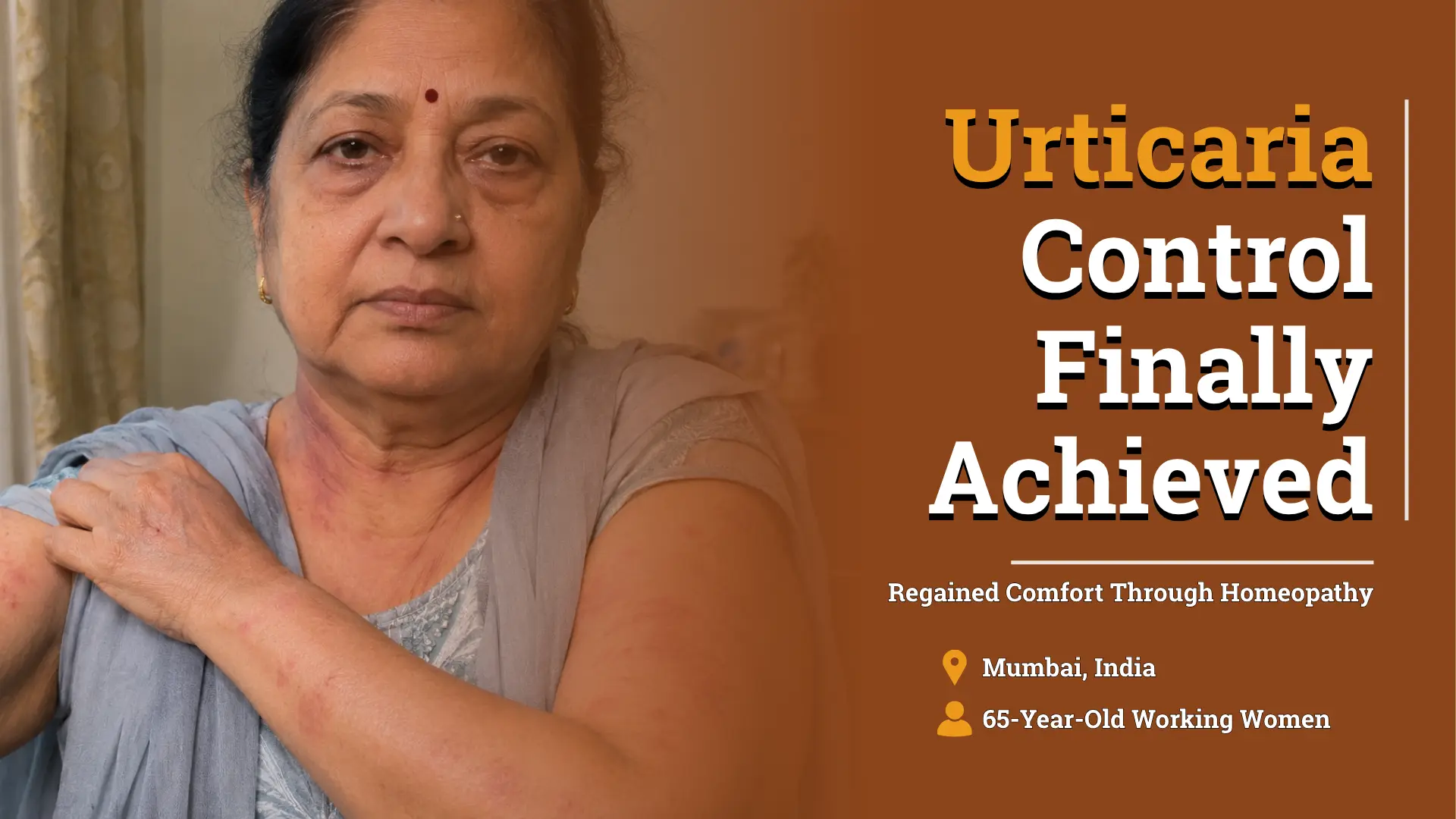
For Mrs. S.T., a 65-year-old woman from Goregaon, Mumbai, urticaria was not just a skin complaint. It was an unpredictable struggle of itching, raised hives, swelling around the lips and eyes, and repeated dependence on antihistamines whenever the flare-ups became difficult to tolerate.
Her condition was diagnosed as urticaria with angioedema. The episodes were triggered by certain foods such as non-vegetarian proteins, gluten, and wheat. At times, the itching was severe, especially over the scalp and vulval region, and the swelling created both physical discomfort and emotional worry.
This case study highlights how individualized urticaria treatment in homeopathy at Life Force Homeopathy helped her achieve long symptom-free phases, reduced antihistamine dependency, and better control over recurring hives and swelling.
Patient Case Details
| Parameter | Details |
| Patient ID | Mrs. S.T. – 40612 |
| Age | 65 years |
| Gender | Female |
| Location | Goregaon, Mumbai |
| First Consultation | July 2019 |
| Condition | Urticaria with Angioedema |
| Main Symptoms | Severe itching, raised hives, swelling of lips and eyes, numbness |
| Duration/Frequency | Recurrent episodes since early 2019; once weekly by mid-June 2019 |
| Intensity | Moderate to severe |
| Associated Conditions | Hypertension, hypothyroidism, diabetes mellitus, leg pain and weakness |
About Urticaria with Angioedema
Urticaria, commonly known as hives, is a skin condition where raised, itchy welts appear on the skin. These may come and go suddenly and may last for a few hours to a few days. When the swelling affects deeper layers of the skin, especially around the lips, eyelids, face, or other areas, it is known as angioedema.
In chronic urticaria, the episodes keep recurring over weeks, months, or even years. Many patients notice triggers such as certain foods, stress, heat, infections, medicines, or unknown internal sensitivity. Some patients may also need antihistamines repeatedly to control itching and swelling.
Common symptoms include:
- Raised, red or skin-colored hives
- Severe itching or burning sensation
- Swelling around the lips, eyes, or face
- Numbness or tightness in the affected area
- Recurring flare-ups after food or stress triggers
- Temporary relief with antihistamines
- Fear of sudden recurrence
In Mrs. S.T. 's case, the condition was recurrent, food-triggered, and associated with angioedema, making the case more sensitive and requiring regular monitoring.
Presenting Complaints
When Mrs. S.T. visited Life Force Homeopathy in July 2019, she complained of recurrent urticaria with angioedema.
Her main symptoms included:
- Severe itching, especially over the scalp and vulval region
- Raised erythematous hives
- Numbness in the affected areas
- Swelling over the lips and around the eyes
- Moderate to severe intensity of episodes
- Episodes lasting 2–3 days without antihistamines
- Episodes reducing to around 1 day after taking antihistamines
- Recurrence around once a week by mid-June 2019
The complaints were aggravated by:
- Non-vegetarian proteins
- Gluten
- Wheat
She had been avoiding wheat and milk since May 2019 and had also tried naturopathy, after which the complaints were absent for some time in May and June 2019. However, the tendency to relapse continued.
She used Cetirizine on an SOS basis whenever the symptoms became difficult to manage.
Living with a Chronic Condition? Get Expert Guidance.
Talk to Dr. Rajesh Shah — 40+ years of experience in managing chronic conditions with a personalized, long-term approach.
Associated Medical Conditions
Mrs. S.T. also had multiple systemic health concerns, which were carefully considered during case evaluation.
Leg Pain and Weakness
She complained of stiffness and heaviness in the calves. Walking beyond 1.5 to 2 km was difficult for her. She also experienced general weakness and lethargy.
Hypertension
She had a history of hypertension and had undergone angioplasty two years before consulting Life Force. She was maintained on conventional medicines including Telma 40, Ecosprin 75, and Tanact.
Hypothyroidism
She had long-standing hypothyroidism, along with gradual weight gain and lethargy.
Diabetes Mellitus
Her diabetes was controlled with Glycophage 500.
Medical & Personal Background
Mrs. S.T. was mild, gentle, soft-spoken, and emotionally sensitive. She described herself as someone who could not fight back or be rude, even during stressful situations.
Although she was emotionally strong in many ways, she would become tearful while sharing her personal struggles. Her emotional stress was significant and long-standing.
Some important stress factors included:
- Financial stress due to house redevelopment
- No rent received for three years
- Her son was unemployed and struggling with chronic fungal infection
- Strained relationship with her daughter
These emotional and personal factors were considered important in understanding her overall constitution and disease pattern.
Investigations
Blood investigations were suggested as part of the overall evaluation and monitoring process.
No specific investigation values were provided in the case file.
Case Analysis & Treatment Approach
Dr. Rajesh Shah studied the case in detail, considering Mrs. S.T.’s recurrent urticaria, angioedema episodes, food triggers, associated medical conditions, emotional sensitivity, and long-term stress background.
At Life Force Homeopathy, the case was not treated only as a skin allergy. A broader individualized approach was followed, taking into account:
- Pattern of hives and swelling
- Frequency and duration of episodes
- Food-related aggravations
- Antihistamine dependency
- Associated hypertension, diabetes, and hypothyroidism
- Emotional stress and sensitivity
- General weakness and fatigue
- Relapsing nature of the condition
A personalized homeopathic prescription was given with the aim of supporting better control over hypersensitivity, reducing recurrence of hives, and helping manage angioedema episodes. Regular follow-ups were advised to monitor her progress and adjust treatment when needed.
Follow-Up & Progress Timeline
Follow-Up: 30 September 2019
Mrs. S.T. reported that she was doing much better. The urticaria episodes had become less intense compared to her initial complaints.
Follow-Up: 2 March 2020
She reported no rashes for the previous 2–3 months. However, there was a gap of around 1.5 months in treatment.
Follow-Up: 23 July 2020
Her condition stabilized again. There was marked overall improvement with only rare episodes. Her confidence in the treatment increased as the frequency and intensity of complaints reduced.
Follow-Up: 17 February 2022
After stopping treatment in August 2020, the patient reported a relapse. Hives started appearing daily, along with burning and swelling on the face. The episodes lasted for around 4–5 hours.
Considering the recurrence, it was decided to restart homeopathic treatment to help control the reappearance of symptoms.
Follow-Up: 7 June 2022
Excellent improvement was noted. Overall, she was around 90% better.
There were no major urticaria episodes. Mild pigmentation on the forehead persisted, but she did not require regular antihistamine use.
Follow-Up: 4 August 2022
She had only 1 to 2 minor episodes in the previous month. Hives appeared around the eyebrows and vulval region, with mild swelling of the lips lasting for around 2 days.
She also experienced occasional numbness of the lips, which settled without intervention.
Follow-Up: 28 May 2023
The patient had discontinued medicines for 8 months, which led to another relapse. Itching and hives returned, and she required Allegra around 2–3 times per month.
Medicines were restarted, and dietary triggers were reviewed again.
Follow-Up: 30 September 2023
Continued progress was observed. Itching around the vulval region was around 60% better.
She required only 2 antihistamine doses per month. The episodes were less intense and self-limiting.
Follow-Up: 2 August 2024
Mrs. S.T. reported sustained remission.
She had:
- No urticaria episodes
- No itching
- No swelling
- No antihistamine use
- Clear and healthy skin
She expressed high satisfaction and relief after dealing with long-standing chronic urticaria and angioedema.
Result Summary
Over the course of treatment, Mrs. S.T. showed encouraging improvement in her chronic urticaria with angioedema.
Her progress included:
- Reduced frequency of hives
- Reduced intensity of itching
- Better control over swelling episodes
- Decreased need for antihistamines
- Improved confidence in managing the condition
- Long symptom-free phase after restarting treatment
- Clear skin and no active urticaria episodes by August 2024
The case also showed that treatment gaps were followed by relapse, highlighting the importance of regular follow-ups and continuity in chronic urticaria management.
Doctor’s Insight
According to the treating team at Life Force Homeopathy, chronic urticaria with angioedema often has a relapsing-remitting pattern. In some patients, food triggers, stress, internal hypersensitivity, hormonal health, and other systemic conditions may influence the frequency and intensity of episodes.
This case highlights the importance of individualized homeopathic treatment, regular monitoring, and patient consistency. The goal is not only to suppress the visible hives temporarily but to support better long-term control over recurrence and improve quality of life.
Conclusion
Mrs. S.T. 's case shows how chronic urticaria with angioedema may improve with a structured and individualized homeopathic approach.
Despite relapses after stopping treatment, she responded well after restarting medicines and eventually achieved a sustained symptom-free phase with no itching, no swelling, and no need for antihistamines by August 2024.
Results may vary from patient to patient depending on the duration of urticaria, severity of angioedema, food triggers, associated health conditions, stress levels, and treatment consistency.
This case study was written by Dr. Deepa Chandroth, Associate to Dr. Rajesh Shah, MD (Hom.).