

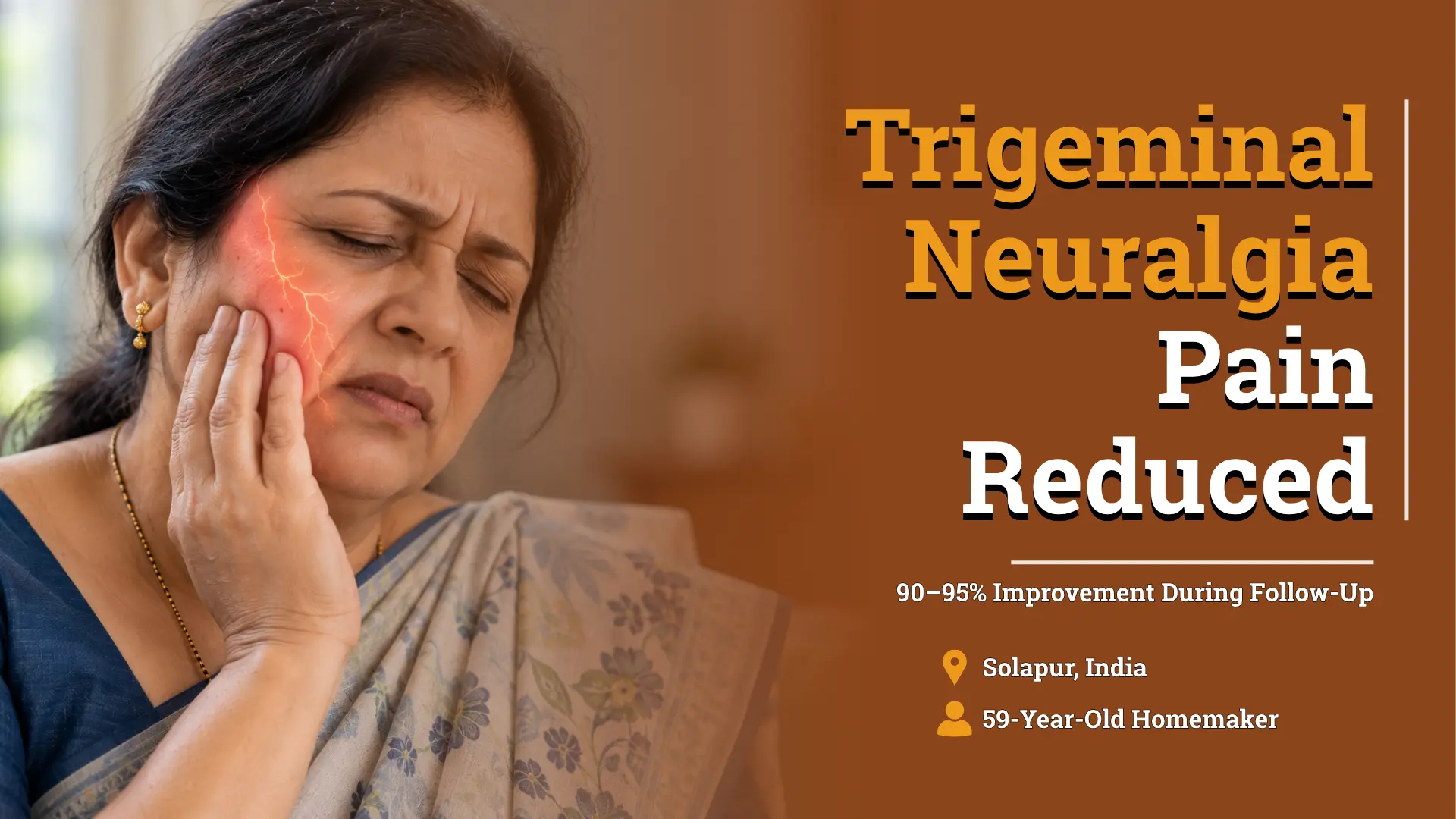
A 59-year-old homemaker with a three-year history of trigeminal neuralgia and two previous surgeries experienced recurrent electric-shock-like facial pain, tingling, numbness, and swelling. During follow-up, the frequency, duration, and intensity of her attacks gradually reduced, with conventional medication used during certain flare-ups. By September 2025, she reported a full pain-free month, and approximately 90–95% improvement was documented by October 2025.
Table of Contents
Hero Introduction
For three years, Mrs. A.G., a 59-year-old homemaker from Solapur, had been living with recurrent severe facial pain caused by trigeminal neuralgia. The pain appeared suddenly, like an electric shock, across the left side of her face and radiated towards her upper lip and ear. She had already undergone two surgeries, but the episodes continued to return.
By late 2023, she was experiencing a newer pattern of facial pain approximately once every 8–10 days. She was not taking conventional medication when she approached Life Force Homeopathy, Thane, on 12 December 2023. Her daughter had searched for another treatment option and decided to seek trigeminal neuralgia treatment at the clinic.
During the documented follow-up period, the frequency, duration, and intensity of her painful episodes gradually reduced, with approximately 90–95% improvement reported by October 2025.
Patient Case Details
| Parameter | Details |
| Patient | Mrs. A.G. |
| Patient ID | 53226 |
| Age | 59 years |
| Gender | Female |
| Profession | Homemaker |
| Location | Solapur |
| First Consultation | 12 December 2023 |
| Branch | Life Force Homeopathy, Thane |
| Condition | Trigeminal Neuralgia |
| Duration | Approximately 3 years |
| Previous Treatment | Two surgeries |
Understanding Trigeminal Neuralgia
What Is Trigeminal Neuralgia?
Trigeminal neuralgia is a neurological pain disorder involving the trigeminal nerve, which carries sensation from the face to the brain.
The condition can cause sudden, intense facial pain that may feel like an electric shock. In this patient's case, the pain affected the left side of the face and radiated towards the upper lip and ear.
Trigeminal Neuralgia Symptoms
The patient's presentation included sudden facial pain with an electric-shock-like quality. Later episodes also involved tingling, numbness, and swelling around the lip.
The pain could occur repeatedly during the day and, during certain phases, was triggered by activities such as brushing the teeth, talking, chewing, swallowing, and exposure to cold air.
These were the trigeminal neuralgia symptoms documented during her treatment journey.
Her History With the Condition
Three Years of Recurring Facial Pain
Mrs. A.G. had been experiencing the condition for approximately three years before approaching Life Force Homeopathy.
The pain was sudden and severe, affecting the left side of her face and extending towards the upper lip and ear. Despite undergoing two surgeries in the past, the painful episodes continued to recur.
By late 2023, she had developed another pattern of pain occurring approximately once every 8–10 days.
Why She Sought Another Option
At the time she approached Life Force Homeopathy, she was not taking conventional medication for the condition.
Her daughter searched for an alternative treatment option, discussed her mother's case with the doctor, and subsequently brought her to the Thane branch.
The patient was looking for a safe and lasting approach to managing a condition that had already required surgical intervention.
Understanding Possible Triggers and Patterns
Trigeminal Neuralgia Attacks
The frequency and duration of her trigeminal neuralgia attacks changed considerably throughout the follow-up period.
At one stage, she experienced three to four episodes a day, each lasting approximately 5–8 minutes. Later, the episodes became shorter, occurring seven to eight times a day for approximately 8–12 seconds.
Over subsequent follow-ups, the frequency reduced further.
Trigeminal Neuralgia Triggers
During one flare-up, the patient's pain was triggered by brushing her teeth, talking, and exposure to cold air.
Later, she also reported pain while chewing, swallowing, and talking.
These triggers were documented as part of her changing symptom pattern.
Case Evaluation and Treatment Planning
Understanding Her Individual Pattern
Under the guidance of Dr. Rajesh Shah, the patient's case was evaluated based on her pain pattern, medical history, and stress levels.
Her previous surgeries and the changing nature of her facial pain were also considered while planning the treatment approach.
Treatment and Follow-Up
A patient-specific homeopathic treatment plan was started on 12 December 2023.
The treatment was reviewed during follow-ups according to changes in the frequency, duration, intensity, and associated features of her pain.
For patients researching homeopathy for trigeminal neuralgia, this case represents one patient's treatment journey and should not be taken as a prediction of response for another person.
Follow-Up and Progress
May 2024 | First Follow-Up
At the first documented follow-up, Mrs. A.G. was experiencing approximately 3–4 episodes a day, with each episode lasting around 5–8 minutes.
She also reported some swelling near the lip.
During this period, she required painkillers for approximately five days.
The treatment plan was adjusted and continued.
July 2024 | Second Follow-Up
Two months later, the pattern had changed.
She was experiencing approximately 7–8 short episodes a day, generally beginning after dinner and continuing until morning.
The episodes were much shorter, lasting approximately 8–12 seconds each.
September 2024 | Fourth-Month Follow-Up
A more noticeable change was documented at this stage.
The frequency had reduced to approximately one episode a day, with each episode lasting around 10–12 seconds.
Importantly, she did not require painkillers during this period.
November 2024 | Temporary Flare-Up
A brief flare-up occurred during this period.
Her pain was triggered by brushing her teeth, talking, and exposure to cold air. She also experienced numbness and swelling.
Her local physician prescribed Pregabalin and Oxetol.
The homeopathic treatment continued alongside these medicines.
March 2025 | Six-Month Follow-Up
By March 2025, tingling had reduced to approximately 4–5 brief episodes a day.
She had come off Pregabalin but continued taking Oxetol.
The reduction in tingling represented a further change from the earlier pattern of repeated painful episodes.
May 2025 | Short Relapse
A short relapse was reported during this period.
She experienced pain while chewing, swallowing, and talking.
Conventional medication was used briefly during this phase.
July 2025 | Improvement Maintained
By July, the improvement was holding.
The patient reported that the pain was occurring less frequently and with reduced intensity.
She was subsequently off conventional medication from July onward.
September 2025 | Approximately 70% Improvement
By September 2025, approximately 70% improvement was reported.
She had experienced a full pain-free month and was not using painkillers.
October 2025 | 90–95% Improvement
By October 2025, the documented improvement had reached approximately 90–95%.
She had remained off conventional medication since July.
At this stage, Dr. Rajesh Shah discontinued the homeopathic medicines, considering the documented case complete.
What Changed During Her Treatment Journey
Frequency and Duration of Pain
The patient's episodes changed from several longer episodes each day to shorter and less frequent episodes.
At the September 2024 follow-up, the frequency had reduced to approximately one episode a day, lasting 10–12 seconds.
By September 2025, she had experienced a full month without pain.
Associated Symptoms
Numbness and swelling were reported during the November 2024 flare-up.
Tingling was still present in March 2025 but had reduced to four or five brief episodes a day.
Later follow-ups documented further improvement in the overall pain pattern.
Medication Changes
The patient was not taking conventional medication at the beginning of the case.
During the November 2024 flare-up, her local physician prescribed Pregabalin and Oxetol. By March 2025, she had discontinued Pregabalin while continuing Oxetol.
A short course of conventional medication was required again during the May 2025 relapse.
By July 2025, she was reported to be off conventional medication.
Doctor's Insight
Trigeminal neuralgia is characterized by recurrent episodes of sudden, severe facial pain that may have an electric-shock-like quality. The patient's history, symptom pattern, and previous treatment history are important when evaluating such complaints.
The treating doctor also notes that appropriate medical evaluation is important. Investigations such as MRI may be advised to assess possible underlying or secondary causes. Conventional medicines such as carbamazepine or oxcarbazepine may be prescribed, and surgical procedures such as microvascular decompression may be considered in appropriate cases.
In this case, the patient continued to receive conventional medical care when required during flare-ups while her homeopathic treatment was followed separately.
Living with a Trigeminal neuralgia?
Receive a personalized treatment plan from our experienced homeopathic doctors. Trusted by over 100,000+ patients across 180+ countries for safe, natural and long term management of chronic diseases.
Outcome
Changes Documented Over Follow-Up
By October 2025, the case documented:
- Approximately 90–95% overall improvement
- Reduced frequency of painful episodes
- Reduced duration of individual episodes
- Reduced intensity of facial pain
- A full pain-free month by September 2025
- No painkillers required by September 2025
- No conventional medication reported since July 2025
- Improved confidence in carrying out daily activities
The patient was able to resume activities such as eating, speaking, smiling, and other routine activities with greater comfort.
Prognosis and Disease Analysis
A More Detailed Look at Trigeminal Neuralgia
You can check out the following videos for a more detailed analysis of the disease and its management:
Conclusion
Mrs. A.G. had been experiencing trigeminal neuralgia for approximately three years and had previously undergone two surgeries. During the documented follow-up, the frequency, duration, and intensity of her facial pain gradually reduced, despite temporary flare-ups requiring conventional medication. By September 2025, she reported a full pain-free month, and by October, approximately 90–95% improvement was documented. The case highlights the importance of detailed assessment, monitoring of changing pain patterns, and appropriate medical care throughout the treatment journey.