

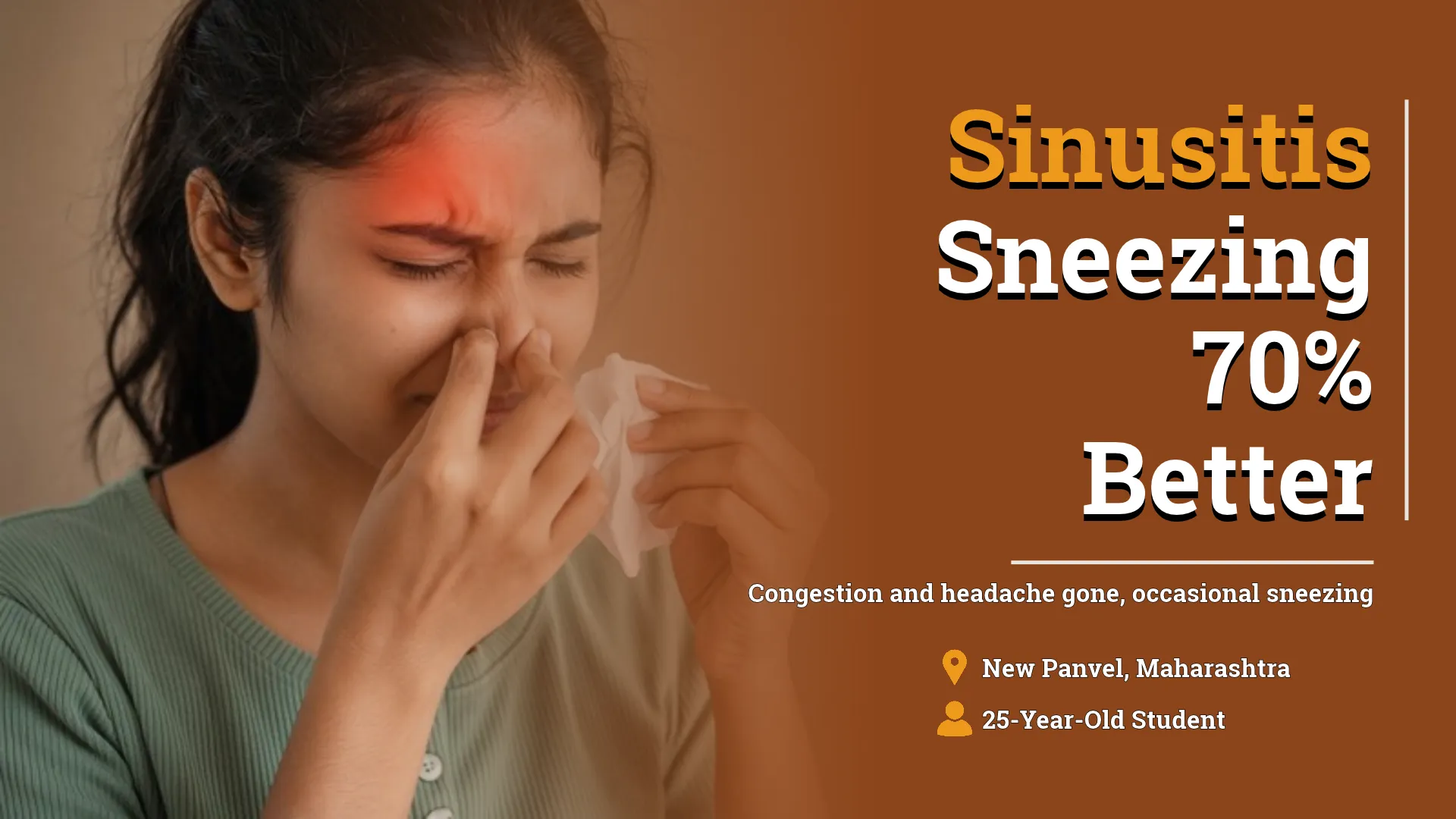
A 25-year-old student from New Panvel had sinusitis for nearly two years, with bouts of up to 15 sneezes, a heavy head and nasal discomfort triggered by dust, cold and strong smells. She started homeopathic treatment at Life Force in February 2025 and was about 80% better by September 2025. A winter relapse followed, and she improved again. By June 2026 she was about 70% better, with her congestion and headache gone.
Table of Contents
Introduction
Sneezing again and again, a heavy head and a stuffy nose can make everyday life hard. This case study is about a 25-year-old student from New Panvel (Patient ID 56898) who had recurring sinusitis symptoms for nearly two years. She had frequent bouts of sneezing, heaviness in the head and nasal discomfort. In one episode, she could sneeze as many as 15 times in a single bout.
Her symptoms were triggered mainly by dust, cold weather and strong smells. She was using a nasal spray for relief, but the repeated nature of her symptoms kept disturbing her daily routine. Looking for a way to manage her recurring sinusitis, she searched online for homeopathy treatment for sinusitis in Vashi and consulted Dr. Rajesh Shah at Life Force Homoeopathy on 11 February 2025.
Patient Case Details
| Parameter | Details |
|---|---|
| Patient ID | 56898 |
| Age | 25 Years |
| Gender | Female |
| Location | New Panvel |
| Profession | Student |
| Condition | Sinusitis |
| Duration | 2 years |
| First Consultation | 11 February 2025 |
| Associated Complaints | Asthma, anxiety disorder |
Understanding Sinusitis
Sinusitis happens when the tissues lining the sinuses become inflamed or swollen. The sinuses are air-filled spaces around the nose and forehead that normally help drain mucus. When this drainage is affected, a person may have nasal blockage, sneezing, watery nasal discharge, a heavy feeling in the face or head, pressure and headache.
Some people notice that their symptoms get worse with specific triggers such as dust, cold air, strong smells, allergies or changes in weather. When these complaints last a long time or keep coming back, they can affect everyday life.
Presenting Complaints
At the time of her first consultation, the patient reported:
- Sinusitis complaints for nearly 2 years
- Frequent sneezing, in bouts of up to 15 sneezes at a time
- Heaviness of the head
- Nasal discomfort
- Symptoms made worse by dust
- Symptoms made worse by cold weather
- Sneezing and nose complaints set off by strong smells
Physical and Personal Details
She followed a mixed diet and had an average appetite. She drank about 3 litres of water daily. Her bowel and bladder habits were satisfactory, and her periods were regular. Her sweating was average.
At the time of the consultation, she was preparing for the MPSC examination. She was talkative and expressive by nature and enjoyed talking to others. At the same time, she tended to get irritable over small matters. These personal traits were considered along with her physical symptoms while studying her case.
Case Evaluation and Individualized Approach
During the consultation, her symptoms and triggers were discussed in detail. Special attention was given to the pattern of her sneezing, the heaviness in her head and the way her symptoms got worse with dust, cold weather, strong smells and temperature changes.
Her history of asthma and anxiety disorder was also taken into account. Other personal details, including her diet, appetite, sleep, bowel and bladder habits, periods and general nature, were also reviewed as part of her overall case assessment.
Based on the complete symptom picture, an individualized homeopathic treatment plan was prescribed. Her progress was tracked through regular follow-ups, and the treatment was continued or adjusted according to her response.
Follow-Up and Progress
17 April 2025: Initial Improvement
At the first follow-up, she reported around 10 to 15% improvement. Her sneezing was less frequent, though the heaviness in her head stayed almost the same. Her watery nasal discharge had reduced a lot, and she felt less tired. The drop in nasal discharge may have been partly due to the change in season.
10 June 2025: 50% Improvement
She reported around 50% improvement in her overall complaints. Sneezing had reduced a lot, and the watery nasal discharge and heaviness of the head were also much better.
5 August 2025: 60 to 70% Improvement
By this follow-up, she felt 60 to 70% better. Sneezing was now occasional and was mainly noticed in the morning and with changes in temperature. The watery nasal discharge and heaviness of the head had reduced a lot. She was no longer taking any medicine for these complaints.
28 September 2025: 80% Improvement
She reported around 80% improvement since starting treatment. She had one episode in the previous month, lasting around 3 to 4 days, which she linked to a change in weather. Overall, she felt much better than at the start of treatment. She sometimes had nasal blockage at night and had to breathe through her mouth.
11 November 2025: Seasonal Relapse
With winter coming, her symptoms started increasing again. She reported moderate sneezing, mainly in the morning and in cold weather. Watery nasal discharge and heaviness of the head also returned. This was considered a relapse of her earlier complaints, and treatment was continued under follow-up.
19 December 2025: Symptoms Worsened
During the next month, her complaints became much worse. She had frequent and almost non-stop sneezing along with watery nasal discharge, nasal congestion and heaviness of the head. The congestion disturbed her sleep, and she also developed headaches.
18 February 2026: Improvement After Relapse
She reported that her symptoms had started improving again. Sneezing and watery nasal discharge had reduced compared to the last visit. Some heaviness and congestion in the head were still there, along with occasional night-time congestion and headache. She had not taken any other conventional treatment.
19 April 2026: 50% Improvement
She reported about 50% improvement. Sneezing and watery nasal discharge had reduced, and her headache was better than before. She still had some heaviness in the head, especially after being in air conditioning. There was no major nasal congestion, and she was not taking any other treatment.
16 June 2026: 70% Improvement
At the latest follow-up, she reported around 70% overall improvement. Only occasional episodes of sneezing remained. Her nasal congestion and headache had gone, and a runny nose came only now and then. The watery nasal discharge had also reduced a lot compared to the start of treatment. She was not taking any other medicine for these complaints.
Doctor's Insight
The patient's symptoms improved gradually over the course of treatment, especially how often she sneezed and her watery nasal discharge, nasal congestion and headache. She did have a clear seasonal relapse in the winter months, after which her symptoms improved again with continued care and follow-up.
Her own symptom pattern and triggers, including sensitivity to dust, cold weather, strong smells and temperature changes, were important parts of her case evaluation.
Living with Sinusitis ?
Receive a personalized treatment plan from our experienced homeopathic doctors. Trusted by over 100,000+ patients across 180+ countries for safe, natural and long term management of chronic diseases.
Conclusion
This case shows how recurring sinusitis symptoms can change over time and can be influenced by things like cold weather, dust, strong smells and temperature changes.
For this patient, regular follow-ups helped track changes in how often and how strongly her symptoms came. After more than a year of follow-up, she reported around 70% overall improvement, with significant relief in sneezing, nasal congestion, watery discharge and headache.
Her progress was watched over time, including the period when her symptoms increased in winter, which allowed the treatment to be reviewed according to her changing symptoms. Results can be different for each person.