


Table of Contents
- 01. Introduction
- 02. Patient Case Details
- 03. About Tinea Cruris and Recurrent Fungal Infection
- 04. Presenting Complaints
- 05. Previous Treatment
- 06. Associated Medical Conditions
- 07. Medical & Personal Background
- 08. Mental and Emotional Nature
- 09. Past and Family History
- 10. Investigations
- 11. Case Analysis & Treatment Approach
- 12. Follow-Up & Progress Timeline
- 13. Result Summary
- 14. Doctor’s Insight
- 15. Conclusion
Introduction
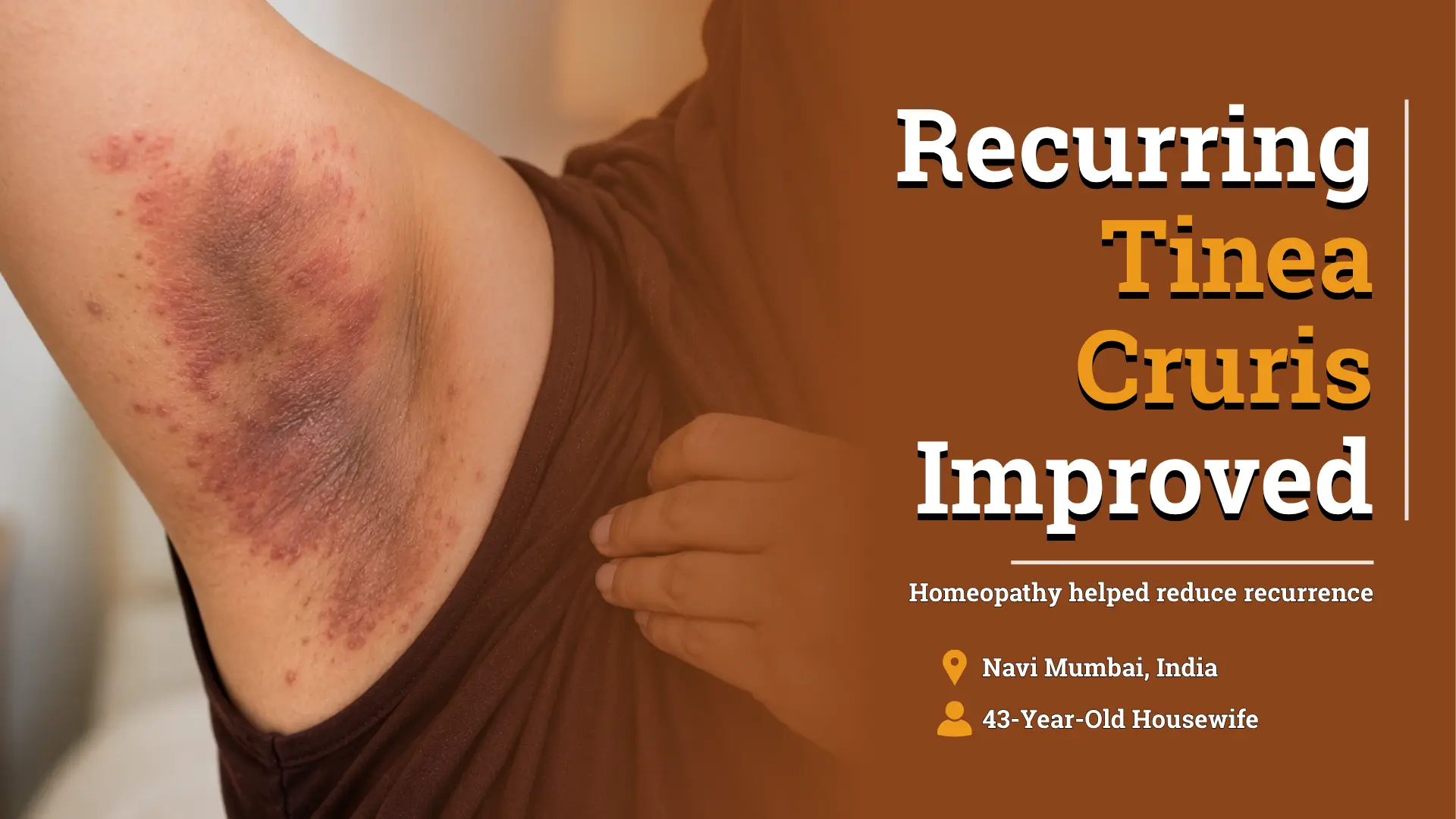
For years, this middle-aged homemaker from Vashi, Navi Mumbai, struggled with repeated fungal infections over her buttocks and underarms. The itching, discomfort, dark brown marks, and repeated eruptions affected her comfort and daily routine.
The difficult part was that the infection kept returning every few weeks, even after taking conventional antifungal tablets, creams, medicated soaps, and other medicines. Sweating, physical exertion, and wearing a burkha for long hours would increase the itching and irritation.
This case study shows how individualized fungal infection treatment in homeopathy at Life Force Homeopathy helped reduce itching, recurrence, and active lesions gradually over time. The improvement was slow but steady, with better skin comfort and reduced dependency on repeated antifungal medicines.
Patient Case Details
| Parameter | Details |
| Patient ID | 58075 |
| Age | Middle-aged |
| Gender | Female |
| Profession | Homemaker |
| Place | Vashi, Navi Mumbai |
| Condition | Tinea Cruris / Recurrent Fungal Infection |
| Duration of Complaint | Since 2016 |
| Affected Areas | Buttocks and underarms / axillae |
| Main Symptoms | Itching, irritation, dark brown spots, recurrent eruptions |
| Aggravating Factors | Sweating, exertion, wearing a burkha for long hours |
| Previous Treatment | Antifungal tablets, antihistamines, antifungal creams, steroid creams, medicated soaps |
About Tinea Cruris and Recurrent Fungal Infection
Tinea cruris is a fungal infection of the skin commonly affecting warm and moist areas of the body. It may involve the groin, inner thighs, buttocks, underarms, or nearby skin folds. It is often associated with itching, irritation, redness, scaling, dark patches, and recurrent eruptions.
Fungal infections tend to grow more easily in areas where sweat, heat, friction, and moisture remain trapped for long hours. Tight clothing, excessive sweating, prolonged dampness, diabetes, repeated steroid cream use, and incomplete treatment may contribute to recurrence in some patients.
Common symptoms may include:
- Itching and burning sensation
- Red, brown, or dark patches
- Ring-shaped or irregular fungal lesions
- Irritation after sweating
- Skin discomfort in covered areas
- Recurrent eruptions after partial relief
- Pigmentation after the active infection settles
In recurrent fungal infection, the visible eruption may reduce temporarily with creams or tablets, but the tendency to come back again remains a major concern for many patients.
Presenting Complaints
The patient consulted Life Force Homeopathy at the Vashi clinic for repeated fungal infection since 2016.
Her main complaints included:
- Fungal patches over the buttocks
- Fungal patches over the underarms / axillae
- Itching and irritation
- Small dark brown spots
- Recurrent eruptions every few weeks
- Discomfort after sweating
Her complaints were aggravated by:
- Sweating
- Physical exertion
- Wearing a burkha for long hours
At the time of consultation, she was taking antifungal capsules and applying medicated ointment.
Previous Treatment
The patient had already taken different conventional medicines in the past, including:
- Antifungal tablets
- Antihistamine tablets
- Antifungal creams
- Steroid creams
- Medicated soaps
Despite repeated treatment, the fungal infection kept recurring.
At the time of starting homeopathic treatment, she was using:
- Cap. Itraconazole
- Chicoheal cream
Associated Medical Conditions
The case file did not mention any active associated medical condition directly linked with the fungal infection at the time of consultation.
However, her past history and family history were carefully considered during case evaluation.
Medical & Personal Background
The patient followed a mixed non-vegetarian diet and had an average appetite. She liked salty and spicy food and had an aversion to sweets. She also reported a craving to eat sand from the wall.
Her water intake was around 2–3 liters daily. Perspiration was average. Thermally, she was neither too hot nor too chilly. Her bowel movements were satisfactory.
Her menses were regular, occurring every 25–27 days. Occasional leukorrhea was present. She also experienced mild pain around 10 days before menses, mainly at night.
She had two children, both delivered by cesarean section.
Mental and Emotional Nature
The patient was mild, gentle, and soft-spoken. She liked to remain alone most of the time.
She was very particular about cleanliness and wanted things to be neat and properly arranged. She enjoyed decorating the house and keeping the surroundings clean.
Her dreams were mainly about strange places, unknown people, dead relatives, and different locations.
According to the patient, her family life and married life were stable and supportive. Her husband was working in Saudi Arabia as an engineer.
Past and Family History
Her past history included:
- Tuberculosis
- Malaria
- Pneumonia
- Sinusitis
- Tonsillectomy
Her family history included:
- Father: Diabetes and hypertension
- Mother: Underactive thyroid
Investigations
No specific investigation details were mentioned in the case file.
In recurrent fungal infections, clinical examination and, when required, laboratory confirmation may help differentiate fungal infection from eczema, psoriasis, intertrigo, or other skin conditions.
Case Analysis & Treatment Approach
The patient’s case was evaluated in detail under the guidance of Dr. Rajesh Shah at Life Force Homeopathy.
The treatment approach was individualized and considered:
- Recurrent fungal infection since 2016
- Location of lesions over buttocks and underarms
- Itching and irritation
- Dark brown marks and pigmentation
- Recurrence despite previous antifungal and steroid creams
- Aggravation from sweating and prolonged covered clothing
- General physical traits
- Menstrual history
- Past history of infections
- Mental and emotional nature
- Preference for cleanliness and staying alone
The homeopathic treatment was prescribed based on the patient’s individual symptom pattern and overall constitution. The aim was to support better control over recurrence, reduce itching and irritation, and help the skin recover gradually.
Regular follow-ups were advised to monitor the active lesions, itching, pigmentation, and recurrence pattern.
Living with a Chronic Condition? Get Expert Guidance.
Talk to Dr. Rajesh Shah — 40+ years of experience in managing chronic conditions with a personalized, long-term approach.
Follow-Up & Progress Timeline
Follow-Up: 2 September 2025
As per the patient, there was not much change initially. Itching and discomfort were still present along with dark spots.
Follow-Up: 14 October 2025
The patient reported that itching was slightly less than before. The marks had started fading slowly.
She had stopped conventional medicines during this period.
Follow-Up: 29 October 2025
Further improvement was noted. Itching was less, and the spots appeared lighter compared to before.
Follow-Up: 10 December 2025
No itching was present at this follow-up.
Dark brown patches were still present but looked lighter. There were no active eruptions.
The patient was not taking any other medicines.
Follow-Up: 21 January 2026
The patient reported around 60–70% improvement overall.
There was no itching. The skin over the affected areas was uneven and slightly rough.
No other treatment was taken.
Follow-Up: 26 February 2026
The patient felt much better over the last few months.
Only 2–3 small new lesions had appeared in the right underarm over the previous 2 weeks, with slight itching.
The buttock lesions were much better than earlier.
Follow-Up: 5 April 2026
No active fungal lesions were present.
Only mild brown patches remained over the underarms and buttocks. There was no itching.
Follow-Up: 19 May 2026
The condition was stable and much better.
Mild pigmentation was still present, but no redness, itching, or active fungal lesions were seen.
The patient was not taking any other medicines.
Result Summary
During treatment, the patient experienced gradual improvement in recurrent fungal infection.
Her progress included:
- Relief in itching and discomfort
- Reduction in recurrent fungal eruptions
- Gradual fading of dark brown patches
- No active lesions in later follow-ups
- No redness or itching by the last follow-up
- Improvement without regular dependency on antifungal medicines
- Better overall skin comfort and stability
The case showed slow but steady progress over time, especially in reducing itching, recurrence, and active lesions.
Doctor’s Insight
According to the treating team at Life Force Homeopathy, recurrent fungal infections may need a broader approach when the condition keeps returning despite repeated external applications or medicines.
In such cases, the patient’s tendency to recurrence, sweating pattern, affected areas, past treatment history, general health, and constitutional features are considered while planning homeopathic treatment.
This case highlights the importance of regular follow-ups, avoiding unnecessary self-medication, maintaining hygiene, keeping affected areas dry, and continuing treatment under medical guidance.
Conclusion
This case shows how recurrent fungal infection can continue for years despite repeated use of antifungal tablets, creams, steroid creams, and medicated soaps.
In this patient, individualized homeopathic treatment at Life Force Homeopathy helped reduce itching, recurrence, and active fungal lesions gradually. By the later follow-ups, there were no active fungal lesions, no redness, and no itching, though mild pigmentation remained.
Results may vary from patient to patient depending on the duration of infection, skin sensitivity, sweating, hygiene, clothing habits, associated illnesses, previous steroid use, and consistency with treatment.