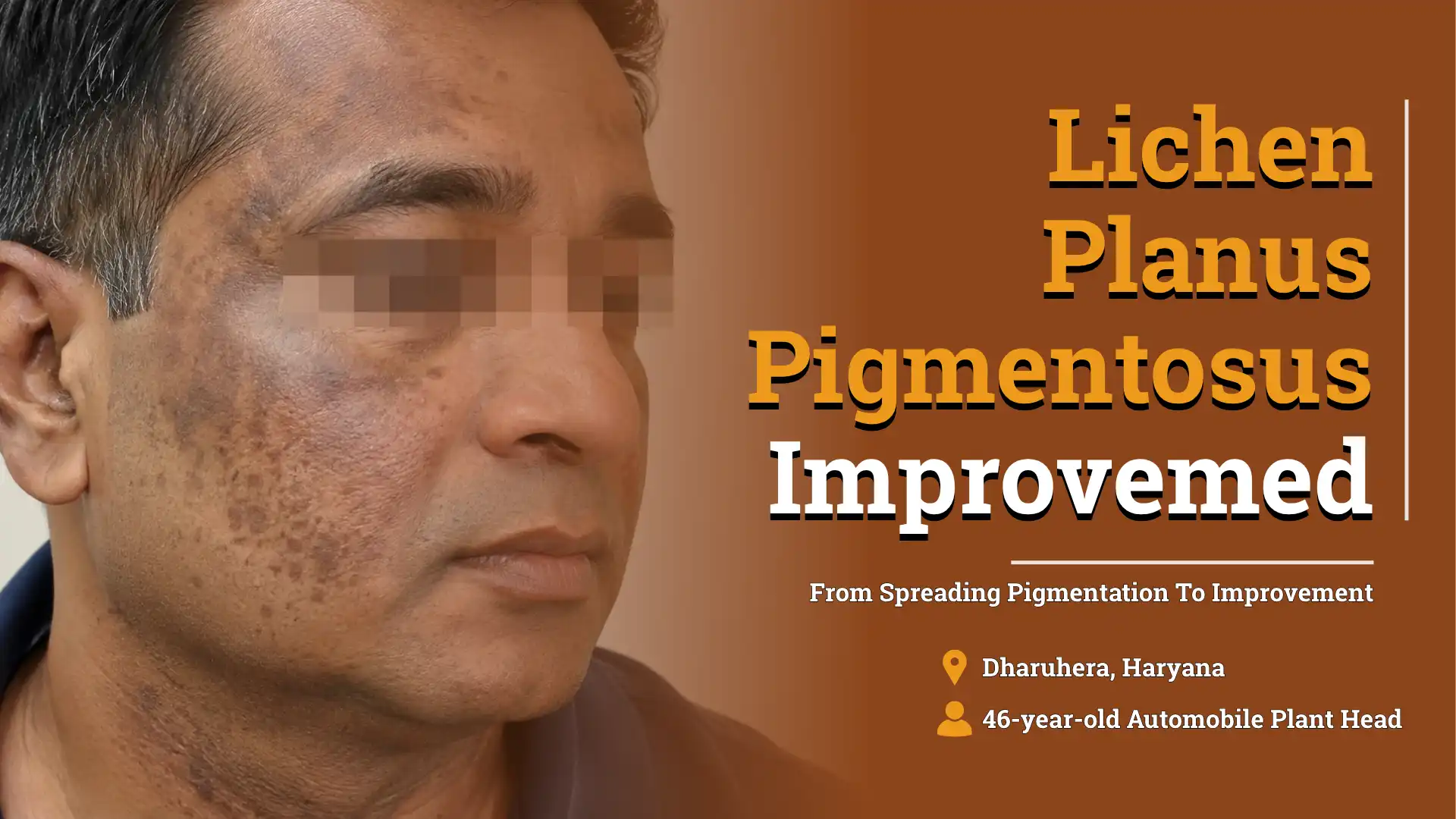


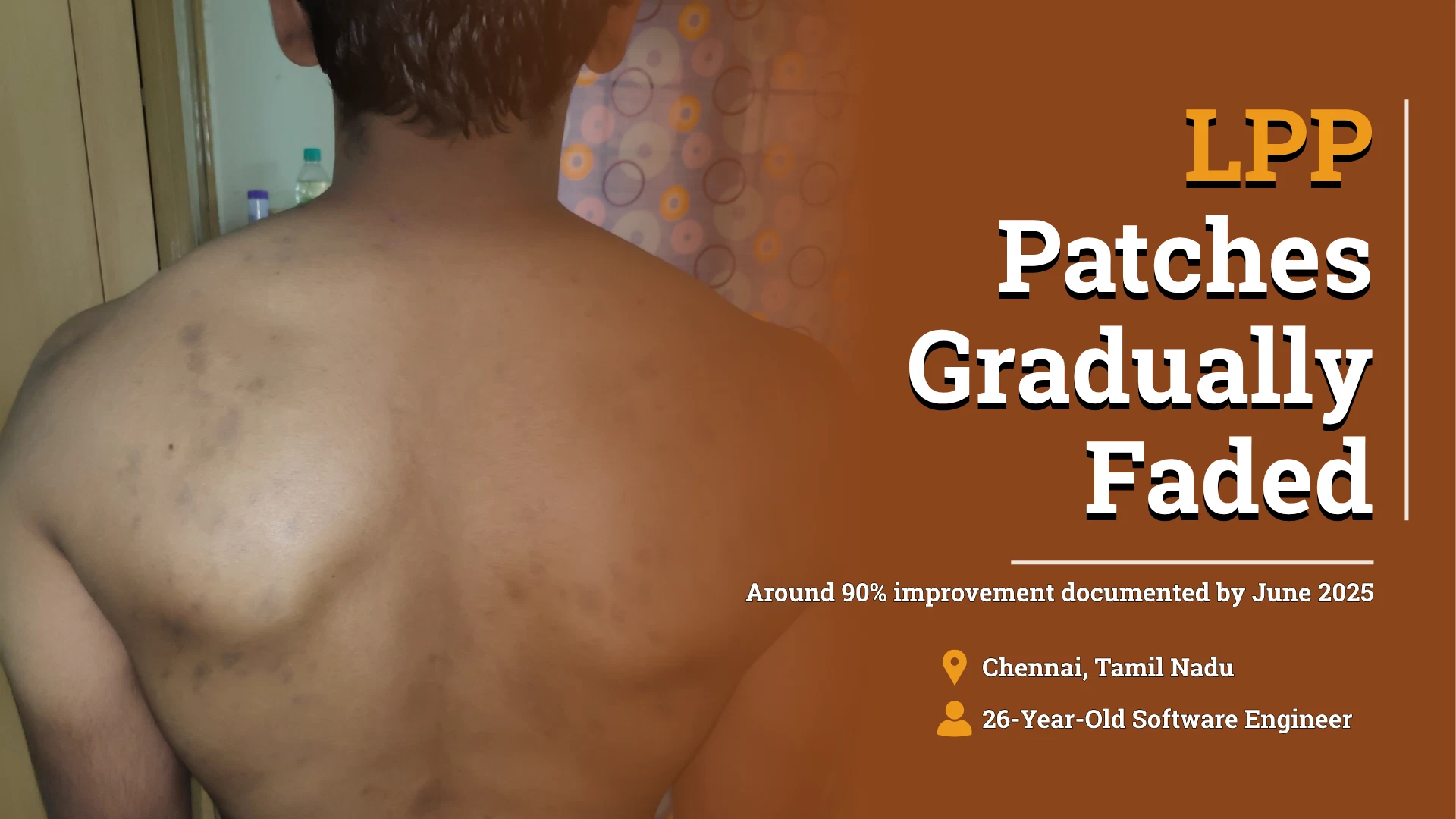
A 26-year-old software engineer from Chennai developed rapidly spreading Lichen Planus Pigmentosus (LPP) affecting multiple areas of his body. After beginning online consultation with Dr. Rajesh Shah in November 2018, the patches stabilized within two months and gradually faded. Approximately 85–90% improvement was documented by July 2020. Following a relapse in 2024 associated with occupational stress, treatment was restarted. By June 2025, approximately 90% improvement was documented, with no active new patches reported.
Table of Contents
- 01. Hero Introduction
- 02. Patient Case Details
- 03. What Is Lichen Planus Pigmentosus?
- 04. His Main Concern: Rapidly Spreading Patches
- 05. Why He Opted for Online Consultation
- 06. Understanding His Overall Health
- 07. How the Treatment Plan Was Developed
- 08. Follow-Up: From Active Spread to Stability
- 09. 5 January 2019 | 2 Months
- 10. 7 March 2019 | 4 Months
- 11. 2019–2020 | Continued Improvement
- 12. 4 July 2020 | 20 Months
- 13. A Relapse After Occupational Stress
- 14. Recovery After Restarting Treatment
- 15. 4 January 2025 | Approximately 2 Months After Restart
- 16. 28 June 2025 | Approximately 12 Months After Restart
- 17. Lichen Planus Symptoms and Skin Distribution
- 18. Ready to Know Your Recovery Chances?
- 19. Understanding Different Lichen Planus Types
- 20. Lichen Planus on Skin: How It Differs From Other Conditions
- 21. Can Lichen Planus Spread?
- 22. What This Case Showed Over Time
- 23. Outcome
- 24. Conclusion
Hero Introduction
A 26-year-old software engineer from Chennai developed rapidly spreading patches of Lichen Planus Pigmentosus (LPP) that had already involved multiple areas of his body within four months of onset. The patches were present over the hips, buttocks, shoulders, thighs, back, legs, forearms, and sides of the body.
The rapid spread was his primary concern. Unlike some forms of lichen planus, the patches were not associated with itching or discomfort. He had already tried treatment from a nearby private homeopathic clinic but had not noticed adequate improvement.
He began online consultation with Dr. Rajesh Shah in November 2018. Over the following years, the patches became stable and gradually faded. By July 2020, approximately 85–90% improvement in hyperpigmentation was documented. After a later relapse associated with occupational stress in 2024, treatment was restarted, with approximately 90% improvement documented by June 2025.
Patient Case Details
| Parameter | Details |
| Patient ID | S.K. (PIN: 38551) |
| Age | 26 years |
| Gender | Male |
| Profession | Software Engineer |
| Location | Chennai, Tamil Nadu |
| Condition | Lichen Planus Pigmentosus |
| Duration at First Consultation | 4 months |
| First Consultation | 17 November 2018 |
| Consultation Mode | Online |
What Is Lichen Planus Pigmentosus?
Lichen Planus Pigmentosus is a chronic variant of lichen planus characterized by changes in skin pigmentation. The source case describes patches appearing across both exposed and covered areas, with involvement of the trunk, limbs, hips, buttocks, shoulders, thighs, back, legs, forearms, and sides of the body.
The exact lichen planus causes are not fully established. Lichen planus is considered an immune-mediated inflammatory condition, while factors such as stress, certain medicines, and infections may be associated with worsening or recurrence in some individuals.
LPP can be persistent and may have a significant cosmetic and emotional impact, particularly when pigmentation spreads across visible areas.'
His Main Concern: Rapidly Spreading Patches
At the time of consultation, the patient had hypopigmented patches involving:
- Hips
- Buttocks
- Shoulders
- Thighs
- Back
- Legs
- Forearms
- Sides of the body, extending from below the armpits toward the hips
The patches had been spreading rapidly, which was his primary concern. There was no associated itching or discomfort.
He had received a diagnosis of LPP approximately four months before his first consultation and had already tried homeopathic treatment elsewhere without adequate response.
Why He Opted for Online Consultation
The patient was already interested in homeopathy when he came across Dr. Rajesh Shah's experience with chronic skin conditions. Patient testimonials, published case experiences, and the availability of online consultations influenced his decision to seek treatment.
Since he was living in Chennai, the online consultation format allowed him to begin treatment without travelling to Bengaluru.
Understanding His Overall Health
The case assessment went beyond the pigmentation pattern and included his physical characteristics, general health, lifestyle, and emotional profile.
He had an average appetite and preferred chicken and fish, while having an aversion to sweets. His daily water intake was approximately 2–3 litres, perspiration was average, and he was neither predominantly hot nor chilly. His bowel and urinary functions were satisfactory, and his sleep was sound.
He described his childhood as happy, with a supportive and loving family. He was emotionally sensitive and expressive. Although generally cheerful, he could experience anger and jealousy depending on interpersonal situations and tended to express anger directly and for a short duration.
How the Treatment Plan Was Developed
Dr. Rajesh Shah reviewed the distribution and rate of spread of the patches along with the patient's broader physical and psychological characteristics.
The treatment plan included constitutional homeopathic medicines, dietary guidance, a skin-care routine, lifestyle advice, and regular online follow-ups.
The prescription was selected after considering the complete case rather than focusing only on the visible pigmentation.
Follow-Up: From Active Spread to Stability
5 January 2019 | 2 Months
The patches remained stable, with no further spread observed. Treatment was continued.
This early stabilization was an important change because the rapid spread had been the patient's main concern at the beginning of treatment.
7 March 2019 | 4 Months
The patches continued to remain stable. Some areas had started to fade gradually.
Overall improvement was assessed at approximately 20%.
2019–2020 | Continued Improvement
During subsequent follow-ups, gradual improvement in the pigmentation was documented.
The changes developed progressively rather than suddenly, with continued monitoring through the online consultation process.
4 July 2020 | 20 Months
After approximately 20 months of treatment, the patient was assessed at 85–90% improvement in hyperpigmentation.
The case record described significant cosmetic improvement at this stage.
A Relapse After Occupational Stress
The patient remained stable for several years before experiencing a relapse in June 2024, following a period of occupational stress.
Previously affected areas including the thighs, legs, and buttocks developed pigmentation again. New patches were also noticed on the fingers, right arm, and waist.
No other associated symptoms were reported. Treatment was restarted following the relapse.
Recovery After Restarting Treatment
4 January 2025 | Approximately 2 Months After Restart
Changes in the patches were observed within two months of restarting treatment. The affected areas began fading, and no further spread was noted.
28 June 2025 | Approximately 12 Months After Restart
At the latest documented follow-up, the patient was assessed at approximately 90% improvement.
No active new patches were reported, and treatment was continued for consolidation.
Lichen Planus Symptoms and Skin Distribution
Typical lichen planus symptoms can vary depending on which part of the body is affected. Skin involvement may include itching, bumps, discoloration, or flat lesions, while mucosal involvement can produce different symptoms.
This case was different in that the patient's LPP patches were not associated with itching or discomfort. The primary concern was the rapid spread and visible pigmentation changes.
LPP may involve areas such as the trunk and limbs, as seen in this patient. Other forms of lichen planus can involve the lichen planus face, scalp, mouth, genital region, or other areas.
Ready to Know Your Recovery Chances?
Discover your recovery chances from chronic diseases in percentage with Life Force Homeopathy's FREE Assessment Test. Get a personalized evaluation from our experienced doctors.
Start Your FREE Assessment Test →Understanding Different Lichen Planus Types
The term lichen planus types covers several clinical patterns depending on the location and appearance of lesions.
For example, oral involvement is referred to as lichen planus mouth or oral lichen planus. Other presentations may involve the scalp, genital region, nails, or specific patterns on the skin.
Genital lichen planus and oral involvement require appropriate clinical assessment because symptoms and management can differ from skin-only presentations.
Lichen Planus on Skin: How It Differs From Other Conditions
Lichen planus on skin can sometimes resemble other inflammatory or pigmentary disorders. Diagnosis is therefore based on the clinical appearance, distribution, history, and, when required, additional examination or investigations.
Patients may also search for lichen planus vs psoriasis because both can produce chronic skin lesions. However, their typical appearance, distribution, and clinical characteristics differ, so a medical assessment is important rather than relying on photographs or online descriptions alone.
Can Lichen Planus Spread?
People commonly search how to stop lichen planus from spreading when new patches continue appearing.
The appropriate approach depends on the type of lichen planus, extent of involvement, possible triggers, and the individual's medical history. In this case, the first major change documented after treatment was stabilization of the patches, with no further spread noted at the two-month follow-up.
The later relapse in 2024 demonstrated that continued observation can remain important even after substantial improvement.
What This Case Showed Over Time
The documented course can be summarized as:
November 2018: Rapidly spreading LPP at presentation
↓
January 2019: Spread stabilized
↓
March 2019: Approximately 20% improvement
↓
July 2020: 85–90% improvement
↓
June 2024: Relapse following occupational stress
↓
January 2025: Fading of recurrent patches, no further spread
↓
June 2025: Approximately 90% improvement, no active new patches
This long-term timeline was important because it captured both substantial improvement and a later relapse.
Outcome
The documented outcome included:
- Stabilization of rapidly spreading patches within the first two months
- Gradual fading of existing pigmentation
- Approximately 85–90% improvement by July 2020
- A later relapse in June 2024 following occupational stress
- Improvement after treatment was restarted
- Approximately 90% improvement by June 2025
- No active new patches at the latest documented follow-up
- No itching or systemic symptoms reported throughout the documented course
- Improved confidence and quality of life reported in the case
The patient continued treatment for consolidation after the June 2025 assessment.
Living with a Lichen Planus Pigmentosus?
Receive a personalized treatment plan from our experienced homeopathic doctors. Trusted by over 100,000+ patients across 180+ countries for safe, natural and long term management of chronic diseases.
Conclusion
This case documents the long-term journey of a 26-year-old software engineer from Chennai with Lichen Planus Pigmentosus.
At presentation, the rapidly spreading patches involved multiple areas of the body without associated itching or discomfort. Following the start of treatment, the patches became stable within two months and gradually faded. Approximately 85–90% improvement was documented by July 2020 after around 20 months of treatment.
A relapse occurred in June 2024 following occupational stress, involving both previously affected and new areas. After treatment was restarted, fading of the patches was observed within two months, with approximately 90% improvement documented by June 2025.
For patients exploring homeopathy for lichen planus, this case provides a documented example of long-term monitoring of LPP, including both improvement and relapse.