





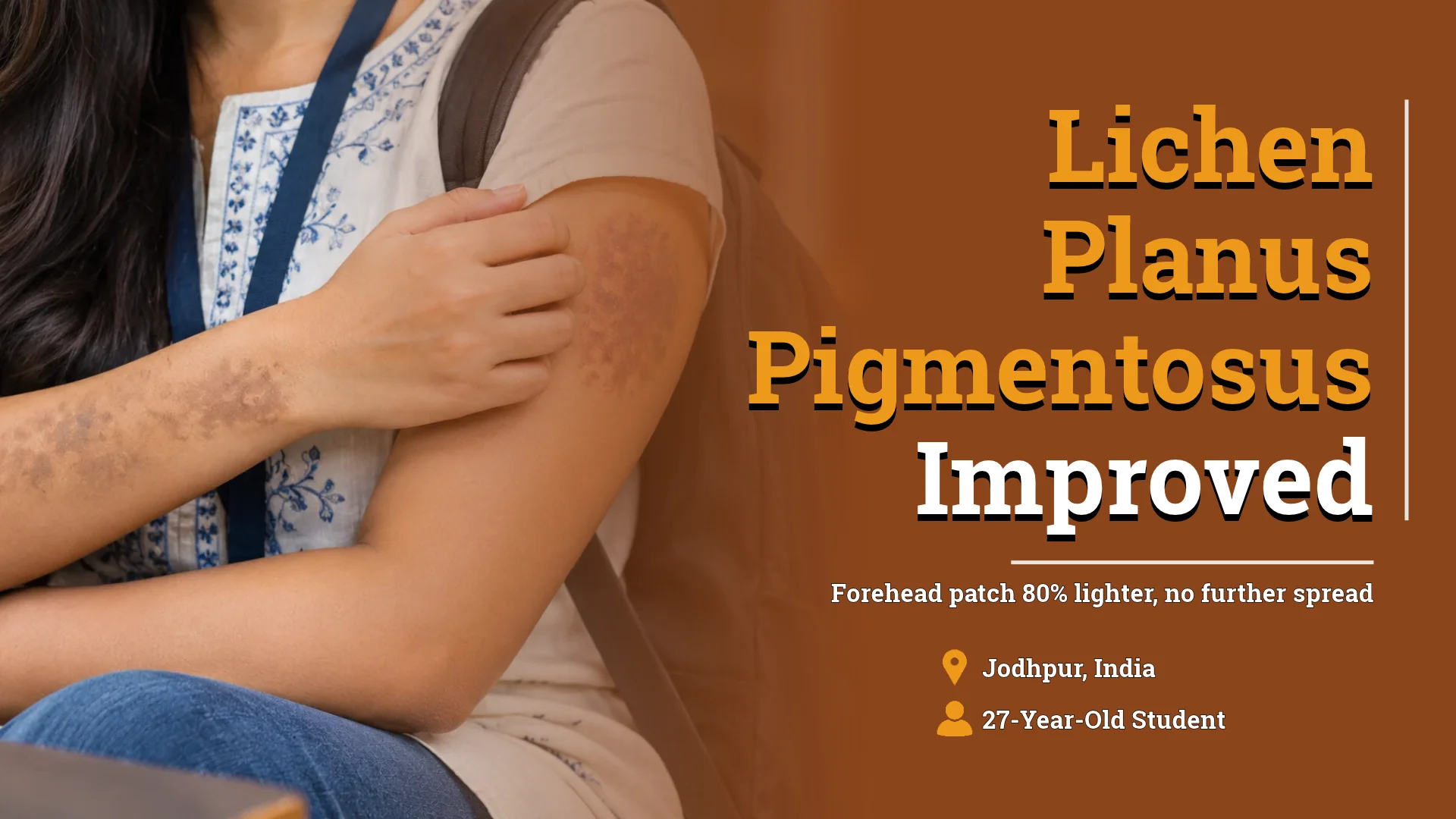
A 27-year-old woman from Jodhpur had a dark patch on the left side of her forehead for about 10 months. It was slowly spreading, and the skin was dry and itchy in the sun. She started online homeopathic treatment at Life Force in December 2024. Over time the patch became lighter, her itching and dryness went away, and it stopped spreading. At her latest follow-up in May 2026, she was about 80% better.
Table of Contents
- 01. Introduction
- 02. Patient Case Details
- 03. Presenting Complaints & Symptoms
- 04. Individual Case Assessment
- 05. Case Analysis: Doctor's Perspective
- 06. Treatment Approach
- 07. Treatment Plan
- 08. Medicine Prescribed
- 09. Follow-Up & Progress Timeline
- 10. Outcome
- 11. Doctor's Insight
- 12. Key Learnings
- 13. Conclusion
Introduction
Lichen Planus Pigmentosus (LPP) is a long-lasting skin problem that causes dark brown to grayish-black patches on the skin. It often shows up on the face and other parts that are open to the sun. Along with the change in how the skin looks, some people also get itching, dryness and extra sensitivity to sunlight. This can affect confidence and day-to-day life.
This is the documented journey of a 27-year-old woman (PIN 56337) from Jodhpur. She had a dark patch on the left side of her forehead that kept getting bigger. She was worried about the growing pigmentation and how it made her look, so she took online treatment at Life Force Homeopathy.
Over the course of treatment, the patch slowly became lighter, her itching and dryness went away completely, and the pigmentation stopped spreading. This case shows how individualized homeopathic treatment may help some people with lichen planus pigmentosus when it is given under a doctor's supervision.
Patient Case Details
| Parameter | Details |
|---|---|
| Patient ID | 56337 |
| Age | 27 Years |
| Gender | Female |
| First Consultation | 06 December 2024 |
| Condition | Lichen Planus Pigmentosus (LPP) |
| Duration at Presentation | Approximately 10 Months |
| Location of Lesion | Left Forehead |
Presenting Complaints & Symptoms
At the time of consultation, the patient had:
- A dark patch on the left forehead since February 2024
- Slow spread of the patch from the hairline to the left side of the forehead
- Dryness of the skin over the patch
- Itching that got worse in the sun
- Sensitive skin that was easily irritated
- Worry about her appearance and the pigmentation
The patch had first appeared as a small spot inside the hairline. Over the next few months, it slowly grew bigger.
Individual Case Assessment
A detailed homeopathic case evaluation was done to understand the patient beyond the visible skin problem.
Important observations included:
- She felt cold easily and was not very thirsty
- She craved oily foods, even though they made her acne worse
- Her periods were regular, with low back pain and acne before the periods
- She slept well and was generally in good health
- She was calm, kind and reserved
- She felt angry when things did not go as expected
- Comfort and consolation helped her when she was upset
- She enjoyed dancing and yoga
- She had very little stress and a supportive family
- Her elder brother had lichen planus in the past and had recovered with treatment
These personal and body traits play an important role in choosing the right medicine for each person. The doctor does not look only at the skin patch.
Case Analysis: Doctor's Perspective
Dr. Rajesh Shah did a detailed case evaluation. He looked at her physical symptoms, her overall makeup, her family history and her personality.
Lichen Planus Pigmentosus often moves slowly. It can be hard to treat because the dark color stays and the patch can spread. Conventional treatment mainly focuses on managing symptoms and stopping the condition from getting worse.
The homeopathic approach aims to support the body's own healing response with treatment that fits the person's overall symptom picture. In this case, the pattern of the pigmentation, her sensitive skin, her feeling of cold, her food cravings, her nature and her family history were all kept in mind while planning the treatment.
Treatment Approach
Based on the detailed assessment, individualized homeopathic medicines were prescribed, with regular monitoring and follow-ups.
Treatment Plan
The treatment plan included:
- Personalized homeopathic medicines based on her overall nature
- Regular follow-up consultations
- Changing the medicines from time to time based on her response
- Keeping watch for any spread of the pigmentation
- Watching for any new skin problems
- Long-term checking of her overall health and general improvement
Medicine Prescribed
After a thorough evaluation of her case, Dr. Shah carefully looked at her symptoms, family history and personality before prescribing Sepia 30, a homeopathic medicine for her condition.
Follow-Up & Progress Timeline
1st Follow-Up: 28 January 2025
The lesion on the forehead showed improvement. Itching and dryness reduced. No further spread was seen.
2nd Follow-Up: 29 April 2025
About 50% improvement in the pigmentation. No itching, dryness or spread.
3rd Follow-Up: 27 June 2025
Further improvement, with 60 to 65% lightening of the patch. No new patches and no progression.
4th Follow-Up: 21 August 2025
Around 70% improvement in the pigmentation. No spread of LPP. She had a new complaint of itching and small blister-like eruptions on the fingers, which looked like atopic dermatitis.
5th Follow-Up: 25 October 2025
The forehead patch looked even lighter. The finger eruptions were also noted.
6th Follow-Up: 12 December 2025
The patch was stable, with no improvement and no spread.
7th Follow-Up: 11 March 2026
Further lightening of the patch was seen.
Latest Follow-Up: 5 May 2026
80% improved. No new patch and no spread of the patch were seen.
Outcome
Over the course of treatment, the patient had a clear improvement in her lichen planus pigmentosus:
- About 70% reduction in pigmentation
- Complete relief from itching and dryness
- No further spread of the patch
- Slow, steady lightening of the affected area
- Better overall skin health
- Settling of the finger eruptions
- More confidence and satisfaction with her appearance
The improvement came slowly and stayed stable throughout the treatment period.
Doctor's Insight
According to the treating team, Lichen Planus Pigmentosus needs an individualized approach. It looks not only at the visible pigmentation but also at the patient's overall makeup, skin sensitivity, family tendency and general health pattern. In this case, her symptoms and family history were kept in mind while planning treatment. The slow reduction in pigmentation, relief from itching and dryness, and no further spread showed positive long-term skin stabilization.
Key Learnings
- Lichen planus pigmentosus may respond well to individualized homeopathic care.
- Stopping the spread can be an important early step in treatment.
- Family history and personal traits can give useful information when assessing a case.
- Regular follow-ups help track progress and adjust treatment.
- Staying consistent with treatment and long-term monitoring are important in long-lasting pigment problems.
Living with Lichen Planus Pigmentosus ?
Receive a personalized treatment plan from our experienced homeopathic doctors. Trusted by over 100,000+ patients across 180+ countries for safe, natural and long term management of chronic diseases.
Conclusion
This case shows a clear improvement in lichen planus pigmentosus after individualized homeopathic treatment. Over time, the pigmentation reduced by about 70%, itching and dryness went away, and the patch did not spread any further. The case highlights the importance of individualized assessment, regular follow-ups and steady treatment in managing long-lasting pigment problems. Results may vary depending on how long the condition has been there, how severe it is, individual factors and how regularly treatment is followed.

