


Table of Contents
Underactive bladder can significantly affect quality of life, especially in elderly individuals. Difficulty passing urine, weak urine flow, urinary retention, and dependency on catheters often create both physical discomfort and emotional stress. Recovery may become more challenging when associated with prostate enlargement and prolonged immobilization.
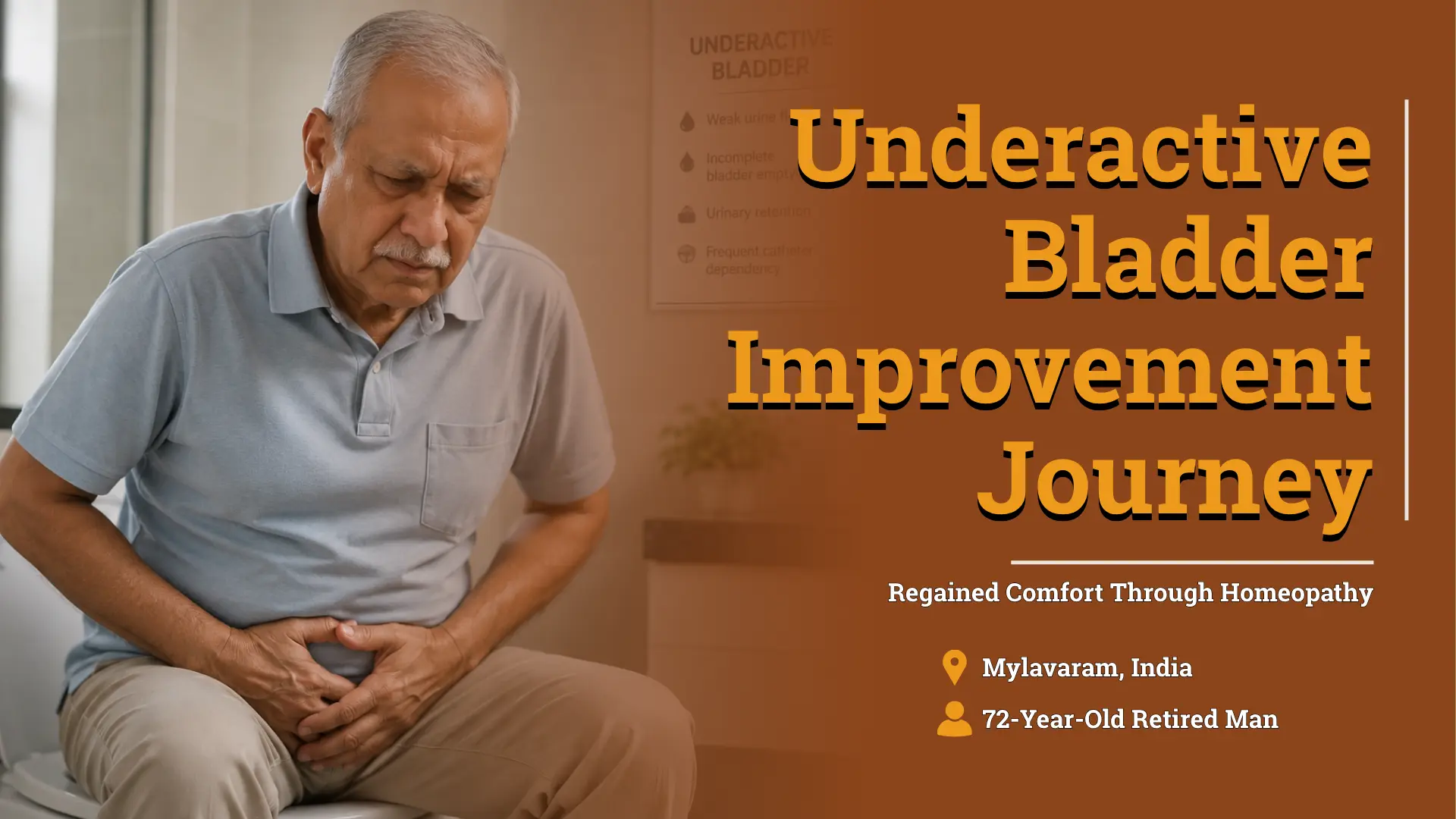
This case study presents the journey of an elderly retired army officer who experienced gradual improvement in urinary flow and bladder function with individualized homeopathic treatment after prolonged catheter dependency.
Patient Case Details
| Parameter | Details |
| Patient ID | S.D. (55303) |
| Age | Elderly |
| Gender | Male |
| Occupation | Retired Army Officer |
| First Consultation | 11 August 2024 |
| Condition | Underactive Bladder |
| Associated Conditions | Benign Prostatic Enlargement, Hypertension |
About Underactive Bladder
Underactive bladder is a condition in which the bladder muscles lose their ability to contract effectively, resulting in incomplete bladder emptying or urinary retention. The condition is more commonly seen in elderly individuals and may occur after prolonged catheterization, nerve-related disorders, prostate enlargement, or prolonged immobilization.
Common symptoms include:
- Weak urine flow
- Difficulty initiating urination
- Sensation of incomplete bladder emptying
- Urinary retention
- Frequent catheter dependency
- Burning sensation while urinating in some cases
Presenting Complaints
The patient approached Life Force for:
- Underactive bladder with weakened bladder muscles
- History of urinary retention
- Weak urinary stream
- Sensation of incomplete bladder emptying
- Dependency on catheter support for two months following an ankle fracture and prolonged bedridden state
After catheter removal, he continued to experience poor urinary flow and difficulty emptying the bladder completely.
He was also taking conventional medicines at the time of consultation.
Associated Medical Conditions
The patient also had:
- Benign enlargement of the prostate for two years
- Hypertension for fourteen years, managed with regular medication
Medical & Personal Background
The patient followed a mixed diet and had a preference for fish and chicken. Thermally, he was ambithermal.
He was a retired army officer and lived separately from his son and daughter, who were settled in the United States with their families.
Emotionally, he was impatient, restless, and easily irritated over small matters. He also tended to worry excessively about his health.
Living with a Chronic Condition? Get Expert Guidance.
Talk to Dr. Rajesh Shah — 40+ years of experience in managing chronic conditions with a personalized, long-term approach.
Investigations
USG Whole Abdomen (27 June 2024)
Findings included:
- Grade I prostatomegaly (24 cc)
- Over-distended urinary bladder
- Significant post-void residual urine (645 cc)
- Possible acute urinary retention
- Mildly altered liver echotexture
- Small gallbladder polyp (4 mm)
- Small umbilical hernia
Case Analysis & Treatment Approach
The case was evaluated in detail by Dr. Rajesh Shah, considering the patient’s urinary symptoms, prostate enlargement, emotional profile, and overall health condition.
An individualized homeopathic treatment plan was prescribed along with recommendations for necessary investigations and monitoring.
The treatment approach focused on:
- Supporting bladder muscle function
- Improving urinary flow
- Reducing urinary retention symptoms
- Gradually minimizing catheter dependency
- Supporting overall urinary comfort and stability
Follow-Up & Progress Timeline
First Follow-Up – 10 October 2024
The patient reported improvement and was able to pass urine with a normal flow without catheter support for the previous month.
An occasional burning sensation was noted after consuming spicy or garlic-based food. He continued Uritone 25 mg three times daily.
Medicines were prescribed for the next two months.
Second Follow-Up – 11 December 2024
Further improvement was observed. The patient continued passing urine normally without requiring a catheter.
There was no burning sensation. Conventional medicines continued alongside homeopathic treatment.
Third Follow-Up – 7 February 2025
The patient remained stable with normal urine flow and no burning sensation.
His treating physician had stopped Uritone tablets one month earlier. Based on continued progress, medicines were prescribed for another two months.
Fourth Follow-Up – 12 August 2025
The patient reported overall stability with normal urine flow and no urinary complaints.
Homeopathic medicines were continued.
Fifth Follow-Up – 14 October 2025
The patient remained comfortable with normal urinary flow and no active complaints.
Continued treatment was advised for supportive long-term stability.
Result Summary
Over the course of treatment, the patient experienced:
- Gradual improvement in urinary flow
- Successful removal of catheter dependency
- Reduced urinary discomfort
- Resolution of burning sensation
- Improved bladder emptying
- Stable urinary function over time
Doctor’s Insight
According to the treating team at Life Force, urinary conditions in elderly individuals often require a comprehensive and individualized treatment approach. Addressing both physical symptoms and the patient’s constitutional profile may help support long-term urinary stability and quality of life.
Conclusion
This case study demonstrates that individualized homeopathic treatment may support symptomatic improvement in underactive bladder and urinary retention in some patients.
Although treatment outcomes may vary depending on age, severity, associated prostate enlargement, and overall health condition, regular follow-ups and a structured approach may help improve urinary comfort and bladder function over time.