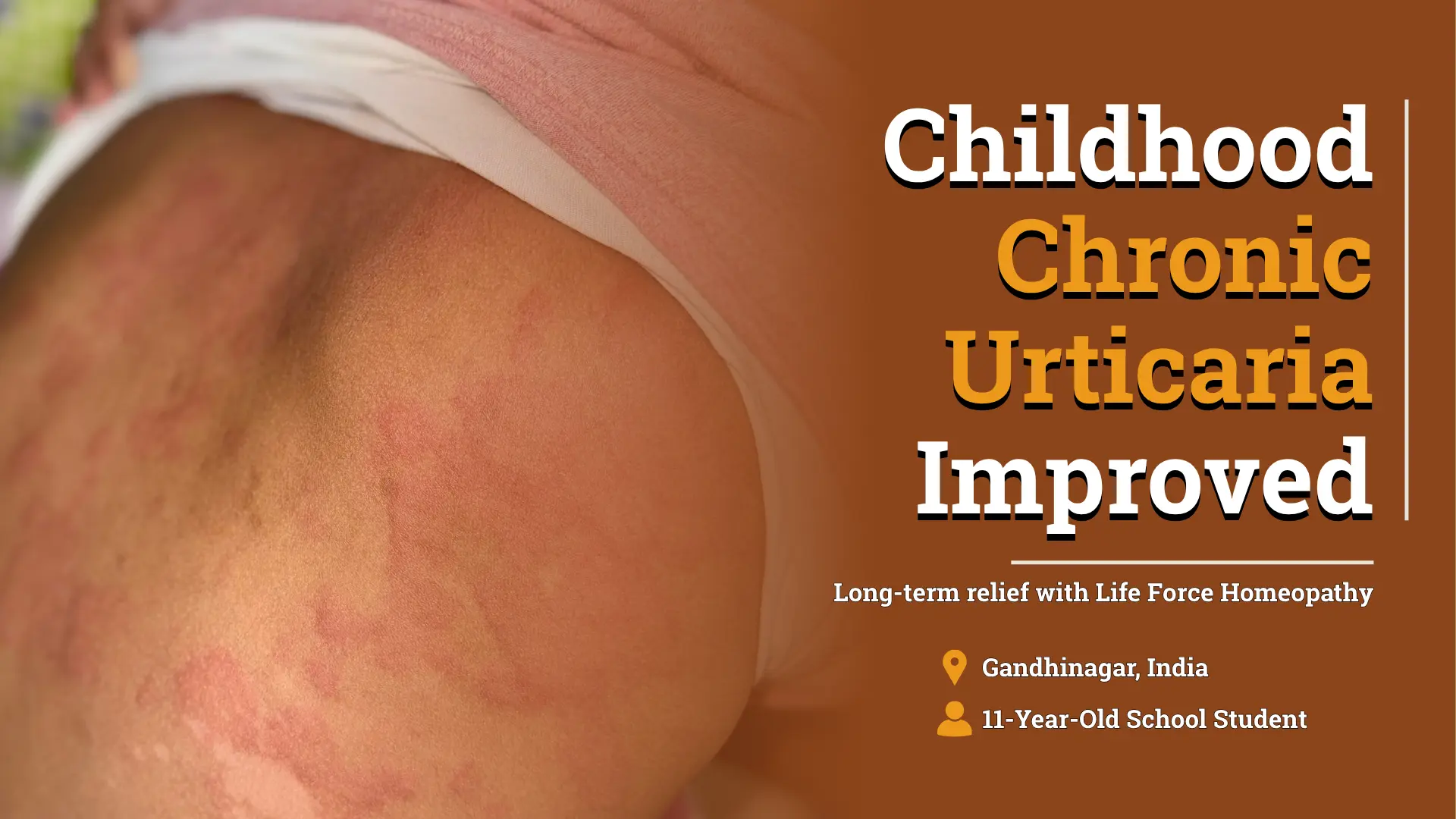


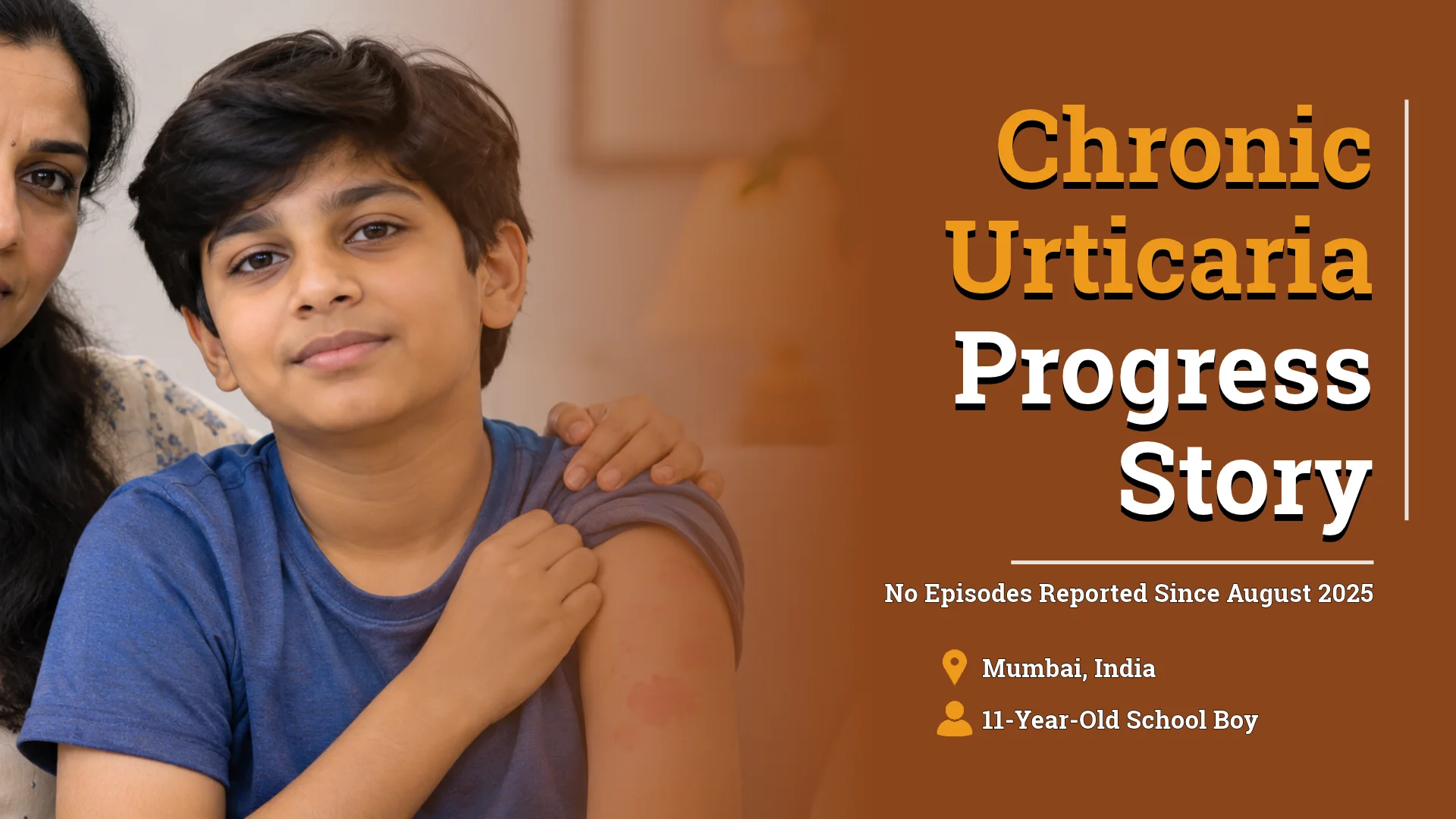
An 11-year-old boy from Mumbai experienced recurring chronic urticaria, with widespread hives, intense itching, redness, and occasional swelling. After consulting Life Force Homeopathy, he received individualized homeopathic treatment under Dr. Rajesh Shah. His journey included several recurrences, followed by longer symptom-free periods. According to the latest follow-up records, no urticaria episodes were reported from August 2025 onward.
Table of Contents
- 01. Patient Case Details
- 02. Understanding Chronic Urticaria in Children
- 03. When the Hives Kept Coming Back
- 04. His General Health and Family History
- 05. An Active Child Who Enjoyed Being Around People
- 06. How His Urticaria Treatment Was Planned
- 07. Follow-Up Journey: From Repeated Outbreaks to Longer Symptom-Free Periods
- 08. Before and After Treatment: What Changed?
- 09. How Much Did His Condition Improve?
- 10. Doctor's Insight
- 11. Conclusion
For an 11-year-old boy from Kandivali, Mumbai, recurring hives had become an uncomfortable part of everyday life. Large red patches would appear across his body, accompanied by intense itching, a burning sensation, and occasional swelling. Even when medicines helped settle an episode, the relief did not always last.
The problem began in March 2023, during a cruise trip to Japan, when he experienced his first severe outbreak. Over time, the episodes continued to return, sometimes affecting his entire body.
The child, identified as Mast H.N. (Patient ID: 55963), later consulted Life Force Homeopathy, Borivali Branch, for chronic urticaria treatment.
His case documents a gradual change in his symptoms during individualized homeopathic care. Although he experienced several recurrences during follow-up, his later records showed longer periods without hives and reduced use of antihistamines.
Patient Case Details
| Parameter | Details |
|---|---|
| Patient ID | 55963 |
| Patient Name | Mast H.N. |
| Age | 11 years |
| Gender | Male |
| Location | Kandivali, Mumbai |
| Clinic | Life Force Homeopathy, Borivali |
| Condition | Chronic Urticaria |
| Symptoms Since | March 2023 |
| Main Complaints | Recurring hives, intense itching, redness, heat sensation, and swelling |
| Treating Doctor | Dr. Rajesh Shah |
| Latest Reported Status | No urticaria episodes reported from August 2025 onward |
Understanding Chronic Urticaria in Children
Urticaria, commonly known as hives, is a skin condition that causes raised, itchy patches called wheals. These eruptions develop when substances such as histamine are released from cells in the skin.
The wheals may appear suddenly, change shape, disappear, and reappear in different areas. Individual wheals usually settle within 24 hours, although new ones may continue to develop.
When hives keep recurring for more than six weeks, the condition is generally classified as chronic urticaria.
Children with chronic urticaria may experience:
- Raised red or skin-coloured wheals.
- Intense itching that interferes with daily comfort.
- Redness and a burning or warm sensation.
- Swelling around the lips, eyes, or other areas, known as angioedema.
- Repeated episodes without an obvious trigger.
In many children, a single cause cannot be identified. Infections, temperature changes, certain medicines, and other factors may sometimes contribute to flare-ups.
When the Hives Kept Coming Back
At his first consultation, the boy had a history of severe urticaria affecting almost his entire body.
His symptoms included large red wheals, intense itching, widespread redness, a strong sensation of heat, and occasional swelling.
The eruptions were uncomfortable and required repeated medication to bring them under control.
Previously, steroid medicines had provided temporary relief. However, the episodes continued to recur.
The child also experienced frequent colds and coughs. During later follow-ups, some urticaria episodes appeared alongside these respiratory complaints.
No consistent food or environmental trigger was identified.
His General Health and Family History
Despite the recurring skin symptoms, the boy was active, energetic, and interested in outdoor activities.
His general health details included:
| Parameter | Details |
|---|---|
| Appetite | Good |
| Food Preferences | Spicy food and non-vegetarian food, especially chicken |
| Thirst | Adequate |
| Bowel Movements | Regular |
| Urination | Regular |
| Mother's Medical History | Hyperthyroidism |
| Father's Medical History | Diabetes mellitus |
An Active Child Who Enjoyed Being Around People
The boy was talkative, friendly, and expressive. He interacted comfortably with others and generally maintained a positive attitude.
He was quick to respond and sometimes became irritated when interrupted or contradicted, although he remained cooperative.
Academically, he showed good understanding and concentration.
He also enjoyed cycling and playing basketball.
These personal and general health details were recorded during the homeopathic case assessment.
How His Urticaria Treatment Was Planned
At Life Force Homeopathy, Dr. Rajesh Shah reviewed the child's recurring symptoms, medical history, and general health before planning his homeopathic treatment.
The assessment covered:
Living with a Chronic Condition? Get Expert Guidance.
Talk to Dr. Rajesh Shah — 40+ years of experience in managing chronic conditions with a personalized, long-term approach.
- Duration and recurrence of urticaria since March 2023.
- Severity of itching and appearance of wheals.
- Distribution of rashes across the body.
- Redness, heat sensation, and episodes of swelling.
- Possible associations with recurring colds and coughs.
- Previous treatment with steroids and antihistamines.
- Food preferences, general health, and family history.
- The child's emotional characteristics and daily routine.
Following the assessment, Carcinosin 30, along with other homeopathic medicines described in the records as research-based, was prescribed.
The treatment plan involved monitoring the frequency, severity, and duration of his urticaria episodes through regular follow-ups.
Conventional medicines, including antihistamines, were also used during parts of his treatment period.
Follow-Up Journey: From Repeated Outbreaks to Longer Symptom-Free Periods
The child's progress was not immediate or completely uninterrupted.
Some follow-ups showed improvement, while others recorded fresh episodes, particularly after changes in antihistamine use.
15 December 2024: Another Severe Episode
The boy experienced a severe urticaria episode involving extensive redness, large wheals, intense itching, and a marked heat sensation.
The symptoms settled within two to three days after conventional medication.
At this stage, he was taking Bilastine 10 mg once daily.
12 February 2025: A Period Without Hives
At this follow-up, the child was stable and had experienced no urticaria episodes since November 2024.
He continued taking Bilastine 20 mg once daily.
This was an encouraging period, although he was still receiving antihistamine treatment.
26 March 2025: Symptoms Returned After Stopping Bilastine
The child developed another outbreak after stopping Bilastine 20 mg approximately 15 days before the follow-up.
This episode involved rashes, itching, and redness over his hands, legs, back, and face.
The recurrence showed that his symptoms were not yet consistently controlled without antihistamines.
10 May 2025: Recurring Episodes and Facial Swelling
The boy continued experiencing urticaria episodes approximately every one to one and a half months.
These episodes lasted around five to six days.
One particularly severe episode involved widespread rashes, itching, redness, and swelling around the lips and eyes.
The symptoms improved after taking Bilastine 20 mg.
The family also reported that urticaria episodes were often associated with colds and coughs.
17 June 2025: No New Urticaria Episodes
At this visit, the child had experienced no urticaria episodes since the previous follow-up.
He had a brief episode of cold and cough lasting three to four days, which was managed with Sinarest.
No new hives were reported during this period.
August 2025 Onward: Continued Stability
According to the latest available follow-up summary, the child remained free from urticaria episodes from August 2025 onward.
The records describe him as stable and symptom-free, with improvement maintained while receiving homeopathic treatment alone.
This was a positive change compared with the recurring episodes documented earlier in his treatment journey.
However, the available records do not establish that homeopathy caused the remission or prevented future outbreaks.
Before and After Treatment: What Changed?
| Before Treatment | Later Follow-Ups |
|---|---|
| Severe urticaria affecting the entire body | No urticaria episodes reported from August 2025 onward |
| Large red wheals and intense itching | No itching or wheals reported during the latest symptom-free period |
| Episodes involving redness, heat, and swelling | No further swelling reported in the latest follow-up summary |
| Repeated use of medicines for temporary relief | Later records describe stability without antihistamine use |
| Episodes recurring every 1–1.5 months during part of follow-up | Longer periods without recurrence |
| Episodes lasting approximately 5–6 days during part of follow-up | No active episodes reported in the latest available records |
How Much Did His Condition Improve?
The most encouraging change was the longer period without urticaria episodes toward the end of the documented follow-up period.
Earlier, the child had experienced severe outbreaks involving extensive rashes, itching, redness, and swelling. Some episodes required antihistamines, and symptoms returned after Bilastine was stopped in March 2025.
By June 2025, he had experienced a period without new hives. The latest records subsequently described continued stability from August 2025 onward.
The main improvements reported were:
- Longer intervals without urticaria episodes.
- No active itching or wheals in the latest symptom-free period.
- No further severe outbreaks documented after the earlier recurrences.
- Reduced reliance on antihistamines in the later treatment records.
- Improved overall symptom control.
These observations describe the child's recorded progress. They do not establish that the underlying tendency to develop urticaria had permanently resolved.
Doctor's Insight
Chronic urticaria in children can be unpredictable. Symptoms may settle for several weeks and return unexpectedly, sometimes alongside infections or other triggers.
In this case, the treating team considered the child's recurrence pattern, skin symptoms, associated colds and coughs, previous medicines, and overall health while planning individualized care.
The follow-up history also highlighted the importance of monitoring symptoms when antihistamines are reduced or discontinued.
Because urticaria can recur even after long symptom-free periods, continued observation remains important.
Conclusion
This case of an 11-year-old boy from Kandivali highlights his progress during chronic urticaria treatment at Life Force Homeopathy, Borivali. After experiencing repeated episodes of severe itching, widespread wheals, redness, and swelling, he gradually reported longer periods without symptoms. By August 2025, the available follow-up records described him as stable and free from urticaria episodes. His experience with homeopathic treatment for urticaria, alongside conventional medication during earlier follow-ups, emphasizes the importance of careful assessment, regular monitoring, and ongoing care for children with recurring hives.