


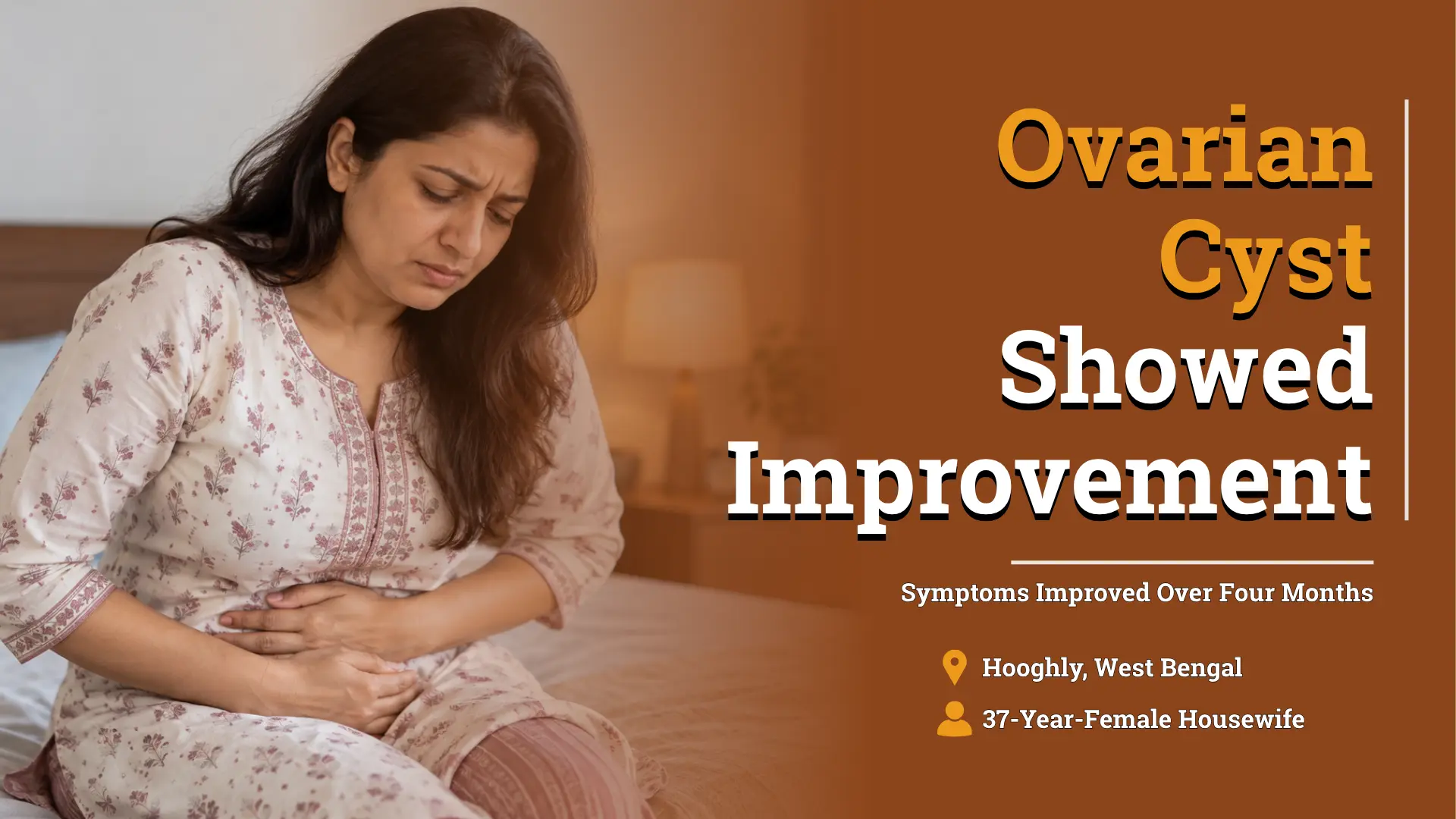
A 37-year-old woman with a two-year history of a left ovarian hemorrhagic cyst experienced improvement in menstrual symptoms and associated complaints during four months of follow-up. Her initial ultrasound showed a 2.19 × 1.84 cm cyst, while repeat ultrasound on 7 March 2026 reported no signs of an ovarian cyst. Approximately 80% overall symptom improvement was documented.
Table of Contents
- 01. Hero Introduction
- 02. Patient Case Details
- 03. Patient’s experience with ovarian cyst
- 04. Understanding Ovarian Cysts
- 05. Ready to Know Your Recovery Chances?
- 06. Ovarian Cyst vs PCOS: Are They the Same?
- 07. A Closer Look at Her Health
- 08. How Her Treatment Plan Was Developed
- 09. Why Follow-Up Imaging Was Important
- 10. Dr. Rajesh Shah’s Perspective
- 11. Four Months of Follow-Up
- 12. What Changed During the Follow-Up?
- 13. When Does an Ovarian Cyst Need Urgent Medical Attention?
- 14. Key Takeaways From This Case
- 15. Conclusion
Hero Introduction
For a 37-year-old homemaker from Hooghly, West Bengal, an ovarian cyst had been a concern for nearly two years. Along with the cyst, she was dealing with heavy menstrual bleeding, large clots, abdominal cramps, vaginal discharge, and vulval itching.
An ultrasound performed on 14 November 2025 showed bilateral bulky ovaries along with a left ovarian hemorrhagic cyst measuring 2.19 × 1.84 cm. She had been advised conventional hormonal treatment for an ovarian cyst but was concerned about possible side effects and decided to seek another medical opinion.
She consulted Life Force Homeopathy's Jayanagar branch on 18 November 2025. Her case was reviewed in detail, including her menstrual symptoms, general health, emotional characteristics, and lifestyle. During the following four months of ovarian cyst treatment with homeopathy, her symptoms gradually reduced. A repeat ultrasound on 7 March 2026 showed no signs of an ovarian cyst, while approximately 80% overall symptom improvement was documented.
Patient Case Details
| Parameter | Details |
| Patient ID | 57500 |
| Age | 37 years |
| Gender | Female |
| Occupation | Housewife |
| Location | Hooghly, West Bengal |
| Condition | Left ovarian hemorrhagic cyst with bilateral bulky ovaries |
| Duration | Approximately 2 years |
| First Consultation | 18 November 2025 |
| Branch | Jayanagar, Bengaluru |
| Physician | Dr. Rajesh Shah, M.D. (Hom.) |
Patient’s experience with ovarian cyst
The ovarian cyst was not her only concern when she first consulted. Her periods were associated with profuse bleeding and large clots, along with abdominal cramps.
She also reported:
- A left ovarian hemorrhagic cyst that had persisted for approximately two years
- Heavy menstrual bleeding with clots
- Abdominal cramps during menstruation
- Leukorrhea, or vaginal discharge
- Vulval itching
Her ultrasound dated 14 November 2025 showed bilateral bulky ovaries and a 2.19 × 1.84 cm hemorrhagic cyst in the left ovary.
She had been advised conventional hormonal therapy but was apprehensive about possible side effects. This prompted her to explore another treatment approach while continuing appropriate medical monitoring.
Understanding Ovarian Cysts
An ovarian cyst is a fluid-filled sac that develops in or on an ovary. Many ovarian cysts are related to the menstrual cycle and may resolve without treatment, while others can persist or cause symptoms and require monitoring.
Symptoms can vary depending on the type and size of the cyst. Some women have no symptoms, while others may experience pelvic discomfort, changes in menstrual bleeding, bloating, or pain.
A hemorrhagic cyst occurs when bleeding takes place within a cyst. Its appearance, size, symptoms, and changes over time are important considerations when deciding how it should be monitored.
The management of an ovarian cyst depends on factors such as its appearance on imaging, size, symptoms, age, and whether it changes over time. Depending on the clinical situation, a doctor may recommend observation with repeat imaging, medication, further evaluation, or a procedure.
Ready to Know Your Recovery Chances?
Discover your recovery chances from chronic diseases in percentage with Life Force Homeopathy's FREE Assessment Test. Get a personalized evaluation from our experienced doctors.
Start Your FREE Assessment Test →Ovarian Cyst vs PCOS: Are They the Same?
No. An ovarian cyst and PCOS are not the same condition.
PCOS is a hormonal and metabolic condition that may involve irregular periods, increased androgen activity, and characteristic ovarian findings. An individual ovarian cyst, on the other hand, is a specific fluid-filled structure that may develop in or around an ovary.
Therefore, finding an ovarian cyst on an ultrasound does not automatically mean that a woman has PCOS. The two conditions require different clinical assessments.
A Closer Look at Her Health
The consultation included a review of the patient's general health and personal characteristics along with her gynecological complaints.
She followed a non-vegetarian diet, had an average appetite, and had a marked craving for sweets. Her thirst was average, with approximately 2–2.5 litres of water intake daily. She had average perspiration and was uncomfortable with extreme weather conditions.
Her bowel movements were unsatisfactory, with hard stools and a tendency to strain. There were no urinary complaints. Her sleep was sound, and she preferred sleeping on her sides.
She described her childhood and married life as happy and supportive. However, she was notably anxious about her health and tended to overthink. She was sensitive and emotional, cried easily, and often sought consolation from others.
She enjoyed travelling, while her memory, perception, logical thinking, and analytical abilities were reported to be intact.
These observations formed part of the overall case assessment.
How Her Treatment Plan Was Developed
Dr. Rajesh Shah reviewed the patient's menstrual history, physical symptoms, general health, emotional characteristics, and ultrasound findings before selecting the prescription.
The treatment plan included prescribed homeopathic medicines along with dietary and lifestyle guidance. A diet chart suited to her case was also provided.
During follow-ups, attention was given to changes in menstrual bleeding, clotting, abdominal and back pain, leukorrhea, vulval itching, and the overall symptom pattern.
Importantly, the ovarian finding was not assessed through symptoms alone. A repeat ultrasound was advised so that the initial imaging could be compared with a later scan.
Why Follow-Up Imaging Was Important
Symptoms can tell us how a patient feels, but they do not by themselves confirm whether an ovarian cyst is still present.
In this case, the initial ultrasound provided a measurable baseline:
14 November 2025:
Left ovarian hemorrhagic cyst measuring 2.19 × 1.84 cm, with bilateral bulky ovaries.
After the patient reported improvement in her symptoms, a repeat ultrasound was advised.
7 March 2026:
The repeat scan reported no signs of an ovarian cyst.
This before-and-after imaging provides an objective part of the case record alongside the reported improvement in menstrual and associated symptoms.
Dr. Rajesh Shah’s Perspective
Ovarian cysts can have different clinical courses, so understanding the individual patient's symptoms and monitoring relevant investigations is important. In this case, the patient's symptoms were reviewed alongside her ultrasound findings during follow-up.
The case can also be accompanied by relevant information on Dr Rajesh Shah's clinical experience and research work in women's health and chronic conditions.
Four Months of Follow-Up
| Follow-Up | Clinical Progress |
| 15 January 2026 – 1st Follow-Up | Her period had started on 3 January 2026. There was no spotting on day 1. Flow was moderate initially, followed by heavy bleeding with large clots on days 2 and 3. Bleeding became moderate on day 4, followed by spotting on day 5 before stopping. Back pain was present on days 2 and 3. Leukorrhea persisted on some days but had improved, while vulval itching had reduced. |
| 4 March 2026 – 2nd Follow-Up | Her period had started on 2 February 2026. Flow was moderate, with clots on days 2 and 3, but the quantity was reduced. She reported no abdominal or back pain during this cycle. Vulval itching and leukorrhea had resolved. Her period lasted five days. A repeat ultrasound was advised to assess the ovarian finding. |
| 7 March 2026 – Repeat USG | The ultrasound showed no signs of an ovarian cyst. Approximately 80% overall symptom improvement was documented within four months of starting the treatment plan. |
What Changed During the Follow-Up?
The improvement involved several of the symptoms that had initially troubled the patient.
Her menstrual bleeding became more manageable, with a reduction in the quantity of clots during the second documented cycle. Abdominal and back pain were no longer reported during that cycle. The earlier leukorrhea and vulval itching had also resolved.
The most significant objective finding came from the repeat ultrasound on 7 March 2026, which reported no signs of the previously documented ovarian cyst.
The case therefore includes both reported symptom improvement and a change documented on repeat imaging. However, because ovarian cysts can have different natural courses, this single case cannot determine the cause of the imaging change.
Living with a PMOS?
Receive a personalized treatment plan from our experienced homeopathic doctors. Trusted by over 100,000+ patients across 180+ countries for safe, natural and long term management of chronic diseases.
When Does an Ovarian Cyst Need Urgent Medical Attention?
Most ovarian cysts do not require emergency treatment, but certain symptoms should not be ignored.
Seek urgent medical evaluation if there is:
- Sudden or severe pelvic or abdominal pain
- Severe pain accompanied by vomiting
- Fainting, dizziness, or marked weakness
- Heavy or unusual vaginal bleeding
- Sudden worsening of previously stable symptoms
Such symptoms can occur with complications such as ovarian torsion or cyst rupture and require prompt assessment.
Key Takeaways From This Case
A few important observations from this patient's journey include:
- The left ovarian hemorrhagic cyst had been present for approximately two years before consultation.
- The initial ultrasound measured the cyst at 2.19 × 1.84 cm.
- Heavy menstrual bleeding, clots, abdominal cramps, leukorrhea, and vulval itching were among her presenting complaints.
- Menstrual and associated symptoms improved during the documented follow-ups.
- A repeat ultrasound approximately four months later reported no signs of the ovarian cyst.
- Approximately 80% overall symptom improvement was documented at the latest follow-up.
- Follow-up imaging provided an objective way to compare the ovarian finding over time.
Conclusion
This case follows a 37-year-old woman who had been experiencing an ovarian cyst for approximately two years along with heavy menstrual bleeding, abdominal cramps, leukorrhea, and vulval itching.
Her initial ultrasound showed a 2.19 × 1.84 cm hemorrhagic cyst in the left ovary along with bilateral bulky ovaries. During the following four months, her menstrual and associated symptoms improved. A repeat ultrasound on 7 March 2026 reported no signs of an ovarian cyst.
For patients exploring homeopathy for ovarian cysts, this case represents one individual's experience rather than evidence that the same outcome will occur in other patients. Ovarian cysts can differ in type, cause, size, and natural course, so appropriate gynecological evaluation and follow-up remain important.